


 CDN NEWS |
  US NEWS








A challenging business
The specifics of tank terminals
Often located near the coast and close to major cities or refineries, there are around 6,400 tank terminals worldwide. Their total storage capacity of more than 1 billion cubic meters is continuously served by ship, road and rail tankers or pipelines. While the facilities can only contain one, but also up to several hundred tanks, they all have in common that the quantity and quality of the incoming and outgoing goods is directly related to the economic success of these versatile and busy places.
In addition to safety during the delivery of new fuels and the shipping of stored fuels, stable product quality during storage and the avoidance of unintentional mixing and product loss are further important tasks of a tank farm, which are supported, controlled and secured by digital measuring devices.
The importance of regulations
Regardless of whether it is diesel, gasoline, jet fuel, or ethanol for blending, compliance with internationally recognized product specifications (e.g. ASTM or EN) and local equivalents derived from them is of utmost importance for fuel trade at tank terminals where legal regulations need to be fulfilled and complaints have to be avoided. Each individual petroleum fuel product is precisely characterized by a set of clearly defined properties, which in turn can be characterized using measuring technology.
Achieving these target properties is not only important for trading fuels, but of course also for the safe and proper operation of the intended engine.
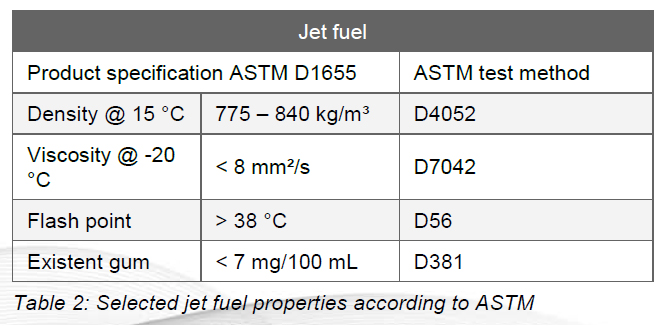
The following tables showcase a selection of fuel properties for diesel according to EN 590 and jet fuel according to ASTM D1655:

Volume to mass conversion
Mass is one of the fundamental units for trading liquids. But many transfer points in the petroleum industry are equipped with volume meters. Therefore, density is needed to calculate the mass of the transferred products from the volume.
Because of the huge amount of product, which is transferred between parties, a small measuring error can cause a major financial loss. The financial loss is a linear function of the error of the density measurement! An error of a tenth percent of the density measurement will be a deviation of a tenth percent in the accounting. Because of the huge amount of product this can be a huge amount of money.
In addition, a highly accurate and continuous density measurement prevents the operator of a tank farm – besides a loss of profit – to be confronted with legal regulations against black marketing where deviations in the mass balance of tank farms have to be kept below a certain limit.
The combination of a highly accurate process density meter L-Dens 7400 and a volume flow meter assures an optimum of mass balance determination, required for tight financial control of custody transfer points. The combination of continuous density and volume measurement is a good alternative to direct mass flow measurement because of competitive pricing, higher density accuracy and lower integration effort as well as the possibility to upgrade existing flow meters. If a modification of a plant is not possible, the accuracy of the mass calculation can be easily improved by using the highly accurate laboratory density meter DMA 4501 or DMA 5001 from Anton Paar.

MORE INFORMATION
The new Anton Paar L-Dens 7000 series – the new generation of Anton Paar’s process density sensors with a tube size of 6.3 mm (inner diameter) – is a result of more than 35 years of essential practical experience. This all-in-one solution combines the highest accuracy, compact and robust design, and easy integration, which makes it best-in-class for precise concentration measurement. Learn more about our Anton Paar products by visiting our website at https://bit.ly/3BFhZot or calling us at 1-800-912-9262.
Share This:






















INSIGHT: The Northern Shield Energy Corridor Provides Energy Security for All Canadians – Yogi Schulz