CDN NEWS |
  US NEWS







An impending decline in oil exports poses a challenge for the Canadian economy. Canada is the largest foreign oil supplier to the U.S. and the country has the world’s third-largest crude reserves locked in its oil sands region of northern Alberta. The oil and gas sector has accounted for about 5% of Canada’s economy.
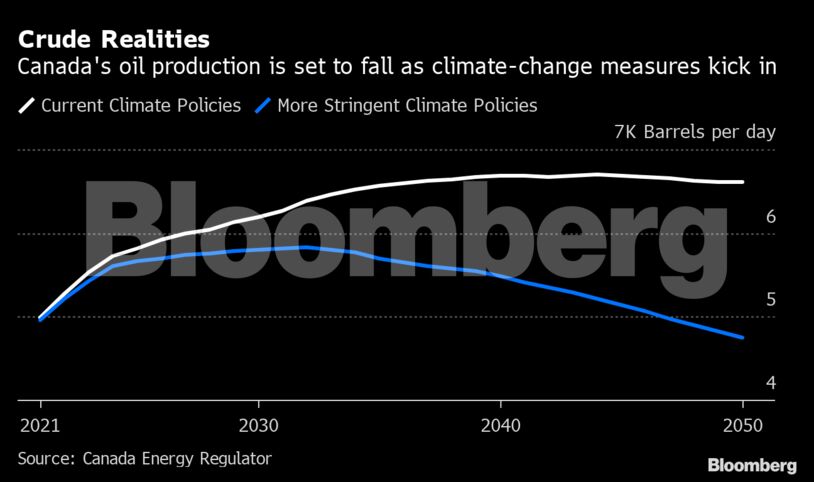
The projections by Canada’s energy regulator are based on countries continuing to strengthen measures to fight climate change, which will contribute to inflation-adjusted Brent crude falling to $40 a barrel by 2050 from this year’s annual average of $68 a barrel. Should climate change measures be less stringent, Canadian output will plateau at 6.7 million barrels a day in 2040 and Brent will average $70 a barrel through “much” of the projection period, the report predicts.
While conventional and shale oil companies must constantly invest in drilling new wells to keep production steady, the slow natural decline in output from the oil sands will mean that levels remain relatively “resilient.” Oil sands producers invest billions in new mines or steam-assisted production wells and once in operation those facilities last for decades at little cost compared to conventional or shale oil wells.

Still, the report warned that much more ambitious carbon-reduction plans, in line with the International Energy Agency’s 2050 net-zero scenario published earlier this year, could lead to “significantly lower” Canadian production levels than what are projected. Canadian energy producers have proposed plans to zero out emissions from their facilities, mostly by extracting and sequestering carbon underground, but they’re seeking the government to fund as much as 75% of those schemes.
Canada’s own energy consumption will decline over the next 30 years and grow increasingly cleaner, the regulator said. Total primary energy use is expected to drop 21% by 2050 and fossil-fuel consumption that is not abated with carbon-capture methods will fall 19% by 2030 and 62% by 2050.
Natural gas output in Canada will remain near current 15.5 billion cubic feet a day through much of the next two decades before declining to 13.1 billion cubic feet a day by 2050. An increasingly larger portion of the country’s gas will be exported in liquefied form, with nearly 40% shipped abroad as liquefied natural gas by 2050.
Canada’s first LNG plant is being built in the western province of British Columbia and is scheduled to start operating in the first half of this decade. LNG exports will allow B.C. will surpass Alberta as Canada’s largest natural gas producing province by 2028.
Share This: