CDN NEWS |
  US NEWS







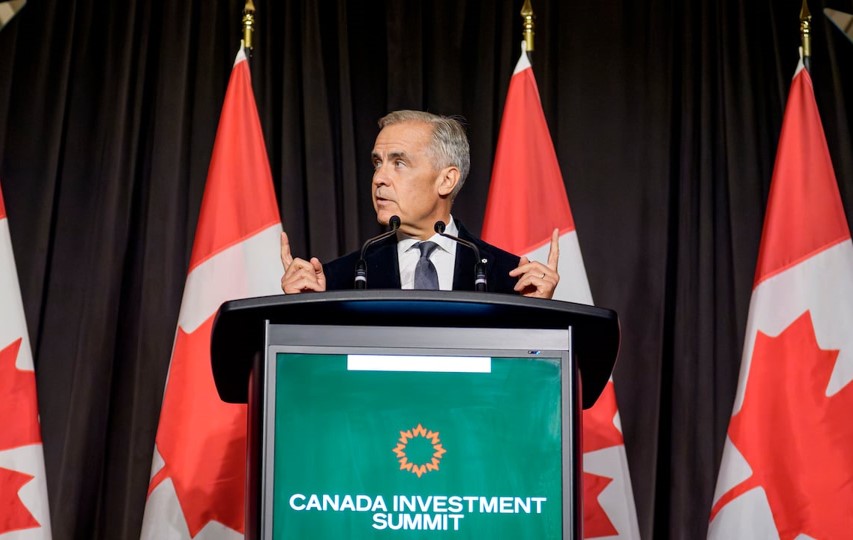
Canada has the resources, talent and political stability investors want, long turnaround times and approval issues have previously turned some investors away from Canada.
Terry J. Winnitoy – EnergyNow
Prime Minister Mark Carney’s Canada Investment Summit in Toronto may be one of the most consequential economic meetings held in this country in decades and ceertainly since 2015. The reason I say 2015 is that it is hard to imagine this a summit of this type being taken seriously during the lost decade of the Trudeau government. So I want to give Mark Carney credit for a least being able to pull this summit together. There is probably no one else in Canada at the moment that could have done this.
The two-day summit on September 14 and 15 brings together approximately 300 executives representing institutions with more than $120 trillion in assets under management. Carney, federal cabinet ministers, provincial premiers and Canadian business leaders are presenting opportunities across energy, mining, critical minerals, transportation, artificial intelligence, data centres, defence and advanced manufacturing.
The federal government’s ambition is enormous. Catalyse $1 trillion in total investment in Canada over the next five years but than is less than 1% of the assets under management cominig to the summit.
That target is not merely a headline or an exercise in attracting foreign money. It is a test of whether Canada can transform itself from a country known for its potential into one known for completing major projects. Many say Carney’s goal is lofty but under the right investment conditions, it is achievable.
The summit comes at a defining moment. Canada has spent nearly four decades building an extraordinarily successful—but increasingly vulnerable—economic relationship with the United States. The United States will remain Canada’s largest customer, closest ally and most important economic partner. But tariffs, protectionism and pressure to relocate manufacturing south of the border have demonstrated the danger of relying too heavily on one market.
Canada does not need to abandon the United States. It needs more choices.
That means building the pipelines, LNG facilities, ports, railways, power generation, transmission systems, mines and processing facilities required to reach customers in Europe and Asia. It also means attracting the capital needed to develop Canadian artificial intelligence, advanced manufacturing and defence industries. It also means investing in projects with a return on investment, not government political pet projects for attracting votes.
The Toronto summit is important because Canada cannot finance that transformation through government spending alone, no should it. A stable, welcoming investment climate will attract investors. Under the previous Trudeau government that was hardly the case.
Why the summit matters so much
Canada is competing in a world in which capital is mobile, governments are aggressively supporting strategic industries, and major investors can choose among projects on almost every continent.
Investors do not invest because a country needs them. They invest because they believe a project offers a competitive, risk-adjusted return.
Canada enters that competition with considerable advantages:
- Vast reserves of conventional and lower-emission oil and natural gas.
- World-class uranium, potash, nickel, copper, graphite and other critical-mineral resources.
- A stable banking system and a AAA sovereign credit rating.
- An educated workforce and respected legal institutions.
- Preferential access to approximately 1.5 billion consumers through 16 free-trade agreements covering 51 countries.
- Established expertise in nuclear energy, hydroelectricity, carbon capture, artificial intelligence and resource development.
The federal government says Canada’s tax treatment for new business investment is the most competitive in the G7. It is also proposing approximately $280 billion in government capital investments and incentives intended to help generate more than $1 trillion from public, private and institutional partners. Prime Minister of Canada
Global instability could also work in Canada’s favour. Predictability, reliable institutions, abundant resources and political stability have become more valuable as trade conflicts and geopolitical risks grow.
The summit therefore offers Carney an opportunity to present Canada as a dependable democratic alternative in an increasingly unpredictable world.
But it is also a major political test.
Carney was elected in large part on his financial credentials and his promise to defend Canada against the economic threat posed by American protectionism. His government says it has already secured more than $97 billion in foreign investment commitments and more than 20 new economic and defence partnerships.
The Prime Minister must now demonstrate that his international relationships can produce factories, infrastructure, exports, productivity and employment—not simply announcements and memoranda of understanding.
Energy should be at the centre of Canada’s pitch
Canada’s strongest investment proposition begins with energy.
Reliable, affordable energy supports almost every other sector represented at the summit. Mines need electricity and transportation. LNG projects require natural gas, pipelines and power. Data centres require enormous amounts of dependable, around-the-clock generation. Advanced manufacturing requires competitive energy prices. Ports and railways are necessary to move products to international customers.
Among the nation-building opportunities being advanced by Canada are LNG Canada Phase 2, Ksi Lisims LNG, the West Coast Oil Pipeline, Pathways Plus, new nuclear generation, Atlantic wind development, the Port of Churchill, northern transportation corridors and major electricity-transmission projects. The federal Major Projects Office now lists 18 projects and eight transformative strategies under its mandate. Major Projects Office
These are not isolated developments. Together, they could form the foundation of a more diversified Canadian economy.
A new West Coast oil pipeline could expand access to Asian markets. Additional LNG capacity could supply countries seeking alternatives to coal and insecure energy sources. New nuclear and natural-gas generation could support industrial expansion and AI infrastructure. Ports in British Columbia, Quebec, Atlantic Canada and Churchill could provide additional trade gateways. Critical-mineral corridors could connect remote deposits to processing facilities and international markets.
The opportunity is to present investors with integrated economic corridors—not a disconnected list of individual projects.
For example, a northern critical-minerals development becomes more investable when it is accompanied by roads, power, communications, Indigenous ownership and port access. A data-centre proposal becomes stronger when it includes firm power, natural-gas supply, transmission capacity, water planning and a realistic approval schedule.
Canada should be selling complete investment ecosystems.
A summit cannot overcome an uncompetitive system
The danger is that Canada mistakes investor attendance for investor confidence.
Bringing BlackRock, Blackstone, Temasek, Macquarie, APG and other major institutions to Toronto is an achievement. It is not the same as securing final investment decisions.


Reuters reports that more than 160 Canadian projects are being presented at the summit. Yet Canada’s recent history includes many projects that attracted investor interest but were delayed, redesigned, sold or cancelled after years of regulatory and political uncertainty. Reuters
Investors will look beyond the presentations and ask straightforward questions:
- How long will approvals take?
- Can the schedule be trusted?
- Will federal and provincial governments reach consistent decisions?
- Is there sufficient power, transportation and workforce capacity?
- Are Indigenous communities participating early and meaningfully?
- Will tax, emissions and regulatory policies remain stable?
- Can the project reach customers at a globally competitive cost?
Canada’s weak productivity performance makes answering those questions particularly urgent. The OECD has warned that Canadian labour productivity lags peer countries and has recommended reducing regulatory barriers, strengthening competition, improving research and development incentives and removing obstacles within Canada’s internal market. OECD Economic Survey of Canada
The Bank of Canada has also emphasized that political, economic and trade uncertainty causes businesses to delay or reduce investment. Capital-intensive projects require confidence because their costs are incurred years before their returns are realized. Bank of Canada
Canada cannot control every source of global uncertainty. It can control the uncertainty created within its own borders.
What Canada must do next
The true measure of the summit will be what happens during the following 12 to 18 months. Canada needs a disciplined investment-conversion strategy.
1. Establish a single accountable project leader
Every strategically important project should have one senior official responsible for coordinating federal departments, provincial authorities, regulators and financing agencies. Investors should not be required to navigate an uncoordinated collection of departments and agencies.
2. Deliver “one project, one review”
Canada has promised to eliminate overlapping federal and provincial assessments and reach federal decisions on major projects within two years.
That commitment must become an operating standard with public timelines, identified decision-makers and clear consequences when deadlines are missed. Faster decisions do not require weaker environmental reviews. They require coordinated reviews, adequate staffing and an end to unnecessary duplication.
3. Publish an investment scoreboard
The government should report quarterly on:
- Capital committed.
- Capital actually deployed.
- Projects reaching final investment decision.
- Permits completed.
- Construction started.
- Projects placed in service.
- Jobs created.
- Indigenous equity participation.
This would prevent preliminary expressions of interest, bank lending capacity and recycled announcements from being presented as completed investment.
It would also answer criticism that governments focus on money entering Canada while ignoring capital leaving the country.
4. Make policy durability part of the offer
A project expected to operate for 30 or 40 years cannot be financed against policies that may change after every election.
Federal and provincial governments should negotiate durable frameworks covering taxation, industrial carbon policy, royalties, infrastructure access and project approvals. Major changes should include reasonable transition periods and protection for capital already committed under previous rules.
5. Build infrastructure ahead of demand
Canada cannot approve mines, LNG facilities, data centres and manufacturing plants without also planning the power generation, transmission lines, pipelines, roads, railways and ports they require.
The country needs corridor-based planning that treats enabling infrastructure as part of the investment proposition—not as a problem to be addressed after the primary project is announced.
6. Make Indigenous ownership standard practice
Meaningful Indigenous participation should begin when projects are being designed, not after key decisions have been made.
Canada’s expanded Indigenous Loan Guarantee Program can help First Nations, Métis and Inuit communities acquire commercial equity in major projects. That can create long-term revenue, strengthen local support and reduce project risk while respecting Indigenous rights.
7. Mobilize Canadian capital alongside foreign investment
Canada should welcome international investment without allowing domestic companies, intellectual property and strategic assets to be unnecessarily hollowed out.
Canadian pension funds, banks, insurance companies, Indigenous investment organizations and the proposed Canada Strong Fund should be encouraged to invest alongside international partners. Domestic participation would allow Canadians to share in the financial returns generated by Canadian resources and infrastructure.
Canada must prove that it can build
The Toronto summit is important because the status quo is no longer sufficient.
The United States is actively competing for investment. Europe and Asia are pursuing energy security, critical-mineral supply chains, artificial intelligence and industrial capacity. Capital will move to the countries that provide the strongest combination of opportunity, returns and certainty.
Canada possesses many of the resources the world needs. It has a respected financial system, a skilled population, strong institutions and access to global markets. Few countries can offer the same combination of conventional and clean energy, critical minerals, agricultural production, technological expertise and political stability.
But natural advantages do not automatically produce investment.
Carney and his government must show that Canada can approve major projects within predictable timelines, maintain competitive fiscal policies, build supporting infrastructure and work constructively with provinces and Indigenous communities.
If the summit produces a credible pipeline of final investment decisions and construction starts, it could mark the beginning of Canada’s most important economic expansion in generations. If it produces only speeches, commitments and photographs, investors will move on.
The world may be ready to invest in Canada. Toronto is Canada’s opportunity to prove that Canada is finally ready for the investment.
Share This: