


 CDN NEWS |
  US NEWS







In an era of posturing and overblown rhetoric, critical conversations are neglected.
By Maureen McCall
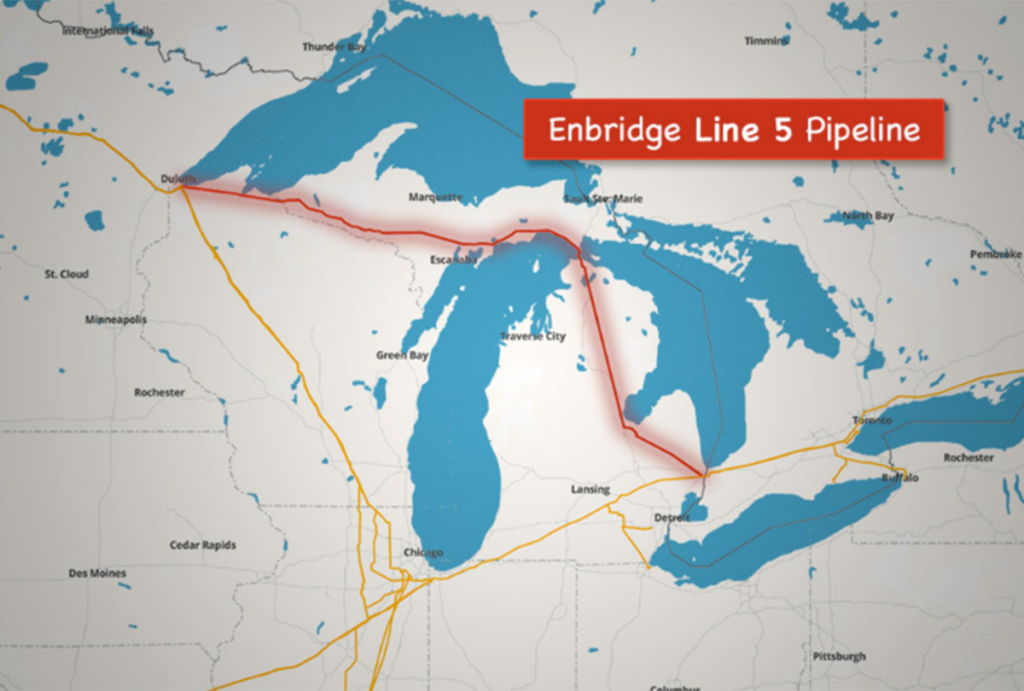
For more than 65 years, Enbridge’s Line 5 has delivered Canadian light oil and natural gas liquids (NGLs) that heat homes and businesses, fuel vehicles and power industry in both Canada and the U.S.
Since October 1, 1977, the Enbridge Line 5 has been protected by a 1977 treaty between the United States and Canada regarding the flow of oil and natural gas across borders.
The treaty has specific language regarding the rights of both countries and is enacted: “Believing that pipelines can be an efficient, economical and safe means of transporting hydrocarbons from producing areas to consumers, in both Canada and the United States.”
Article II of the treaty states “No public authority in the territory of either Party shall institute any measures, other than those provided for in Article V, which are intended to, or which would have the effect of, impeding, diverting, redirecting or interfering with in any way the transmission of hydrocarbon in transit.”
The shutdown of Line 5 has been the focus of Michigan Governor Gretchen Whitmer since 2019, and that fight has held the spotlight for years.
But a quieter dispute has been flying under the radar for many years.
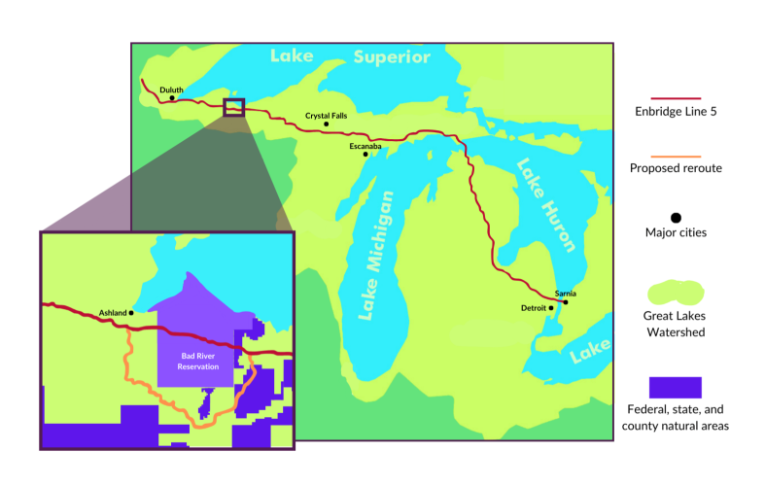
About 12 miles of Enbridge’s Line 5 pipeline runs across the Bad River Band of Lake Superior’s reservation along the shores of Lake Superior. The tribe sued Enbridge in 2019 to force the company to remove the section from its land, arguing land easements allowing operation expired six years earlier and the 73-year-old pipeline was prone to a catastrophic spill.
In 2023, a federal judge gave Enbridge 3 years to close Line 5 on Bad River tribal land, giving the company until June 2026 to remove the segment from the reservation. The Bad River and conservation groups want the line completely shut down and have kept the reroute project tied up with legal challenges.
Impacts of a Possible Shutdown
According to Enbridge’s analyses, published on their website, the ramifications of the shutdown of Line 5 are clearly equally detrimental to both U.S. and Canadian economies.
“Shutting down Line 5 would have immediate and severe consequences on the economies of Michigan, Ohio, Ontario, and elsewhere. Refineries served by Enbridge in Michigan, Ohio, Pennsylvania, Ontario and Quebec would receive approximately 45% less crude from Enbridge than their current demand. Michigan would face a 756,000-US-gallons-per-day propane supply shortage, since there are no short-term alternatives for transporting NGL to market.”
In the current complicated and uneven energy landscape shaped by geopolitical tensions between the U.S. and Canada as well as abroad, the deadline delivered by the U.S. judge is critical.



Information from PBF Energy, which operates one of two refineries in Toledo, provides perspective on the impact of a total Line 5 shutdown – whether for a reroute or for other reasons.
- “ A Line 5 shutdown would put Ohio refineries at risk. The closure of one of those refineries could result in the loss of $5.4 billion in annual economic output to Ohio and southeast Michigan, and the loss of thousands of direct and contracted skilled trades jobs.
- A Line 5 shutdown would compromise crude supply to 10 refineries in the region to varying degrees, directly affecting fuel prices.
- Closing Line 5 would hurt Ohio and Michigan economies and threaten union jobs.
- There are no viable options for replacing the volume of light crude delivered by Line 5, with rail able to provide less than 10% of that volume.
- A Line 5 shutdown puts at least 15% of northwest Ohio’s fuel supply at risk, as well as more than half of the jet fuel supplies for the Detroit Metro Airport.”
By February 2026, an administrative law judge upheld Enbridge’s state wetlands permit, removing the project’s last legal hurdle and clearing the way for construction. On Feb 24, 2026, Enbridge started the Line 5 reroute around Bad River Reservation. Just last month, on July 30th, a U.S. Federal Appeals Court affirmed that Enbridge had trespassed on Bad River Reservation, rejecting Enbridge’s challenge to the ordered Line 5 reroute and involving a recalculation of millions in awards for damages.
So the latest development in this long saga of roadblocks to U.S./Canadian energy collaboration and energy security comes at the worst time- when U.S. and Canadian leaders are at loggerheads in a storm of retaliatory tariffs and measures that are becoming at times as ridiculous as the renaming of Lake Ontario.
August 26th Accident – Shutdown & Repair of Line 5
Last week, a collision resulted in a leak of natural gas liquids less than five miles east of the Bad River Band of Lake Superior Chippewa Indians Reservation, shutting down Line 5, which continues to be shut down this week as emergency response continues.
On Tuesday, August 25th, a parked, unoccupied semi-truck rolled into the pipeline, striking it and resulting in the release of natural gas liquids, with witnesses reporting large white plumes of smoke emitting from the rupture.
https://www.facebook.com/watch/?v=28056653530629567
The section of pipeline was exposed at an open excavation site for a valve repair project near Saxon, Wisconsin, a section of the pipeline approximately 1.5 miles away from an ongoing project to re-route the pipeline so that it no longer passes through the Bad River Reservation.
Local U.S. media reports that Enbridge currently estimates the return to service of Line 5 between Aug. 31 and Sept. 5, 2026.
Considering the profound impacts of a Line 5 closure, even a brief shutdown, Canadian media is strangely quiet about this incident that would have wide impacts on operations in both countries-in Michigan, Ohio, Pennsylvania, Ontario and Quebec.
Maureen McCall is an energy professional who writes on issues affecting the energy industry.
Share This:




















SETTING OFF ALARM BELLS: Carney’s EU Deal Threatens Alberta, Energy, & Sovereignty – 170,000 Reasons to Reject Canada’s EU “Associate Membership” – The Nemeth Report