CDN NEWS |
  US NEWS







By Pablo Sinha

- Brent projected to average $89.05 per barrel in 2026
- Forecast raised from $85.08 in previous month’s poll
- WTI forecast at $83.90, up from $80.20
Sept 30 (Reuters) – Analysts have raised their 2026 oil price forecasts with benchmark Brent crude expected to average nearly $90 a barrel as disruption to Gulf exports offsets concerns over demand growth.
A September survey of 30 economists and analysts forecast that Brent crude would average $89.05 a barrel in 2026 and U.S. crude $83.90 a barrel.
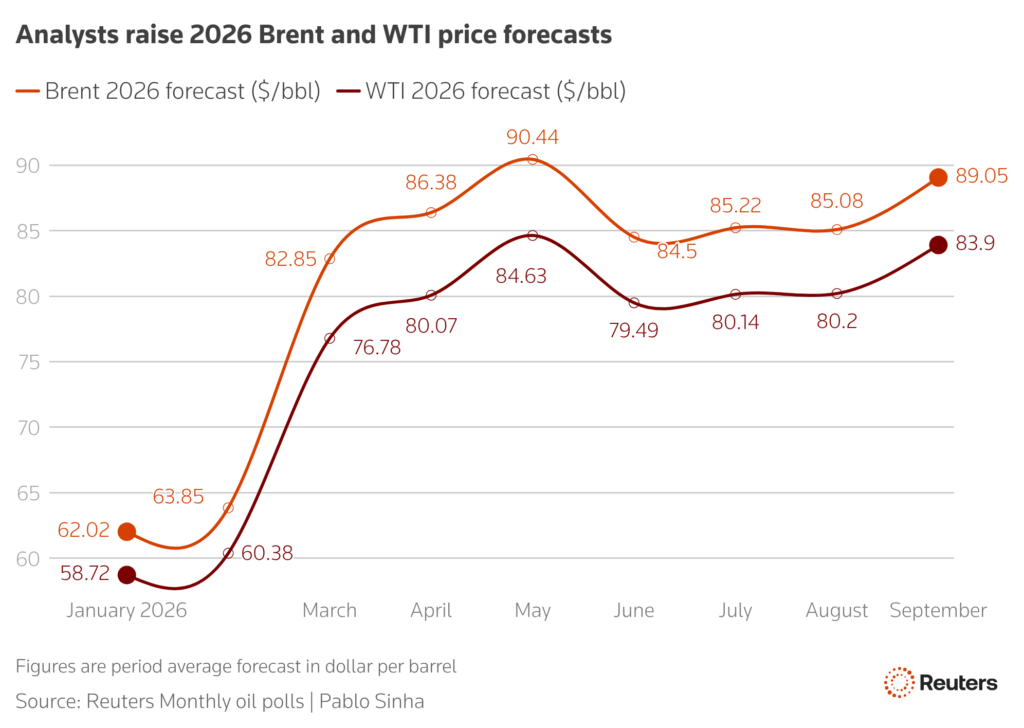
Analysts raise 2026 Brent and WTI price forecasts
Forecasts for average Brent prices ranged from $77.27 to $97.60.
Several analysts said the market has become increasingly convinced that a full restoration of exports through the Strait of Hormuz remains unlikely in the near term, leaving inventories to absorb much of the supply shortfall.
“We are not betting on a resolution to the conflict within the next three to six months,” said Suvro Sarkar, head of energy research at DBS Bank. “Significant upside risks to our forecasts exist if conflict continues to escalate instead of dialling down.”
HSBC said its base-case scenario assumes only gradual improvements in shipping conditions and a “structurally impaired” Hormuz, with liquids flows recovering slowly from current levels and remaining far below the roughly 19-20 million barrels per day (bpd) that passed through the strait before the conflict.
Goldman Sachs estimates Gulf oil exports, including “dark exports” involving ships operating with their location transponders turned off, have recovered to 23.3 million barrels per day over the last week, in line with their 2025 average, as exports doubled in September, it said in a note.



CHINA STOCKPILE BUFFER BEGINS TO SHRINK
Several analysts identified Chinese inventories as one of the most important uncertainties for the market over the coming year.
Analysts said the world’s largest crude importer has spent much of the conflict drawing on sizeable stockpiles accumulated before the outbreak of hostilities, reducing its need to compete for crude cargoes in global markets.
That trend has begun to reverse, as Chinese imports have risen during the past two months, reaching nearly 9 million bpd in August, although still below historical norms.
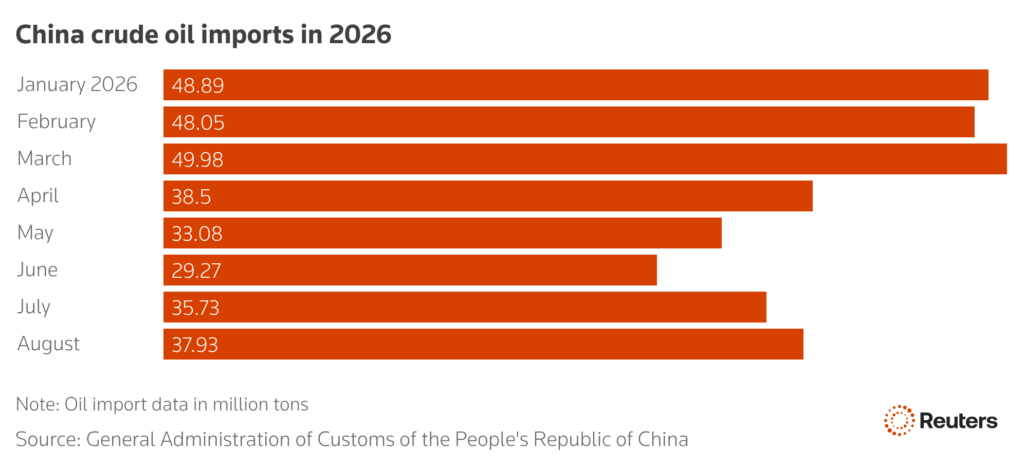
China oil imports in 2026
“Chinese inventories are currently the main unknown in the equation, as they turned out to be much larger than estimated at the start of the conflict. However, they are finite and cannot cover the whole winter, so we expect Chinese buying to strengthen from current levels,” said Davide Tabarelli, president of Nomisma Energia.
LOOKING AHEAD
Despite growing concerns about the global economy, most analysts continue to view supply risks rather than demand weakness as the primary driver of prices through 2026.
“Slower global economic growth and weaker manufacturing activity are still restraining demand growth. These factors should prevent prices from approaching the highs reached immediately after the outbreak of the conflict, even as geopolitical tensions stay elevated,” said analysts at EIU.
They also expect inventories to decline substantially in 2026 as consuming countries draw down emergency and commercial stockpiles to offset lower Gulf exports.
Most analysts expect the market to move back into surplus during 2027 as shipping conditions improve, Gulf production gradually recovers and non-OPEC supply continues to expand.
Reporting by Pablo Sinha in Bengaluru; editing by Jason Neely
Share This: