


 CDN NEWS |
  US NEWS







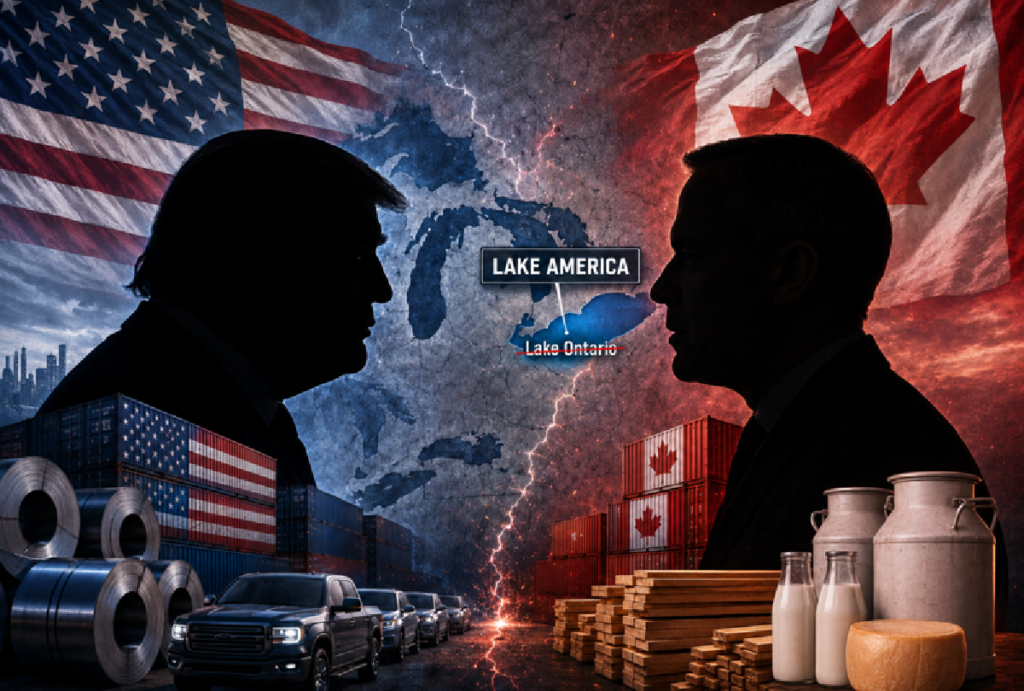
For Canadians, the escalating trade conflict with the United States is impossible to ignore. It dominates political speeches, business discussions and national news coverage. Jobs, investment decisions and the future of Canada’s most important trading relationship are all potentially at stake.
In the United States, however, the picture is considerably different.
Most Americans know that President Donald Trump has imposed tariffs and that his administration is engaged in disputes with several trading partners. But the available evidence suggests that many are not closely following the details of the confrontation with Canada, or treating it as a distinct national crisis like Canada is.
The simplest conclusion may be this: Americans are aware of the tariff war, but many are paying attention only when it affects their prices, jobs or local industries.
Broad Awareness, Limited Understanding
A February 2026 survey of Americans conducted by Abacus Data found that 87 per cent had heard at least something about tariffs, including 50 per cent who said they had heard “a lot.” Only 13 per cent said they had heard little or nothing.
That sounds like an engaged public. But the survey asked about tariffs generally, not whether respondents understood the latest negotiations, the products affected or Canada’s retaliatory measures.
When the questions became more specific, knowledge dropped.
Nearly one-third of respondents—32 per cent—said they were not familiar enough with the United States-Mexico-Canada Agreement, or USMCA, to express an opinion about its future. Another 25 per cent were unsure whether the agreement had been good or bad for the United States.
In other words, millions of Americans know that tariffs are being imposed but do not necessarily understand the North American trading system those tariffs are disrupting.
There is also anecdotal evidence of that disconnect. The Washington Post, reporting from a recent political event featuring Vice-President JD Vance, found that some attendees “didn’t realize that trade talks between the U.S. and Canada had collapsed.” That collapse had already triggered new American tariffs and Canadian retaliation.
This is an important distinction. General tariff awareness is high, but detailed awareness of the Canada-U.S. dispute appears considerably weaker.
Canada Is Not the Centre of the American News Universe
Canada’s trade relationship with the United States is existential for Canada. The reverse is not true to the same degree.
The United States has a population nearly nine times larger than Canada’s and an economy more than ten times its size. Americans are simultaneously confronting concerns about inflation, housing, immigration, health care, geopolitical conflicts and domestic political divisions.
Against that background, a dispute with Canada must compete for attention with China, Mexico, Europe and virtually every other issue coming out of Washington.
This does not mean Canada is economically unimportant. The Abacus survey found that 77 per cent of Americans believe Canada is important to the U.S. economy, including 34 per cent who consider it “very important.”
However, recognizing Canada’s importance is different from actively following trade negotiations.
The dispute also produces very different emotional reactions in the two countries. For Canadians, American tariffs can feel like a direct threat from a country that had long been considered Canada’s closest ally. For many Americans, Canada is simply one more country involved in the administration’s much broader trade agenda.
That imbalance helps explain why developments that lead Canadian newscasts may receive only limited or temporary attention in the United States.
Americans Notice Prices More Than Trade Policy
What is capturing American attention is the cost of tariffs.
Abacus found that 56 per cent of Americans believed tariffs had made the cost of living worse, including 31 per cent who said “much worse.” Just 20 per cent believed tariffs had improved their cost of living.
Gallup previously found that 89 per cent of Americans expected higher tariffs to result in increased prices on the products they buy. Seventy per cent believed the tariffs would cost the United States more than they generated in the short term, while 62 per cent expected them to remain a net cost over the longer term.
A more recent Ipsos summary found that 73 per cent of Americans believed tariffs would lead to higher prices, while 67 per cent said they were already paying more. Only 35 per cent considered tariffs worth the cost.
The political warning signs are also growing. A May 2026 Marquette Law School poll found that 67 per cent of Americans disapproved of Trump’s handling of tariffs, according to the Washington Post. An April University of Calgary-Ipsos poll reportedly found that American opposition to tariffs on Canadian goods was more than twice the level of support.



These results do not necessarily mean Americans are closely studying the Canada-U.S. relationship. They mean Americans are noticing the economic consequences of the administration’s overall tariff policy.
That may ultimately be more politically important.
Attention Is Much Higher in Border and Industrial States
The trade conflict is unlikely to be experienced evenly across the United States.
Residents of Michigan, New York, Minnesota, Montana, North Dakota and other border states are more likely to encounter the relationship directly. Their economies are connected to Canadian energy, manufacturing, agriculture, tourism and cross-border commerce.
The same is true in industrial states dependent on integrated supply chains.
A vehicle assembled in Michigan may contain components that have crossed the Canada-U.S. border several times. Refineries in the Midwest rely heavily on Canadian crude oil. Farmers and manufacturers depend on Canadian customers, while northern states import Canadian electricity, natural gas, fertilizer and other essential products.
In Michigan, a June poll cited by The Guardian found that 63 per cent of residents opposed the tariffs. That is hardly surprising given the integration of the Michigan and Ontario economies and the potential impact on automotive employment and consumer costs.
For someone in Detroit, the dispute may be immediate and tangible. For someone in a region with limited direct Canadian trade, it may remain another distant policy battle in Washington.
Good News…Americans Still Generally Like Canada and That’s Part of the Problem
Another reason the conflict may not have captured sustained public attention is that most Americans do not see Canada as an adversary.
Gallup reported in March 2026 that 80 per cent of Americans continued to hold a favourable opinion of Canada. That was down nine percentage points from the previous year and represented a record low for Canada in Gallup’s measurements—but it was still an overwhelmingly positive rating.
Abacus found that 64 per cent of Americans had a positive opinion of Canada, compared with only 11 per cent who had a negative one. Positive views reached 69 per cent in border states.
A YouGov survey found that 82 per cent of Americans regarded Canada as either an ally or a friendly country, while only six per cent considered it unfriendly or an enemy.
These numbers suggest there is little grassroots demand in the United States for an economic confrontation with Canada. The trade war appears to be driven more by presidential policy and partisan loyalty than by widespread American hostility toward Canadians.
The Real Risk for Canada
Canada should not assume that American public sympathy will automatically translate into political pressure on the White House.
An American can like Canada, oppose tariffs and still rank the dispute far below grocery prices, health care, immigration or local employment when deciding how to vote.
That is the central challenge for Canadian governments and industries attempting to influence U.S. opinion. Arguing that tariffs are unfair to Canada may have limited impact. Demonstrating that they increase American gasoline prices, threaten U.S. manufacturing jobs, hurt farmers or make homes and vehicles more expensive is far more likely to break through.
Canada’s most effective message is not simply that the trade war hurts Canadians. It is that the conflict damages Americans, too.
The Bottom Line
The vast majority of Americans appear to know that tariffs are being imposed, and many believe those tariffs are increasing their cost of living. But there is considerably less evidence that the public is closely following the specific conflict with Canada or understands the depth of the two countries’ economic integration.
Americans are not entirely unaware. They are selectively attentive.
Interest rises when the dispute reaches the grocery aisle, the gas pump, the auto plant or the family budget. It is also much greater in border states and industries directly dependent on Canadian trade.
For Canada, that means public opinion in the United States could become a powerful source of pressure but only if the trade war becomes personal enough for Americans to notice.
Sources: Abacus Data, Gallup, Ipsos, YouGov, The Washington Post and Gallup’s Canada favourability survey.
Share This:




















SETTING OFF ALARM BELLS: Carney’s EU Deal Threatens Alberta, Energy, & Sovereignty – 170,000 Reasons to Reject Canada’s EU “Associate Membership” – The Nemeth Report