


 CDN NEWS |
  US NEWS







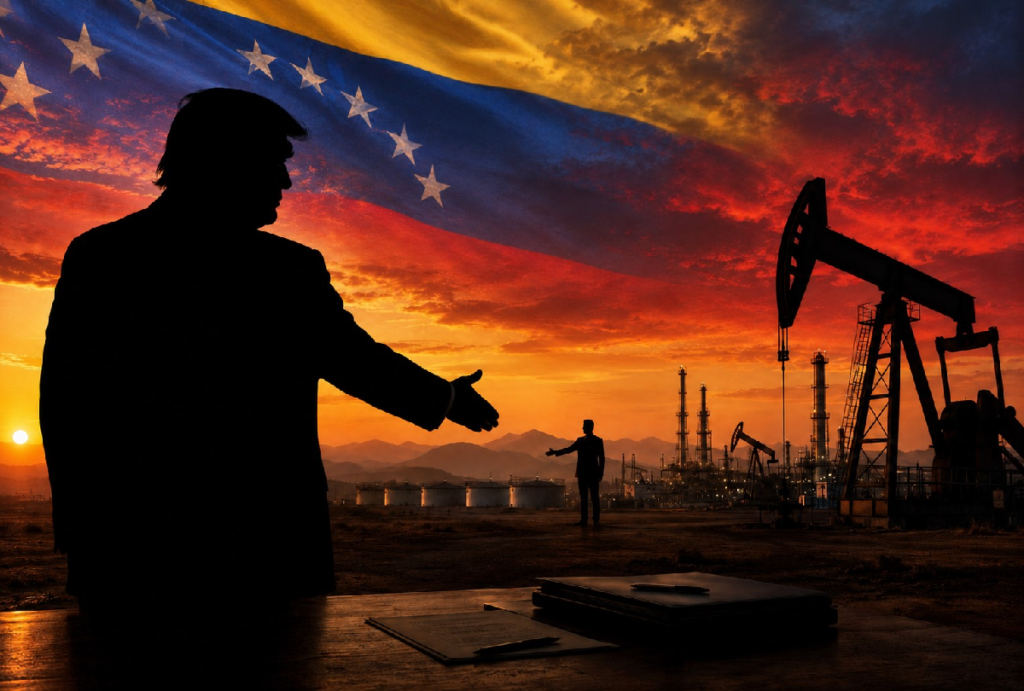
TRUMP’S VENEZUELA OIL GAMBIT:
What a Massive U.S. Deal Could Mean for Canadian Crude
By EnergyNow Editorial Staff
Summary
- President Donald Trump says the United States has secured majority control over more than 65 billion barrels of Venezuela’s proven oil reserves through a partnership with private companies.
- The administration argues the agreement could attract nearly $100 billion in investment, revive Venezuela’s oil industry and eventually help reduce U.S. gasoline prices.
- Venezuela’s interim leader, Delcy Rodriguez, says the development of 17 strategic oilfields could generate $209 billion in tax revenue for the country.
- Major legal, political and infrastructure obstacles could prevent the agreement from producing substantial volumes of oil for years.
- A significant Venezuelan production recovery would create new competition for Canadian heavy crude in the U.S. Gulf Coast, increasing the urgency for Canada to expand pipeline access to the Pacific, Atlantic and other international markets.
President Donald Trump has announced an extraordinary agreement that could dramatically expand American influence over Venezuela’s enormous oil resources and give U.S. companies long-term access to some of the world’s largest petroleum deposits.
Trump said Friday that the United States, working with Venezuela’s interim government and private-sector partners, had secured majority control over more than 65 billion barrels of the country’s proven oil reserves.
The arrangement potentially places approximately one-fifth of Venezuela’s vast reserves under majority U.S. control, although Trump provided few details about precisely what “control” means or how the agreement will be structured.
The administration is betting that American companies can help rebuild Venezuela’s badly damaged energy industry, increase the supply of heavy crude to U.S. refineries and ultimately place downward pressure on American gasoline prices.
Venezuela possesses the world’s largest proven oil reserves but currently produces only about 1.25 million barrels per day—far below its historical output and enormous geological potential. Years of underinvestment, political interference, deteriorating infrastructure, operational mismanagement and international sanctions have severely weakened the country’s production capacity.
Rubio Calls Agreement a Win for Both Countries
Trump announced the agreement in a post on Truth Social.
“At my direction, Secretary of State Marco Rubio, and Secretary of War Pete Hegseth, working closely with Highly Respected Interim President of Venezuela, Delcy Rodriguez, and, through a partnership with private business, have secured majority U.S. control of more than 65 BILLION BARRELS of proven Oil Reserves in Venezuela, at no cost to the American Taxpayer,” Trump wrote.
The announcement followed several weeks of negotiations between Washington and Venezuela’s interim government. Those discussions reportedly focused on providing American companies with long-term access to a collection of Venezuelan oilfields while ensuring that the resulting production would flow primarily to the United States.
Venezuelan authorities are reportedly preparing to sign agreements granting new exploration and production rights to several companies, with U.S. producers expected to receive preferential access.
One proposal under consideration involves a lease-based model under which Venezuelan oilfields could be auctioned or leased to American producers. However, that structure could face constitutional and legal challenges because Venezuela’s state-controlled system reserves core oil industry activities for the government and the national oil company, Petróleos de Venezuela, or PDVSA.
Trump did not identify the participating companies, the individual fields covered by the agreement, its financial structure or the legal mechanism through which the United States would exercise majority control.
A list reviewed by Reuters indicated that the assets are located in two of Venezuela’s most important producing regions: the Orinoco Oil Belt and the Lake Maracaibo basin.
Secretary of State Marco Rubio described the agreement as beneficial to both countries. He said it could provide the United States with a stable source of relatively low-cost crude while helping moderate gasoline prices for American consumers.
Rubio said Venezuela could receive nearly $100 billion in private investment, create thousands of well-paying jobs and begin rebuilding an economy devastated by years of political turmoil and industrial decline.
Venezuela Anticipates Production and Revenue Windfall
Rodriguez became Venezuela’s interim leader after the United States seized President Nicolas Maduro in January. She welcomed the agreement and said it would support the development of 17 strategic oilfields.
According to Rodriguez, the projects could substantially increase Venezuelan production and eventually generate approximately $209 billion in tax revenue for the country.
“These investments will contribute not only to the recovery and modernization of our industry, but also to our country’s economic growth, the energy security of our hemisphere, and greater balance in international markets,” she said in a statement Friday evening.
Those expectations remain highly ambitious. Venezuela has immense oil resources, but much of its crude is extra-heavy and requires specialized production, transportation, blending and refining infrastructure.
Reviving the country’s output would require more than drilling new wells. Companies would need to repair pipelines, production facilities, upgraders, storage terminals, export ports and electrical systems. Venezuela would also require a reliable supply of diluent to blend with its extra-heavy crude so it can move through pipelines and be exported.
Legal and Financial Questions Remain Unanswered
Industry analysts cautioned that it is impossible to determine the agreement’s commercial viability without considerably more information about its legal foundation, ownership structure and financial terms.
David Goldwyn, president of Goldwyn Global Strategies, questioned whether a lease involving the U.S. government would be permitted under Venezuela’s constitution and recently adopted hydrocarbons legislation.
There is “no precedent for having the U.S. government enter into a lease to operate oil fields,” Goldwyn said.
He also questioned whether the agreement would overcome the same problems that have discouraged major international investment in Venezuela for years.
“It is hard to see how this kind of arrangement would accelerate investment at any material scale,” Goldwyn said, pointing to political uncertainty, insufficient export capacity, an unreliable power grid and the Venezuelan government’s continuing discretion over the industry.
There is also no guarantee that the deal will reduce American gasoline prices in the near term. Even if the necessary investment commitments are secured quickly, restoring Venezuela’s production, transportation and refining infrastructure could take years.
Since Maduro’s removal, Washington has been attempting to secure a dependable flow of Venezuelan crude for U.S. refineries while encouraging American companies to invest in rebuilding the country’s petroleum sector.
The political timing is also important. The Trump administration faces midterm elections in November and is under pressure to address consumer concerns about rising gasoline prices. Additional oil supplies could eventually reduce crude costs, although the benefits are unlikely to appear immediately unless existing Venezuelan production can be redirected or increased relatively quickly.
Washington has also been examining ways to replenish the U.S. Strategic Petroleum Reserve, including possible crude-oil swaps with domestic producers.



A Long History of State Control
Venezuela nationalized its petroleum industry in the 1970s and placed PDVSA at the centre of the sector.
Government control became considerably more aggressive under former president Hugo Chavez. Foreign producers were required to convert their operations into state-controlled joint ventures, and the government subsequently expropriated several foreign-owned assets, including projects operated by ExxonMobil.
Production declined sharply under Maduro as investment collapsed, skilled workers left the country, sanctions restricted access to capital and equipment, and Venezuela’s petroleum infrastructure continued to deteriorate.
The Trump administration is now wagering that American capital, technology and operational expertise can reverse that decline. Whether companies will commit tens of billions of dollars without durable legal protections and long-term political stability remains the central unanswered question.
What It Could Mean for Canadian Oil
Short Term: More Political Pressure Than Immediate Competition
In the short term, the agreement is unlikely to cause an immediate reduction in demand for Canadian oil.
Canada produced a record average of 5.35 million barrels per day of crude oil and equivalent products in 2025. It exported approximately 4.3 million barrels per day, with 90.1%—about 3.9 million barrels per day—going to the United States, according to the Canada Energy Regulator.
That supply is already connected to U.S. refineries through a large and highly integrated pipeline network. Canadian production is politically stable, governed by established contracts and supported by dependable infrastructure. Those advantages cannot be replicated quickly in Venezuela.
American refiners are also unlikely to abandon reliable Canadian barrels merely because the White House has announced an agreement with Caracas. Venezuela must first overcome enormous technical, legal and financial obstacles.
In fact, Canadian heavy crude could remain essential while Venezuela rebuilds. U.S. refineries—particularly complex facilities in the Midwest and Gulf Coast—have invested heavily in equipment capable of processing dense, high-sulphur crude. Canadian oil has helped replace Venezuelan and Mexican heavy crude supplies as production from those countries declined.
Canada supplied 60% of all U.S. crude imports in 2023, and Canadian oil represented approximately 24% of total U.S. refinery throughput, according to the U.S. Energy Information Administration.
The immediate threat is therefore not that Venezuela suddenly displaces millions of barrels of Canadian oil. It is that the prospect of future Venezuelan supply gives U.S. refiners and policymakers more leverage when negotiating with Canada.
Longer Term: Direct Competition for Heavy-Oil Refinery Space
The longer-term risk is considerably more significant.
Venezuela and Western Canada produce heavy crude grades suited to many of the same sophisticated U.S. refineries. The EIA notes that Venezuelan heavy oil is particularly well suited to Gulf Coast facilities. Those refineries are also important potential customers for growing Canadian oil production.
If Venezuela eventually adds several hundred thousand, or potentially more than one million—barrels per day, part of that production could compete directly with Canadian heavy crude.
That competition could affect Canada in several ways:
- Gulf Coast refiners could substitute Venezuelan barrels for some Canadian heavy crude.
- Greater heavy-oil supply could weaken prices for Western Canadian Select and similar grades.
- Canadian producers might have to offer larger discounts to retain refinery customers.
- Pipeline systems running from Canada into the United States could face slower volume growth.
- New oilsands projects could become more difficult to finance if investors anticipate lower long-term prices or restricted market access.
Venezuela has previously demonstrated its ability to supply large quantities of oil to the United States. U.S. imports of Venezuelan crude peaked at approximately 1.4 million barrels per day in 1997. Returning to anything close to that level would take considerable time, but the size of Venezuela’s reserves means the threat cannot be dismissed.
Canadian oil would retain important advantages. Oilsands projects have long reserve lives and relatively low production-decline rates once built. Canada offers stronger institutions, predictable commercial law and reliable pipeline infrastructure. Venezuelan operations, by contrast, would remain exposed to political reversals, expropriation risks, inadequate infrastructure and changing U.S. sanctions policy.
Nevertheless, geography and reliability will not fully protect Canada if a large new source of competing heavy crude enters its principal market.
Canada’s Export Vulnerability Has Been Exposed Again
The most important number in this discussion is not Venezuela’s 65 billion barrels. It is Canada’s 90.1% dependence on the United States for its crude exports.
That figure has improved from 95.7% in 2024, largely because the expanded Trans Mountain system created new access to Pacific markets. But Canada remains overwhelmingly dependent on a single customer, one that is actively pursuing majority control over a huge competing reserve base.
The Trans Mountain Expansion entered service in May 2024 and nearly tripled the system’s capacity to approximately 890,000 barrels per day. It increased Western Canada’s tidewater export capacity by roughly 700%, allowing more Canadian crude to reach California and Asian markets. The expanded system averaged 82% utilization following its initial ramp-up, according to the CER.
The effects were immediate. Canadian crude exports increased to 4.2 million barrels per day in 2024, with heavy oil accounting for 79% of the total. Approximately 75% of the year-over-year export increase moved by marine tanker, while 70% went to markets outside the United States.
That demonstrates that diversification is possible when transportation infrastructure exists.
Ottawa Cannot Treat Diversification as a Future Objective
A major Venezuelan revival would not necessarily reduce Canadian production immediately. But if Canadian output continues growing while Venezuela simultaneously increases production, Canada will require additional buyers and additional export capacity.
The policy implications are clear:
- Canada must maximize the existing Trans Mountain system and pursue practical, economically justified expansions.
- Governments must accelerate decisions on a new West Coast pipeline capable of reaching Asian markets at a much larger scale.
- An east-west pipeline should be seriously evaluated to supply Central and Eastern Canadian refineries while creating access to Atlantic export markets.
- Regulatory timelines must become predictable enough to attract private investment before market conditions change.
- Canada must deepen commercial relationships with refiners in Asia, California, Europe and other markets capable of processing heavy crude.
- Additional upgrading, refining and petrochemical capacity should be considered where it can generate greater value from Canadian production.
Diversification does not mean abandoning the United States. The U.S. will remain Canada’s largest and most natural oil customer because of geography, integrated infrastructure and refinery configuration.
It does mean ensuring that the United States is a preferred customer rather than Canada’s only meaningful customer.
Trump’s Venezuela agreement may take years to produce substantial results, and it may never overcome the country’s formidable legal and political risks. But Canada cannot base its energy strategy on the hope that a competing producer will fail.
The announcement is another warning that global oil markets will not wait for Canada’s political and regulatory processes. If Washington is prepared to pursue control of 65 billion barrels in Venezuela, Canada must be equally determined to secure multiple markets for the enormous reserves it already produces safely, reliably and responsibly.
Share This:




















SETTING OFF ALARM BELLS: Carney’s EU Deal Threatens Alberta, Energy, & Sovereignty – 170,000 Reasons to Reject Canada’s EU “Associate Membership” – The Nemeth Report