


 CDN NEWS |
  US NEWS







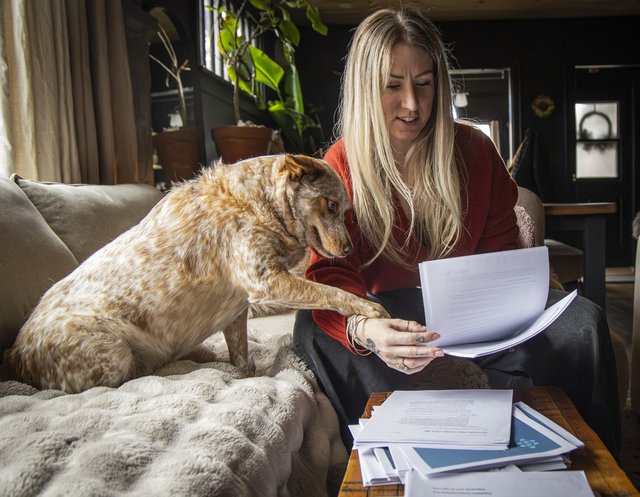
Black and white lawn signs have been popping up around Olds, Alta., on charming tree-lined streets and sprawling acreages alike.
“A data centre and power plant want to move in next door,” they read. “Are you ready for what comes next?”
Dozens of the campaign-style signs are piled up in Bek MacIntosh’s front garden on a calm, overcast June morning. Co-ordinating their distribution is one of the many tasks eating up her time, energy and sanity as she and an informal group of locals get a crash course on Data Centre 101, pore over dense regulatory filings and work to stop the project in its tracks.
“It’s all-consuming,” says MacIntosh, a mom of three who runs a holistic health business in the town of around 10,000 people roughly 80 kilometres from Calgary.
“I work with a client base that has been very accommodating to my bizarre schedule as I’ve committed most of my time to this.”
MacIntosh lives a few minutes’ walk away from the empty tract of land where Synapse Real Estate Corp. wants to build a massive data centre complex. The project has become a flashpoint in the debate around a nascent industry catering to the artificial intelligence boom, stoking both hope and anxiety as big tech arrives suddenly on the doorsteps of small, rural communities like Olds.
The town government sees an opportunity to boost its tax revenue and local employment, while many residents worry about pollution, noise, home values, safety and strain on local health-care and emergency services.
Synapse is planning a 10-building campus in the northeast corner of town with a total of 1.4 gigawatts of gas-fired power generation — about enough to power the City of Edmonton. It also includes 1.8 gigawatts of emergency and backup diesel generation.
One edge of the land borders Highway 27, the main thoroughfare leading into town. Another side runs along a stretch of Highway 2A. Past the steady rumble of pickup trucks and farm machines, on the opposite side of that road, are a row of modest homes behind long, lush lawns — many with the same black and white signs seen elsewhere in town.
MacIntosh first got wind of the development in February, with an information package from Synapse dropped at her home and a social media post from Alberta Premier Danielle Smith trumpeting the $10-billion investment. At first glance, the project seemed to be a nondescript warehouse, but then she investigated further.
“It seemed to be a monstrosity of a project rather than just another industrial building going into town.”
———
“We’re setting a precedent”
The Alberta government is actively courting hyperscalers — tech titans like Meta and Google — to set up shop in the province. In late 2024, Technology and Innovation Minister Nate Glubish said Alberta hoped to have $100 billion in data centres under construction in five years.
Alberta has plentiful natural gas for power and land, but it lacks capacity on its electrical grid to support that scale of development. So the province is prioritizing data centre developers that build their own generation plants, as Synapse is planning to do.
Glubish fielded questions from the Olds community for almost two hours at an April town hall about the project, a recording of which has been heard by The Canadian Press.
“You can do something responsibly and you can do something irresponsibly. And I know many of you will have seen some stories from the United States of jurisdictions that rushed ahead and said ‘This is really cool, we need to do this. We can bring investment from the Facebooks and the Googles and the Microsofts and all the big names.’ …They didn’t do their due diligence, they didn’t do their homework,” Glubish told the town hall.
“We in Alberta don’t intend to be the first to develop data centres, but we do intend to be the smartest.”
He stressed that the Alberta government has taken no position on the Synapse development.
At the April gathering, residents told Glubish they didn’t want a gas plant so close to homes, and the minister said he was “very persuaded” by that point of view, according to the recording.
“I’ll do a little homework to see whether or not there is a need for the province to put something hard-coded into provincial legislation to deal with that,” he said.
At an announcement last week about another data centre planned for an industrial area near Edmonton, Premier Danielle Smith said she had recently visited Olds and heard from concerned residents. She said the province will have to look at the guidance it gives to data centres about what locations are acceptable.
“We want to make sure that those concerns of the local-area residents are addressed and there’s an appropriate distance between homes.”
MacIntosh and other residents have banded together to hold community meetings and get information out to residents on what has become a lively Olds Transparency Project page on Facebook. She said trying to discern which government agency has final say over which project component is like watching an elaborate game of “hot potato.”
The group has held sessions at the local library to guide less tech-savvy community members through how to sign up online for public hearings. MacIntosh is also part of a group that set up a not-for-profit called Little Town Big Data, which aims to take its advocacy and information sharing to the many other communities grappling with similar developments.
“A data centre in Alberta can’t exist as a hyperscaler unless it is building a gas plant. And that’s going to apply to every town,” says MacIntosh.
“We’re setting a precedent here.”
———
“AI moves fast.”
Data centres house computer servers and other hardware needed to power many facets of our technology-driven lives. They’re nothing new, but with the advent of artificial intelligence, and the enormous processing power needed to train and run large language models, their footprints and thirst for electricity are now at mind-boggling proportions.
Sandra Blyth, who is with the town’s economic development agency Invest Olds, says she first found out about Synapse’s plans through a real estate agent who owned the land. They had been contacted by an investor interested in purchasing the property for a data centre project: Synapse CEO Jason van Gaal.
“He didn’t know a lot about the industry either,” she says of the property owner. Blyth was later put in contact with van Gaal, and his idea “passed the initial qualifying tests.”
“It’s moved very quickly since that time,” she says.
Olds’ economy has traditionally centred on agriculture, but the municipal government sees potential for it to be a big player in AI data centres, given its large land base and proximity to the major highway connecting the urban centres of Edmonton and Calgary.
Synapse filed its initial regulatory application to the Alberta Utilities Commission in February. The AUC approves power projects in the province, so its role is not to decide on the data centre itself, but rather the gas generation that accompanies it. The municipality decides on land use — earlier this year the land was rezoned from “future urban district” to “light industrial.” Some residents contend there’s nothing “light” about 1.4 gigawatts of power generation.

The AUC rejected the initial Synapse proposal in March, citing “significant deficiencies.” Synapse filed a rejigged application a month later, which the regulator is in the midst of reviewing, though hearings are on hold as it seeks more information from Synapse.
Reaction to the proposal has been intense, with almost 1,200 individuals registered as interveners in the AUC hearings, where typical proceedings would attract a few hundred.
“I would be concerned if people weren’t concerned. It’s a smaller community,” says Blyth.
Blyth says the town has had to balance making sure citizens are informed with not letting the opportunity pass Olds by.
“AI moves fast. These builds move quicker than any other development I’ve ever worked with,” she says.
“So you don’t want to be last in the race, but we are slowing that down. I think the initial idea from the developer was that it would go a lot quicker.
“The good thing is, with this investor, he sees that. He wants to be part of our community. And he wants to be here for many, many years.”
———
“No one paid much attention to us.”
Van Gaal declined an interview, but provided a written statement in response to a list of emailed questions.
The tech entrepreneur says he’s been designing, building and operating data centres in Canada for more than 15 years and founded one of Canada’s largest now operating in Montreal.
“Until very recently, most people I spoke with didn’t know what a data centre was,” he wrote. “We are traditionally quiet, clean neighbours, so no one paid much attention to us.”
All that has changed.
“Unfortunately, a few projects in the U.S. were built in areas where they weren’t properly regulated. You can build a beautiful car, but if you don’t install a muffler and you drive it around the neighbourhood, your neighbours are rightfully going to be upset,” van Gaal wrote.
“Thankfully, regulations in Alberta require us to be quiet, clean neighbours and to install the data centre equivalent of a muffler.”
The “bring your own power” model in Alberta eliminates the need for more transmission lines to be built and serves as a boost to the province’s vital natural gas industry, he added. The project plans to buy gas from producers at a premium to the provincial price benchmark, AECO, “helping to stabilize Alberta’s gas production.”
As for the location, van Gaal said constructing data centres on light industrial-zoned land is the norm in Canada.
“We worked closely with the Town of Olds and local community members to optimize our site layout, ensuring our natural gas power plants are set back from residential areas at distances comparable to other existing thermal plants in the province.”
Hyperscale providers have expressed interest in the project, and are waiting for permits to be issued before moving forward, he said. Project financing would be tied to those contracts, van Gaal says.
Synapse estimates the data centre and plant will employ 1,000 people full-time once it’s built — half directly and half through its clients.
———
“I found heaven here.”
Carol Edwards sits with a cup of tea on the back deck of her home in a new subdivision in Olds. She pauses mid-interview to listen to the surrounding soundscape — birdsong and a breeze lightly rustling the leaves of a young tree.
“The air is beautiful, the trees. I can walk a few blocks and I’m in farms with horses and cows and deer,” says Edwards, a former finance professor at Simon Fraser University who picked Olds of all places to retire three years ago.
“I moved to this community to get away from Vancouver and the noise and the gridlock and the pollution and the crime, and I found heaven here.”
Edwards, who in her life as an academic specialized in project economics, brings a wonkish lens to the local effort challenging the Synapse data centre and frequently fires off thoroughly annotated critiques of the project to town officials and local media. She cannot see how all of the deficiencies the AUC flagged with Synapse’s initial application — more than two pages’ worth — could have been rectified within a month.
Edwards calls Synapse’s job projection figures “out to lunch at best” and noted they are based on a consultant report commissioned by industry and, as she sees it, skewed in its favour. She’s skeptical tech workers, who can do their jobs remotely, will want to live in Olds or commute from Calgary. The jobs on site would mostly be security and janitorial — not high-paying white-collar roles, she argues.
Edwards has told van Gaal directly to pick a different location.
“Take that damn thing five kilometres away and I will not argue with it.”
Taking on a data centre was not on Edwards’ retirement bucket list, and the time and stress is taking a toll. She doesn’t intend to stay if the data centre goes ahead.
“It’s killing me,” she says.
“You want to cry sometimes. At night you just lie in bed and say, ‘This is a beautiful house; I love my home. I don’t want to lose this.'”
This report by The Canadian Press was first published July 6, 2026.
Lauren Krugel, The Canadian Press
Share This:























OPINION: The Iran War Energy Crisis is Just Getting Started: Bousso