


 CDN NEWS |
  US NEWS







‘We’ve got to think big, and we’ve got to be looking at being one of the top three energy producers and exporters in the world,’ said Danielle Smith
This Article & More From Chris Varcoe Here
From pipeline famine to potential feast — after years of sporadic progress on the oil transportation front, a different landscape now faces western Canadian petroleum producers.
Last week, an ambitious pipeline agreement between Alberta and the federal government to jointly develop a major new oil line to the Pacific Coast took a step forward.
It follows separate proposals from pipeline operators Enbridge, South Bow and Trans Mountain Corp. to expand their systems by more than 1.2 million barrels per day.
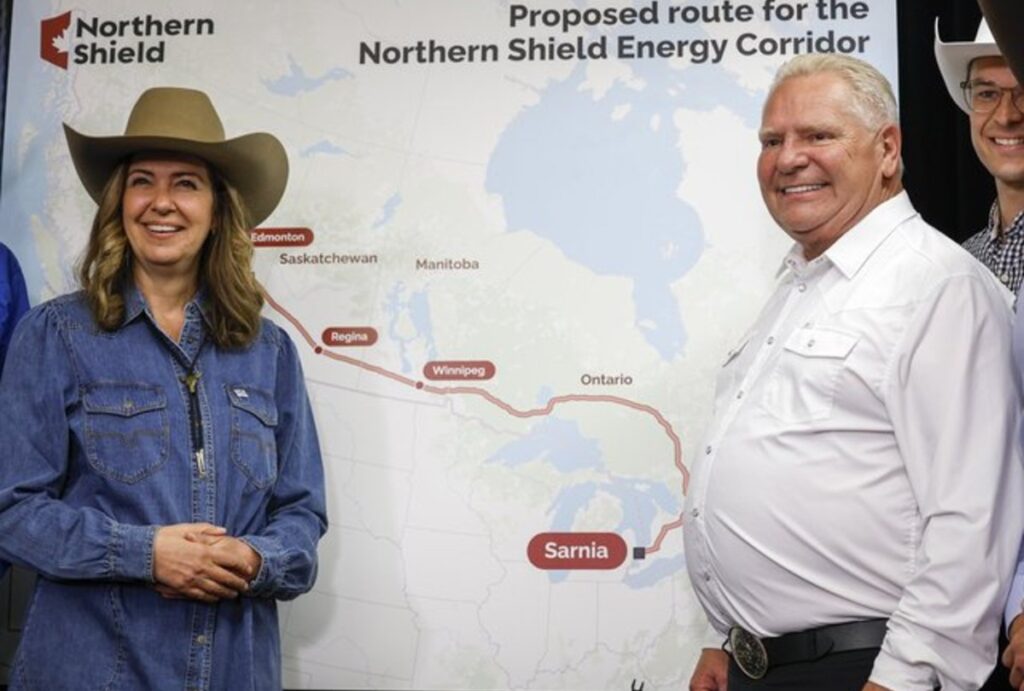
On Monday, add the new Northern Shield Energy Corridor to the list. It’s a pitch by the Ontario and Alberta governments that could move up to 800,000 bpd of western Canadian crude into the country’s largest province.
But will there be enough new production to fill all these lines in the coming years?
“We have to look at the time frame,” Premier Danielle Smith said Monday, standing alongside Ontario Premier Doug Ford to unveil the new concept.
“If you look at how we stage it, if we get the incentives right and we get the environment right to do new greenfield developments over 10, 15 years, I have absolute confidence that we’ll be able to do it.
“Remember, we are one of the largest (oil) reserves on the planet . . . We’ve got to think big, and we’ve got to be looking at being one of the top three energy producers and exporters in the world.”
On Monday, the two premiers announced the proposed route for an all-Canadian corridor that would move oil from Hardisty — southeast of Edmonton — through the Prairies into the Sarnia, Ont., area, where three refineries now operate.
As envisioned, the 3,300-kilometre pipeline would have the capacity to ship 500,000 barrels per day (bpd) to Ontario, with the possibility of expanding to 800,000 bpd.
Aside from increasing transportation capacity for the industry, it would enhance energy security in case of any potential disruptions with Enbridge’s Line 5.
That pipeline transports western Canadian oil east, running under the Straits of Mackinac to move product through Michigan to Sarnia, Ont. (Michigan Gov. Gretchen Whitmer previously tried, unsuccessfully, to shut down Line 5.)
The plan would also consider exploring, with the Manitoba government, the feasibility of a corridor extension to the Port of Churchill.
It’s not been determined who would build a new west-east pipeline, or if it would require government ownership. In other words, these are still early days for the proposal.
“We’ll reach out to the private sector, but we won’t hesitate to do what the government in Canada and Alberta is doing. So, let’s take a look at all options,” Ford said.
“We have to make sure we’re self-reliant, self-sufficient, on everything.”



A feasibility study about the proposal is expected to be completed by the end of 2026.
“This is about potentially delivering a western Canadian molecule wholly within Canadian borders,” said Kevin Birn, Canadian oil markets chief analyst with S&P Global Energy.
On Thursday, Alberta submitted a separate plan for a new million-barrel-a-day pipeline — running from Bruderheim, northeast of Edmonton, to the southern B.C. coast — to the federal Major Projects office for consideration as a project of national importance.
The West Coast line, estimated to cost between $35.2 billion and $43.7 billion, would be owned and developed by the federal government, Alberta and Calgary-based Pembina Pipeline.
The Northern Shield and West Coast developments would require billions of dollars of additional investment by oil producers to boost output to fill that much capacity.
Speaking last week, project proponents appeared confident the West Coast line will happen, particularly after Ottawa, Alberta and the Oil Sands Alliance said they’re working to finalize a deal that would see the country’s largest oilsands operators increase output and build the Pathways carbon capture network.
“Nobody wants to build a pipeline and have it empty, and so we will work together with governments to figure out the right timing and staging, such that those pipelines are coming into service at the right time as production is there to fill them,” said Kendall Dilling, president of the Oil Sands Alliance.
However, critics have questioned whether there will be enough incremental production or investment to fill the one million barrel per day pipeline, along with the other system expansions that are progressing.
The province’s filings with the federal Major Projects Office indicate that won’t be an issue.
“Analysis of individual oilsands projects have shown a combined production capacity that is well in excess of the total volume of planned egress expansion, including this project,” it states.
“Existing and forecast production will be sufficient to fully utilize the pipeline over its lifespan, especially under moderate global oil price scenarios.”
Future oil prices will play a factor, as will the economics of building any pipeline, affecting the tolls shippers would pay to move oil to market.
S&P Global expects Canadian oil production will increase by 500,000 bpd over the next five or six years. To further accelerate output growth, the industry will need to expand into new production areas, instead of optimizing existing oilsands facilities, said Birn.
And while the country requires more transportation capacity, it’s too soon to assume all of the projects will advance.
“Canada needs to prove it can complete these larger projects,” Birn added.
“We feel like we’re in this age of abundance in terms of pipelines, but we’re talking about abundance of promises . . . but we don’t have a track record that exactly matches abundance.”
Chris Varcoe is a Calgary Herald columnist.
[email protected]
Share This:






















COMMENTARY: Here’s How to Help Secure Canada’s Energy Sovereignty – Fraser Institute