


 CDN NEWS |
  US NEWS







Pipeline proposals long considered dead and buried are coming back from the grave — sort of.
Past plans to send oilsands crude east, west and south are being revived with different branding, proponents and routes. And, at least in the first two cases, the efforts are being driven by politicians rather than the private sector.
Here is a look at defunct projects of yore and their resurrected versions:
East
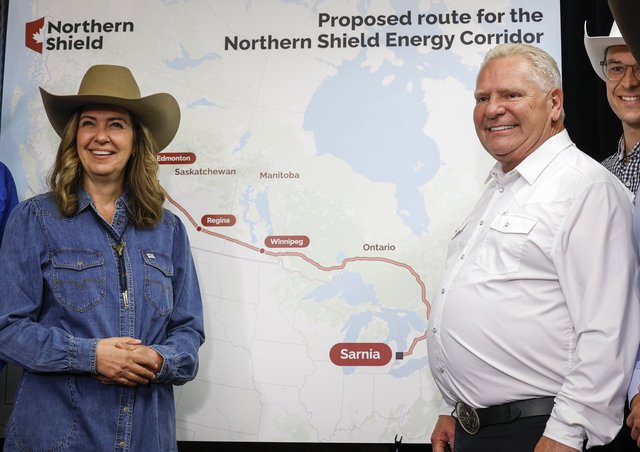
“No one would ever think in 100 years this would be done,” Ontario Premier Doug Ford said Monday of a plan to send an initial 500,000 barrels of crude 3,300 kilometres from Hardisty, Alta., to refineries in Sarnia, Ont.
It was 13 years ago that TransCanada Corp. — now TC Energy Corp. — pitched its Alberta-to-New Brunswick pipeline plan called Energy East.
Energy East would have converted part of an underused cross-Canada natural gas system to carry oil. It aimed to deliver Alberta crude to eastern refineries, and to export terminals in Cacouna, Que., and Saint John, N.B., that would have enabled shipments to Europe.
The project attracted fervent opposition from environmentalists and the Quebec government. TransCanada eventually scrubbed the project in 2017, citing “changed circumstances.” The cancellation happened against the backdrop of weak crude oil prices and a temporary resurgence in TransCanada’s southbound Keystone XL proposal during U.S. President Donald Trump’s first term.
The new east-west proposal, dubbed the Northern Shield Energy Corridor, would avoid Quebec, at least initially.
Alberta Premier Danielle Smith, appearing at a news conference in Calgary alongside Ford, said Northern Shield could eventually be expanded to 800,000 barrels a day and extend to the Atlantic Ocean, enabling tanker shipments to Europe. It could also use the Alberta crude to fill a strategic petroleum reserve in the east. No projected cost was provided.
The Ontario government has a feasibility study underway. Once that’s done, Ford said there will be more clarity about who would pay for Northern Shield and what, if any, private-sector involvement there will be.
West
Northern Shield was announced four days after Alberta filed its application to the federal major projects office for a new pipeline to the West Coast.
Smith had said last year that she wanted to see the pipeline go to a northern B.C. port, the shortest tanker distance to Asia. In the end, though, Ottawa said it would keep its ban on loading oil tankers in north coast waters and Alberta instead proposed a southern route, largely following the existing Trans Mountain pipeline.
An earlier plan to send oilsands crude north serves as a cautionary tale.
Enbridge Inc. filed an application to the federal regulator in 2010 for the Northern Gateway pipeline to Kitimat, B.C. The proposal drew fierce opposition from B.C. First Nations that have not signed treaties with the Crown, particularly those on the coast fearful of an oil spill. There was also staunch resistance from the B.C. government.
Northern coastal First Nations and B.C.’s NDP government were no more keen on Alberta’s pitch for a Northern Getaway 2.0.
The federal government approved the original Northern Gateway in 2014 and court challenges followed. Two years after Northern Gateway got the regulatory green light, the Federal Court of Appeal yanked its permit, saying Ottawa failed in its duty to consult with Indigenous communities.



The government of former prime minister Justin Trudeau then officially killed Northern Gateway, while approving a different Enbridge project to U.S. markets and the Trans Mountain pipeline expansion to the Vancouver area, which Ottawa eventually purchased from pipeline operator Kinder Morgan after that project’s own legal and regulatory roller-coaster.
The Trans Mountain expansion started up in 2024, and continues to be owned by the federal government. The Crown corporation in charge of that pipeline is to also take the lead on developing, building and operating the new million-barrel-a-day iteration unveiled last week.
The Alberta government is to have a share through the business arm of its energy department. Pembina Pipeline Corp. is to take a 10 per cent interest during construction, which could be expanded to 20 per cent once it’s operating and making money. The partners wish to have Indigenous communities eventually come on board as equity partners.
South
South Bow Corp., which spun off from TC Energy in 2024, said it had moved on from the contentious Keystone XL proposal, but that it would “continue to explore opportunities that leverage our existing corridor.”
First proposed in 2008, Keystone XL would have expanded an existing pipeline delivering crude to refineries in the U.S. Midwest and provided a direct route to the world’s biggest refining complex on the Texas coast.
Canada’s energy regulator approved the plan in 2010. South of the border was another matter as activists made the project a proxy for the broader battle against climate change.
Former president Barack Obama nixed the pipeline — twice — only to have President Donald Trump reinstate its permit during his first term. Former president Joe Biden pulled the plug on the pipeline again on his first day in the White House in 2021.
In his second term, Trump said he wanted to revive Keystone XL. And it has been, in a way.
South Bow this spring held an “open season” — a formal process to solicit bids from potential customers — for its Prairie Connector proposal. It received 20-year binding commitments for firm transportation service from Hardisty, Alta., to the Canada-U.S. border, where it would connect to another pipeline proposed by Bridger Pipeline LLC to Wyoming. Trump has granted a cross-border permit to Bridger.
Prairie connector would use about 150 kilometres of pipe in the ground that had been intended for Keystone XL, South Bow said. The company plans to make a final investment decision next year.
At Monday’s news conference, Smith was asked how oilsands companies can produce enough crude to fill pipelines to the east, west and south, in addition to expansions currently underway on existing systems.
“I feel like the industry was there 10 years ago,” Smith said. “They can be there again.”
This report by The Canadian Press was first published July 6, 2026.
Companies in this story: (TSX:SOBO) (TSX:PPL) (TSX:TRP) (TSX:ENB)
Lauren Krugel, The Canadian Press
Share This:






















On The Verge: Energy Sector Primed for New Wave of Growth – ATB Economics