CDN NEWS |
  US NEWS







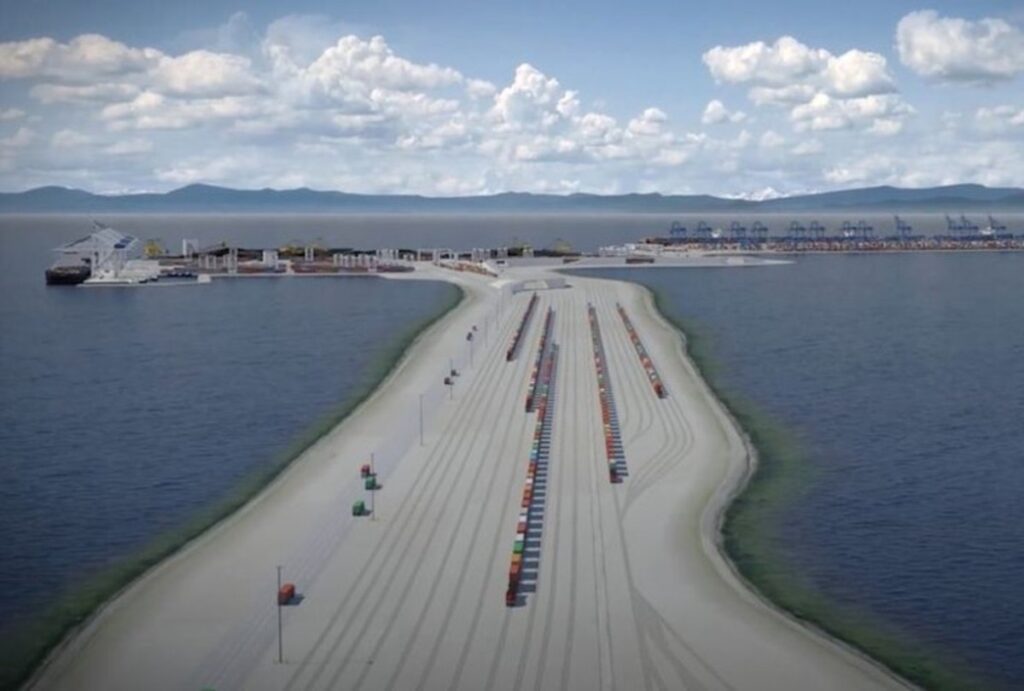
The Canada-BC and Canada-Alberta agreements opened the door to a new west coast oil pipeline, and its least-expected component may be the most telling: a terminal at Roberts Bank.
By Karen Graham
Of the myriad implications and opportunities signalled in the July 2nd Canada-BC Cooperative Prosperity Agreement and related agreement between Canada and Alberta to advance a new oil pipeline to tidewater in BC’s Lower Mainland, perhaps the least-expected component is the proposed terminus—and terminal—at Roberts Bank, a federally-operated artificial island connected by a causeway from Tsawwassen, BC, part of which is included in Tsawwassen First Nation treaty lands.
The Roberts Bank component of this complex set of energy, infrastructure, and transportation proposals allows one to consider a microcosm of Canada’s diversified export opportunity. It is a new focal point of the larger economic necessity of boosting and diversifying markets for western Canadian energy products, and will represent a nexus of Indigenous engagement and possible equity participation, environmental review processes, a rolling (!) definition of an infrastructure corridor, and an apparent reset of fed-prov-prov relations among Canada, Alberta and British Columbia. Let’s unpack them.
Indigenous equity participation / Indigenous consultation
The Canada-Alberta agreement states that a “meaningful equity stake” in the overall west coast pipeline project will be reserved for Indigenous peoples. The Tsawwassen Nation, and other First Nations around the Salish Sea basin, have demonstrated entrepreneurial success across many fields of endeavour, and have played a role in Canada’s west coast commercial waterways for decades. To engage with BC First Nations relating to the pipeline route is to largely build on preceding relationships that enabled the Trans Mountain Expansion project to complete.
To incorporate equity opportunities for Salish Sea nations relating to a Roberts Bank terminal (and rail line, and tank farm?) opens new ways to engage and participate, in a region and under a legislative framework sorely in need of clarity—and a reset – based on pragmatic and innovative roles undertaken by various nations’ economic development corporations (e.g. Tsawwassen EDC, operating since November 2009, shortly after the treaty came into effect).
As for the Constitutional Section 35 duty to consult and accommodate Indigenous groups, assessing the package as a whole (i.e. the agreements between Canada and both western provinces, Canada’s precluding of a northern route, a $250 million budget commitment to advance whale safety and marine protection along the BC coast, an environmental liability and emergency response fund, and “meaningful” equity opportunities), the First Nations located along the Salish Sea can create an avenue to materially advance and clarify a practical consultation framework, steps, and outcomes in a way that can set a new template to which provincial governments, Constitutional experts, First Nations, advisors, and the courts can refer as an example of how to “get it right”. In other words, through a pragmatic approach to consultation, the parties can together perhaps find a way through BC’s DRIPA, Canada’s UNDRIP Act, as well as the legal and procedural uncertainty generated by BC court decisions over the past dozen months.
Applicable environmental review process
The Roberts Bank part of the west coast pipeline project raises questions about which environmental review process will apply. The Canada-Alberta agreement is clear that the interprovincial pipeline project (within federal jurisdiction) will be referred to the Major Projects Office under the Building Canada Act. The port development and related new infrastructure at Roberts Bank appears not to be included, and could therefore be reviewed under the federal Impact Assessment Act, as did the Roberts Bank Terminal 2 container port expansion project (where time was not notably of the essence given the duration and inefficiency of the review process). The Canada-BC agreement references a renewal of their commitment for reciprocity of assessment processes for the project and adherence to the principle of “one project, one review”. However, clarity should be provided at the earliest stage for how a proposed expansion of the terminal to accommodate a large-capacity new oil pipeline – including pipe or rail capacity along the causeway to the terminal, docks to moor Very Large Crude Carriers (VLCCs, the largest oil tankers), and a tank farm, will be assessed under Canada’s—or BC’s—environmental regulatory framework.
A related question is one of capacity and pace: if the Roberts Bank infrastructure is to be constructed in a timely way to serve a new oil pipeline, the relevant government departments and regulatory bodies will need to be endowed with the capacity, and bounded by the timelines set out for review, refinement and a final approval decision. If there is to be any investment interest in the terminal and export infrastructure components by the private sector (would Indigenous participation fall under this category?), answers need to be provided at the earliest opportunity regarding the governing environmental review framework.



Note that energy infrastructure investment is big global business; global capital – including that of pension funds and sovereign wealth funds – is seeking investments in long-term infrastructure assets. To take one example from the Persian Gulf, bilateral investment between Canada and the United Arab Emirates is on the rise: the Caisse de Dépôt et Placement du Québec invested C$2.5 billion in three Dubai ports in 2022, and the Canada-UAE FIPA inked in November 2025 specifically mentions UAE’s sovereign wealth fund’s C$70 billion commitment to invest in Canada; listing energy and ports among the target sectors.
Infrastructure corridor
In BC, infrastructure proponents have long promoted the concept of infrastructure corridors, in which modes of transmission and transport for multiple commodities (e.g. electricity transmission, energy pipeline and rail), are established, pre-vetted (if not specifically permitted) for environmental effects and safe, efficient routing. This is intended to reduce regulatory delay and risk for infrastructure operators, and improve planning predictability for adjacent interests, governments, utilities and shippers.
It has not been much in evidence in the province until very recently, and even then, not by design (see Resource Works’ Stewart Muir’s post on the “accidental corridor”). Through the lens of Roberts Bank as microcosm for Canada’s capacity to build complex projects and export-enabling infrastructure, we can perhaps detect a more deliberate and comprehensive approach to a mini-corridor – even if that too is somewhat accidental. Construction has yet to begin on a widened rail line corridor to serve the Roberts Bank “T2” expanded container terminal. The Canada-BC agreement states that the Port of Vancouver’s “capacity to serve Canadian exporters depends on the infrastructure that surrounds it”, including rail links and associated development.
Perhaps we can detect a plan to develop a mini-corridor to serve Roberts Bank as a diversified port (presently serving bulk commodities and container goods). While rail infrastructure expansion is planned for container service, it will be efficient to “bundle” the construction to serve an oil loading facility at the same time (by rail initially, and subsequently by direct pipe?). In this context, there is already a local example in the Westridge Terminal serving the existing Trans Mountain pipeline network and tanker facility. Made-in-BC infrastructure operating standards govern loading procedures and ship movements to ensure marine safety and environmental protection and can be adapted to Roberts Bank.
Locating land-based tanks of the scale required to serve VLCC ships is perhaps a different question. Adjacent lands (i.e. Tsawwassen) and respective governments will need to take account of geophysical realities: sound engineering guidance will likely determine siting, given the seismic realities of the south Fraser River floodplain.
Inter-governmental relations
Last but not least, the Roberts Bank option for an oil export terminal is already serving as a microcosm test for inter-governmental relations on the development of a major energy infrastructure project. While BC has committed in the agreement not to litigate the proposed pipeline along the proposed TMX route (an easy concession since it had already exhausted legal options a decade ago fighting that pipeline), Roberts Bank offers an opportunity to demonstrate collaborative federalism regarding a specific piece of land essential for the export of Canada’s most profitable commodity. For example, will the rail corridor (right-of-way owned by BC Rail) be a sticking point, or will BC, the Tsawwassen Nation and Canada cooperate to enable its expansion to accommodate an oil export terminal?
As a domestic diplomatic matter, the twin agreements announced among Canada-BC and Canada-Alberta should be applauded for the Prime Minister’s adroitness in addressing two difficult provincial problems. Laying out a viable way forward for Alberta to develop an oil export pipeline, with BC being able to point to “wins” for massive (largely unspecified) funding for environmental protection, royalties from oil exports via a new Roberts Bank terminal, and support for civil infrastructure (Massey Tunnel replacement) facilitates a reset between the provinces, and, perhaps, offers “peace in our time” for the federal bilateral relationships with both provinces. (Implicit in the Cooperative Prosperity Agreement with BC is that the province will stand down from periodic complaints and asks of the federal government for years to come.)
The agreements have dramatically shifted the ground for Canada’s next west coast energy export opportunity. If the relevant jurisdictions, regulators, First Nations and other parties can collaboratively develop Roberts Bank, there is reason for tempered optimism that Canada is capable of “building an affordable, competitive, sustainable and independent Canadian economy” (text of BC agreement) “at the speed and scale this moment demands” (text of Alberta agreement).
The views expressed in this article are those of the author, Karen Graham, and do not necessarily reflect the views of the Resource Works Advisory Council.
Share This: