CDN NEWS |
  US NEWS







Story by Jennifer Lockett
America’s emergency oil stockpile is shrinking at a pace that has turned a technical energy-policy decision into a North American power story. President Donald Trump’s 2026 Strategic Petroleum Reserve release was framed as a response to global supply pressure and Middle East instability, but the numbers reveal a deeper reality: the United States still leans heavily on Canadian crude.
Canada supplied 63.4% of U.S. crude oil imports in 2025, making it not just a trading partner, but a core pillar of American refinery supply. As Washington pulls barrels from underground salt caverns and promises to replace them later, Canada’s oil patch is quietly becoming even more central to U.S. energy security, gasoline prices, and political leverage.
The Emergency Reserve Is Falling Fast
The Strategic Petroleum Reserve was built for moments when oil markets turn fragile, and 2026 has become one of those moments. In March, the Trump administration authorized a 172-million-barrel release from the reserve as part of a broader International Energy Agency effort involving 400 million barrels from member countries. The White House’s argument was simple: move oil into the market quickly, cool supply fears, and reduce the risk of a price shock reaching drivers, airlines, truckers, and factories.
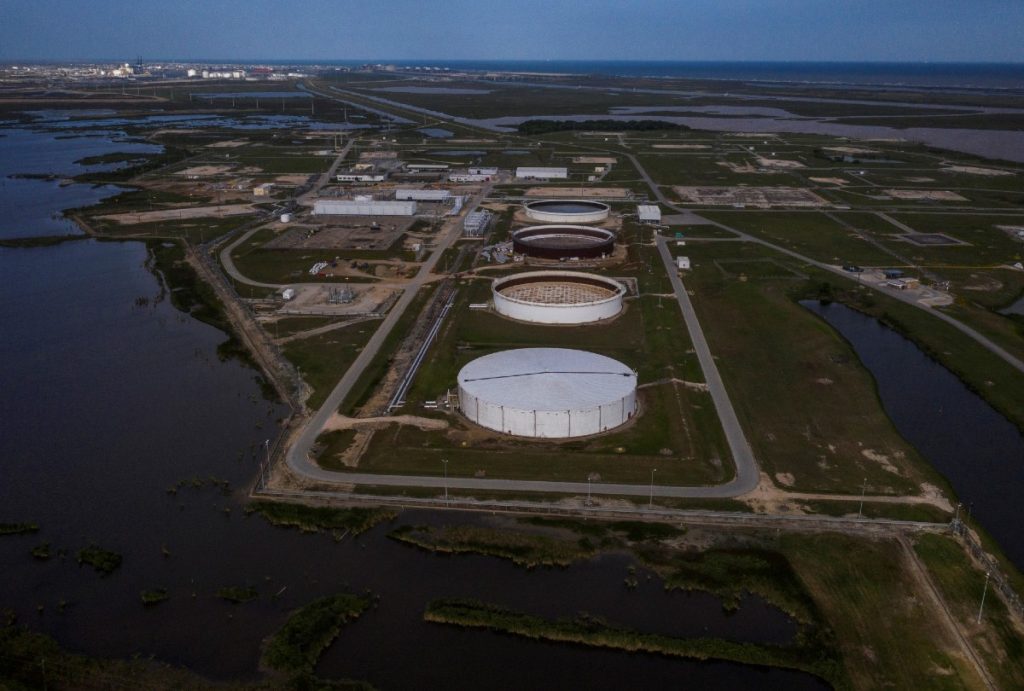
But the drawdown has been dramatic. By early July, EIA data showed the reserve had fallen to roughly 319.5 million barrels, its lowest level since the early 1980s. That is a startling figure for a stockpile authorized to hold hundreds of millions more. The reserve is not a typical commercial tank farm; it is stored in underground salt caverns along the Gulf Coast and exists as a last-resort buffer. When it drops this far, the debate shifts from fuel prices today to preparedness tomorrow.
Trump’s Release Is an Exchange, Not a Simple Sale
The word “release” can make the move sound like oil is simply being emptied and lost. The administration has described much of the 2026 action as an emergency exchange, meaning companies receive crude now and are expected to return more barrels later. In one early tranche, the Energy Department said companies would receive 45.2 million barrels and return 55 million barrels, creating a paper gain for the reserve over time.
That detail matters because the politics are sharp. Critics see a drained reserve at a dangerous moment, while supporters argue that using barrels during a supply emergency is exactly what the reserve is for. The practical risk sits in between. Even if the oil is returned later, the reserve is lower during the vulnerable period. A family watching gas prices, a trucking company managing diesel costs, or a refinery planning summer runs does not feel the promise of future barrels. It feels the market right now.
Canada Has Become America’s Oil Shock Absorber
Canada’s role in the U.S. oil system is larger than many headlines suggest. In 2025, Canada provided 63.4% of all crude oil imported by the United States. Canada also exported about 4.3 million barrels per day of crude oil overall, with roughly 3.9 million barrels per day going to the U.S. That means the U.S. emergency response is happening in a market where Canadian barrels already serve as the dominant foreign supply source.
This is not just a volume story. It is a geography story. Canadian crude moves through established pipeline networks into U.S. refineries that have built their operations around those flows. The relationship is especially important because much of Canada’s export crude is heavier and more sulfur-rich than the light oil produced in many U.S. shale basins. In practice, American energy independence still includes a very Canadian foundation. When Washington talks about supply security, Alberta, Saskatchewan, and pipeline corridors matter as much as political slogans.
Midwest Refineries Are Especially Exposed
The U.S. Midwest is where the Canadian crude story becomes most visible. Federal Reserve Bank of Kansas City research found that U.S. imports of Canadian oil have doubled over two decades, with much of that crude flowing into Midwest refineries. In 2024, Canadian crude represented about 62% of total U.S. crude imports, and Midwest refineries processed roughly 2.8 million barrels per day of Canadian oil.
That dependence is not easily replaced. Refineries are expensive, specialized industrial systems. Many Midwest plants are configured to process heavy sour crude, which requires more complex equipment than lighter crude. Switching to different supply sources can be technically difficult and financially painful. That is why any disruption involving Canadian crude can land quickly in gasoline markets. For consumers in states such as Illinois, Michigan, Ohio, and Indiana, Canada’s oil supply is not an abstract trade statistic. It is part of the price posted outside the local gas station.



The SPR Was Built for a Different Energy Era
The Strategic Petroleum Reserve was created after the 1970s oil shocks, when U.S. leaders wanted a national buffer against import cutoffs and hostile supply disruptions. The system still matters, but America’s energy map has changed. The U.S. is now a far larger crude producer than it was during earlier oil crises, and shale production has transformed global supply balances. Still, the reserve remains one of the most powerful tools Washington can deploy when global markets panic.
The challenge is that the reserve itself is aging. The Department of Energy describes it as the world’s largest emergency crude supply, stored in salt caverns at four Gulf Coast sites. The Government Accountability Office has warned that major drawdowns and maintenance needs are straining the system. That creates a difficult policy tradeoff: the reserve is useful because it can be released quickly, but frequent releases can also expose infrastructure problems that make the system harder to use reliably in the future.
Canada Is Diversifying, But the U.S. Still Dominates
Canada is not standing still. Statistics Canada reported that crude oil extraction reached a record level in 2025, while crude oil exports also climbed to a record. A key shift was that exports to countries other than the United States rose sharply, helped by expanded West Coast access. For the first time in the current data series, non-U.S. destinations drove the overall increase in Canadian crude exports.
Even so, the U.S. remains Canada’s overwhelming crude customer. Canada’s exports to the United States fell in 2025, but still totaled 222.7 million cubic metres, and most of those exports continued to move by pipeline. That leaves Canada in a powerful but complicated position. More Pacific access gives producers optionality, but the U.S. refining system still provides unmatched scale, proximity, and infrastructure. Canada wants more buyers; America still needs the barrels. That tension is becoming more important as trade politics become louder.
Trans Mountain Gives Canada New Leverage
The expanded Trans Mountain system has changed the conversation because it gives Canadian crude a stronger path to the Pacific. Reuters reported that the pipeline’s expanded capacity is 890,000 barrels per day and that Trans Mountain has discussed optimization projects that could add more capacity by 2028. The pipeline is Canada’s key westbound route, offering direct access to Asian markets at a time when Ottawa and industry leaders are trying to reduce overreliance on the United States.
That does not mean Canada can easily walk away from the U.S. market. The American refining network remains the natural home for large volumes of Canadian crude. But even partial diversification matters. If more barrels can move to Asia or the U.S. West Coast, Canadian producers gain more bargaining power. In a world where Washington is draining emergency reserves while depending on Canadian imports, pipeline optionality becomes more than infrastructure. It becomes leverage.
Oil Security Is Now a North American Test
The Middle East shock that pushed governments toward emergency reserve releases shows how quickly oil security can become a global stress test. OPEC lowered its 2026 oil demand growth forecast amid the effects of the Iran conflict, while supply routes and tanker flows remained central concerns. Those kinds of disruptions remind policymakers that crude oil markets are global even when production is local.
For North America, the lesson is uncomfortable but clear. The United States can produce huge amounts of oil, but its refineries still rely on crude types and trade routes that domestic shale cannot fully replace. Canada can export more widely than before, but its biggest and most integrated customer remains the U.S. Trump’s SPR release may help soften a near-term supply crunch, but it also highlights a long-term truth: American energy security is increasingly tied to Canadian reliability.
The Bigger Political Risk Is Complacency
The reserve’s falling level may not trigger a crisis by itself. The U.S. still has commercial inventories, domestic production, imports from Canada, and a promise that exchanged barrels will come back with additional volumes. But emergency systems are not judged only by whether they work once. They are judged by whether they remain ready for the next shock.
That is where the politics become harder. If Washington uses the reserve to calm markets, it must also fund repairs, plan refills carefully, and recognize the role Canada plays in keeping refineries supplied. If Ottawa wants to turn energy into a stronger strategic advantage, it must keep building export flexibility while maintaining access to the U.S. market. The numbers tell a blunt story: America is drawing down its emergency cushion, and Canada is supplying the crude that keeps much of the system running.
Share This: