


 CDN NEWS |
  US NEWS







In late June, Executive Director of the International Energy Agency (IEA) Fatih Birol came to Montreal for meetings with Finance Minister Francois-Philippe Champagne. I watched as he was lauded for his admitted reversal on forecasts and policies his organization has trumpeted since 2021 to sell us “energy transition”.
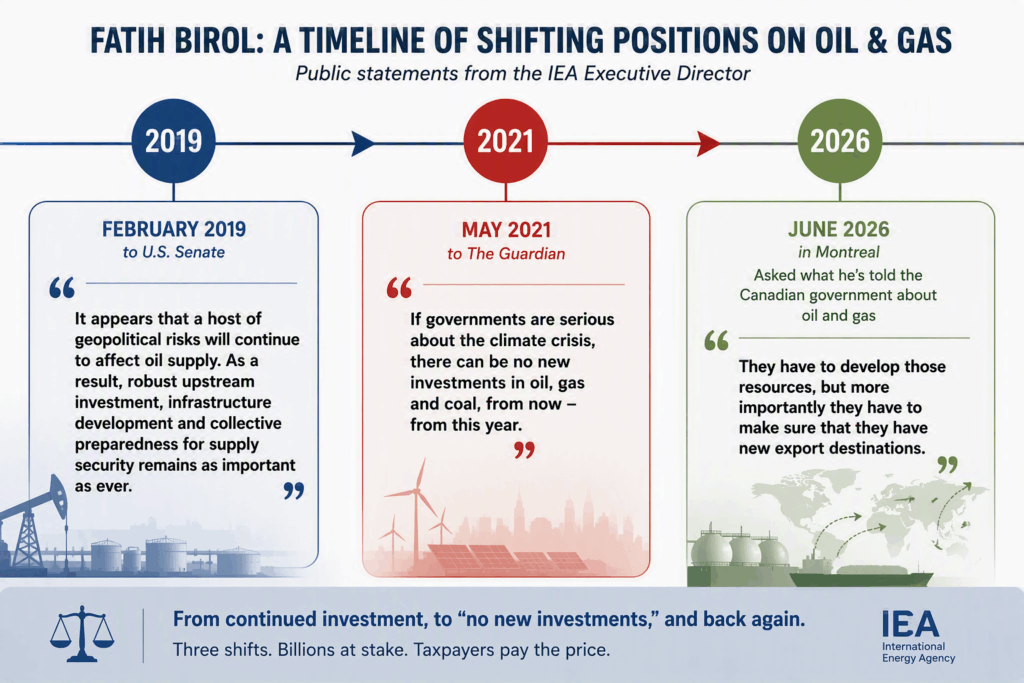
June 2026: Asked after his speech what he’s told the Canadian government about oil and gas, he replied:
“They have to develop those resources, but more importantly they have to make sure that they have new export destinations.”
May 2021: To ‘The Guardian’:
“If governments are serious about the climate crisis, there can be no new investments in oil, gas and coal, from now – from this year.”
In the frenzy of camera flashes, perhaps no one noticed that this reversal was, in fact, a reversal of his previous reversal on his pre-2021 position that oil and gas would continue to remain an important source of energy globally for the foreseeable future.
February, 2019 – to U.S. Senate:
“it appears that a host of geopolitical risks will continue to affect oil supply. As a result, robust upstream investment, infrastructure development and collective preparedness for supply security remains as important as ever.”
So, Mr. Birol’s flip-flop is actually a somersault.
The great irony in all this is that the IEA was formed in 1974 to give energy import-dependent nations (Canada included) an outlook on energy supplies worldwide, guarding against being held hostage by unfriendly regimes; this was in response to the ‘oil embargo’ enforced by the Oil Producing and Exporting Countries (OPEC).
Fast forward to the past decade, and oil analysts around the world largely ignore IEA information and rely instead on data and forecasts produced by OPEC. Why? Because the IEA has proven to be as consistent in their forecasting as a weathervane in a cyclone.
I attended the annual meetings of the IEA in March 2022 – shortly after the start of the Russian war on Ukraine – and I can assure you the Agency’s reported outcomes from that meeting did not reflect the dialogue from member countries throughout the session. The problem was how to adjust to a disruption from a hostile party (Russia) that provided Europe with roughly half of their natural gas and one-quarter of their oil and was receiving roughly half a billion dollars (US) a day from a continent that suddenly felt very threatened by its hostilities. The American Administration-inspired response was to arrive at a ‘demand adjustment’, rather than address an adequate ‘supply response’, as has been typical in such crises.
How Does This Happen?
Let’s examine who funds the IEA. The U.S. has the highest voting weight at around 25% (staggering given that there are at least 32 countries in the Agency), and their dues payments are commensurate. In addition, further voluntary contributions are provided – with no definitive ‘quid pro quo’ – just the ability to influence research, focus, and direction. In the end, policy is people, and people produce what they are paid to produce, for the people who pay them to do it.
More proof in that pudding came from Saudi Arabia (the lynchpin of OPEC) in 2022 – when they decided to stop using input from the IEA because of their concern of the influence on the data of the largest funder of the Agency – the U.S. Administration. In their words. “the IEA has an independence problem, which is translating into a technical assessment problem.”



The issue is not whether one supports oil and gas, renewable energy, or some combination of the two. Reasonable people can disagree on the pace and shape of the energy transition. The issue is whether governments, businesses, and taxpayers are receiving objective analysis or ideological guidance dressed up as analysis.
That distinction matters because public policy carries real consequences. Investment decisions worth billions of dollars are made using forecasts from organizations like the IEA. Infrastructure is built, projects are cancelled, regulations are imposed, and taxpayers bear the cost. If the analysis is wrong, the consequences are not academic or rhetorical. Talk is cheap. Policy adjustments to adapt to inconsistent ideological underpinnings are very, very expensive.
For decades, the IEA earned influence because governments trusted its independence. Today, that trust has disappeared.
Mr. Birol may have sold the IEA’s independence to the highest bidder, but what he doesn’t seem to realize he gave away was any credibility the organization had.
Developed countries created the IEA to provide clear-eyed analysis in moments of uncertainty. Instead of echoing opportunistic narratives, it was supposed to guide governments on what they need to know about the world’s energy outlook.
These same governments should start asking a simple question: why are taxpayers continuing to fund an institution whose greatest export is no longer energy analysis, but unrealistic, ‘aspirational’ narratives?
Because accountability should not end at national borders. It should apply just as much to the international organizations that influence billions of dollars in policy decisions around the world.
The Canadian Context
Let’s bring this home, because this bend-a-knee mentality is growing increasingly prevalent in Canada. Who is accountable, in Canada, for hundreds of billions of dollars burned in the name of climate over the last decade, only to have a partial policy pivot by a few words from a man whose organization’s forecasts on global energy development are less reliable than a daily horoscope?
Somewhere along the way, the Government of Canada (and much of the world) forgot our role in energy production. We have never been competitive on price. Our oil-producing jurisdictions suffer the whipsaws of global oil pricing. Our free-market companies need to profit from finding, drilling, producing, and delivering their products to energy-hungry markets, all while paying royalties and taxes to the governments we elect, and meeting the strictest environmental standards in the world. The tragic irony in the success of Canada’s oil industry is that the politics that make us preferrable as a supplier globally are the very politics that break us apart internally as energy exports become the political battleground of regions and special interests divided by the benefits attributed to these energy supplies.
Why This Matters
Supranational organizations that are funded by national governments are largely separate from accountability to the people whose taxes make those government contributions possible. Their employment is not measured by the accuracy of their outcomes. They are detached from responsiveness and above accountability.
Here’s the consequence:
- U.S. Administrations (of every stripe) influence the data provided for forward guidance by a supposedly independent world body that was conceived to provide future clarity on energy security;
- Energy analysts ignore the tainted data;
- Governments that depend upon it religiously (or opportunistically) incur significant costs when they adhere to the direction provided;
- Taxpayers continue to fund these organizations that lack accountability – so pay multiple times for misdirected policy; and,
- The world (Canada!) is unprepared to meet the emergent outcome in the global energy landscape when the foreseeable future unfolds.
Then, the IEA gets back on its horse and tells Canadians to take advantage of the opportunity quickly, never mind the years that it will take for these opportunities to unfold. No foresight means no opportunity to meet the moment. We are all worse off as a result – Canadians and those who could depend on us for energy security.
The Liberal Cabinet lauding Mr. Birol’s changing narrative doesn’t surprise me. So many of the frontbenchers in that government are just looking to see which way the wind is blowing. Like the IEA, that’s not leadership, so they’ve found good company.
It’s time that we hold up the mirror to the IEA and start basing our energy policy on an outlook that lasts longer than one American election cycle. It’s time Canadian energy policy stopped following American-funded misinformation organizations. And it’s time we held all these organizations – in Canada and elsewhere – accountable for the mess they’ve delivered us.
Share This:






















COMMENTARY: Varcoe: ‘Do No Harm’: Should Alberta Step in to Fix Gas System Constraints, Given Past Energy Interventions?