


 CDN NEWS |
  US NEWS







More than 40% want a temporary pause on new approvals until their impact on electricity prices, grid reliability, water use and emissions can be reviewed
By This Article and More by Graison Foster Here
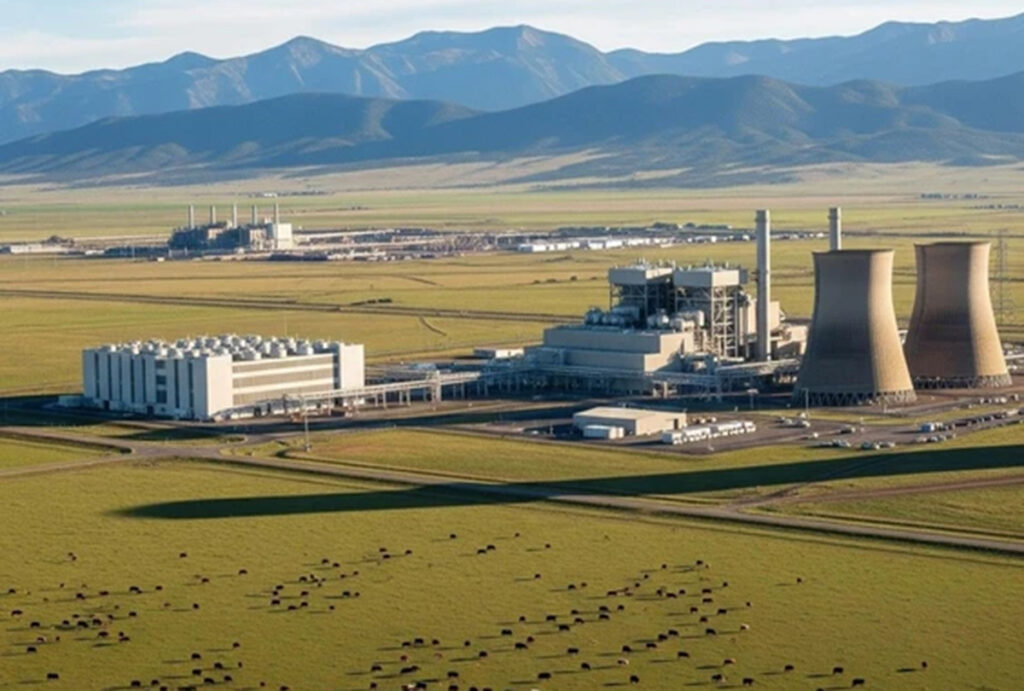
A digital rendering of a proposed data centre in Alberta.
Albertans don’t appear to be sold on data centres, and they aren’t overwhelmingly skeptical either, a new Leger survey suggests.
Forty-two per cent of those polled said they want a temporary pause on new approvals for large AI data centres until an independent public review examines the effects on electricity prices, grid reliability, water use and emissions.
Another 40 per cent said Alberta should keep considering and approving them under current rules, so the province does not lose investment and jobs to other jurisdictions. Leger describes opinion as nearly evenly divided.
Data centres use enormous amounts of electricity, and Leger asked who should pay for it. Almost nobody polled wants them treated like an ordinary customer. Just 12 per cent of respondents said a data centre should be able to hook into Alberta’s power grid and pay the same rates as any other big industrial user.
Half went further. The single-largest group, 29 per cent, said data centres should build or buy their own power and cover the full cost of connecting to the grid, close to what the province already requires. Another 22 per cent said Alberta should not approve of them at all. In between, a similar share would allow grid access only if operators paid the full cost of the power and the lines to carry it.
Andrew Enns, an executive vice-president at Leger, said respondents have very little to go on.
“We don’t actually have that many of them in full operation in Canada yet,” Enns said. “We need a few of these things to start operating and actually get a sense of what the operation is like, in terms of the demand for electricity, the implications for ratepayers, the demands on the environment.”
“You see very mushy opinions,” he said.
Enns is right about the shortage of working examples. Canada has five hyperscale data centres in operation, two in British Columbia and one each in Ontario, Quebec and New Brunswick, with 96 more announced or under construction. Hyperscale means anything drawing 50 megawatts or more. Meta Platforms Inc.’s planned facility northeast of Edmonton would draw 20 times that.
Alberta accounts for roughly 90 per cent of the proposed capacity. Those figures come from a working paper published earlier this month by Alexander Carlo and Lyndsey Rolheiser, researchers at York University’s Schulich School of Business.
The same paper counts 194 active data centres across Canada, drawing 1.6 gigawatts between them. Meta’s would draw one gigawatt by itself.
Rolheiser said the figures are current as of the beginning of June and that Meta’s project alone would equal about two-thirds of Canada’s current total capacity.
“I can’t speak directly to what Albertans should take from it, other than this scale is incredibly large and the potential for negative local externalities is also large,” Rolheiser said.
“A transparent conversation about the actual positive local externalities needs to take place, as well as what guardrails the province and county are willing to put up to prevent the local costs from outweighing the benefits.”



On Meta’s project specifically, 44 per cent of those polled said they support it; 36 per cent said they oppose it, and 20 per cent had no view.
Respondents were then told what the project involves. It is expected to bring more than $13 billion in investment, over 3,000 construction workers at a peak and more than 300 permanent jobs once running. It would be a one-gigawatt facility powered by a new natural-gas plant, and Meta says it will pay for the energy and grid infrastructure it needs.
On those terms, 57 per cent called it a good deal for Alberta, against 27 per cent who called it a bad one.
Ask what worries them and the answer is the power bill. Electricity demand and power prices led the concern list, ahead of water use.
“There’s been a few data centres in the United States where, once they were up and running, suddenly there was a bit of an implication for local ratepayers in terms of their rates going up,” Enns said.
Investment in Alberta topped the benefits list at 19 per cent. The next most common answer, at 17 per cent, was that the projects deliver no real benefit at all. Long-term jobs finished at 10 per cent.
“These data centres aren’t big, heavy employee-driven operations,” Enns said. “That long-term employment, that’s not a really big selling feature.”
Divide Meta’s $13 billion by the 300 permanent jobs, and each one costs about $43 million.
Men and women split further apart. Among men polled, 59 per cent backed the Sturgeon County project. Among women, 30 per cent did.
Enns attributed the gap to two things. Women track environmental impacts more closely, he said, and they tend to run the household ledger.
“In a lot of households, women are responsible for the micro budget choices,” he said. “Squaring the utility bills at the end of the month, the cash flow in versus the cash flow out. We see it on the affordability side, that women are much more attuned to anything that might make things for the household more expensive.”
Rocky View County has already had this argument. Council rejected Kineticor Asset Management’s 1,100-acre campus near Balzac in a vote of six to one last September, citing the location and the impact on neighbouring farmers.
Asked about a comparable facility within 25 kilometres of their own home, respondents flipped to 41 per cent support and 44 per cent opposition.
The explanation falls to the government.
“The big numbers that get thrown around, $13 billion, or millions of dollars in tax revenues, they don’t stand on their own as being just a good thing,” Enns said. “Governments and local municipalities shouldn’t take for granted that the public is aware. I would argue they’re not.”
Leger surveyed 1,000 Alberta adults online July 17-19. Online panels cannot be assigned a margin of error, but a probability sample of this size would carry one of 3.1 percentage points, 19 times out of 20. Results were weighted by age, gender and region.
[email protected]
Share This:




















GRETCHEN WHITMER IS AT IT AGAIN: The Michigan Governor has Threatened to Shut Down Line 5 “Within Months” – Jim Warren