CDN NEWS |
  US NEWS







Geology, existing infrastructure and a skilled workforce give the province an edge
By Will Gibson
Epic Photography Inc.
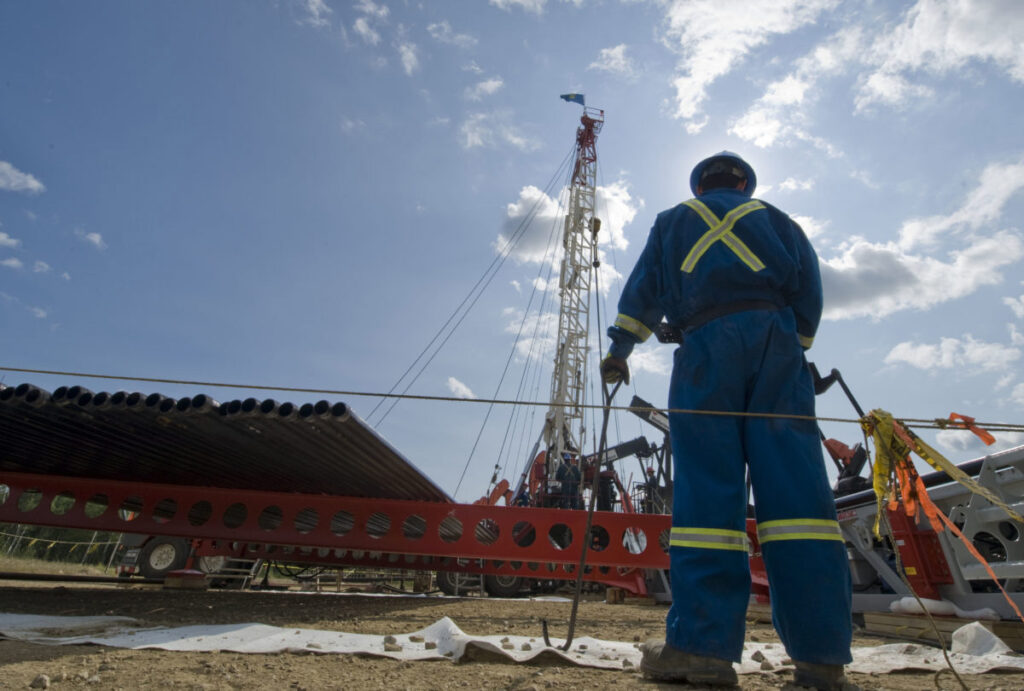
Energy worker in Alberta. Photo courtesy Government of Alberta
As global interest in naturally occurring hydrogen grows, researchers at InnoTech Alberta say the province has “exceptional potential” to lead production of the rare, nearly zero-emission energy resource.
Alberta is in a prime position for the emerging field because of its rich geology and energy industry expertise, they said.
“We are trying to de-risk this for exploration companies through our work,” said InnoTech’s Dr. Tiago Morais, a geologist and one of the study’s authors.
The gold standard
Natural hydrogen — known as “gold” or “white” hydrogen in the industry’s colour-coded system — is rare but highly sought after.
Unlike “grey” hydrogen, produced from natural gas or coal without carbon capture and storage (CCS), “blue” hydrogen, which incorporates CCS, or “green” hydrogen made from renewable energy, natural hydrogen can be extracted directly from the earth.
It’s a resource in the very early stages of commercial development.
Today’s only production comes from the West African country of Mali, producing five metric tonnes per year, or enough to power a small village, according to the International Energy Agency.
For end uses, hydrogen produces no emissions – only electrical power, water and heat.
“The idea that the Earth might generate a clean, replenishing energy source has attracted attention worldwide,” Dan Arthur, president of Tulsa, Okla.-based ALL Engineering, wrote for the American Association of Petroleum Geologists.
The U.S. Geological Survey’s first Geologic Hydrogen Prospectivity Map, released in January 2025, marked a turning point for the emerging resource, Arthur wrote.
A resource rich with potential
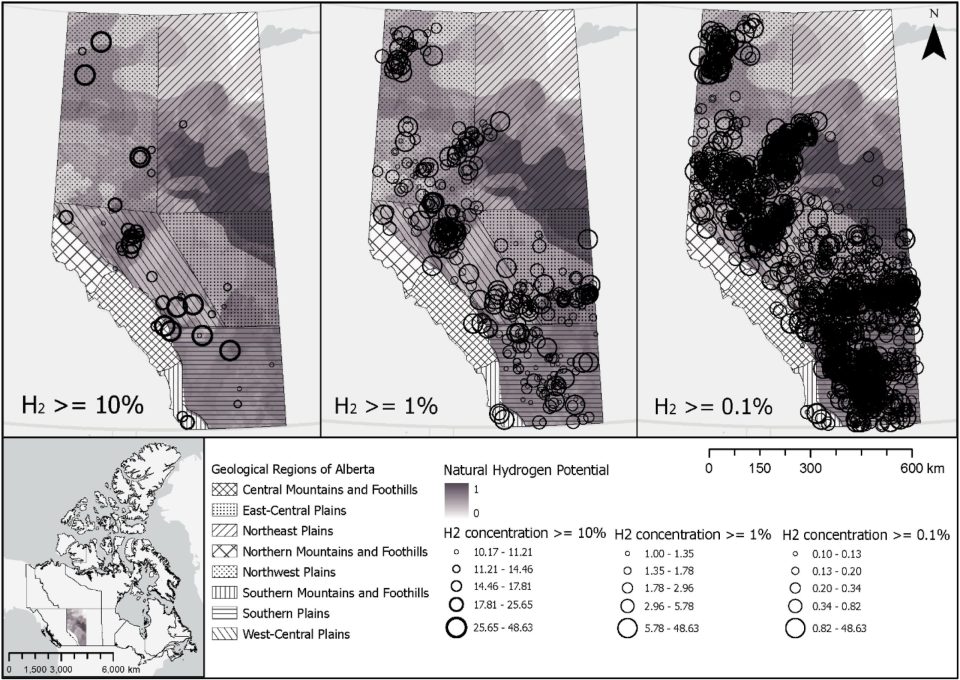
Spatial map illustrating the potential for natural hydrogen occurrence across the eight geological regions of the province and the distribution of hydrogen concentrations greater than 10 %, 1 %, and 0.1 % in natural gas samples. Courtesy InnoTech Alberta
While hydrogen does not yet have widespread uses for the average consumer, it has long been a critical feedstock for heavy industry.
Canada produces about four million tonnes of hydrogen each year, primarily from natural gas, according to Natural Resources Canada.
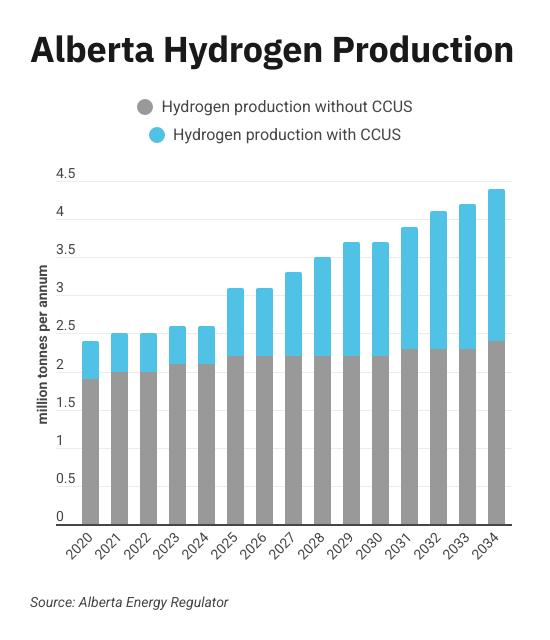
More than 60 per cent of that — roughly 2.5 million tonnes — comes from Alberta, according to the Alberta Energy Regulator (AER).
This is largely used to refine crude oil, upgrade bitumen from the oil sands, produce petrochemicals and make ammonia for fertilizers.
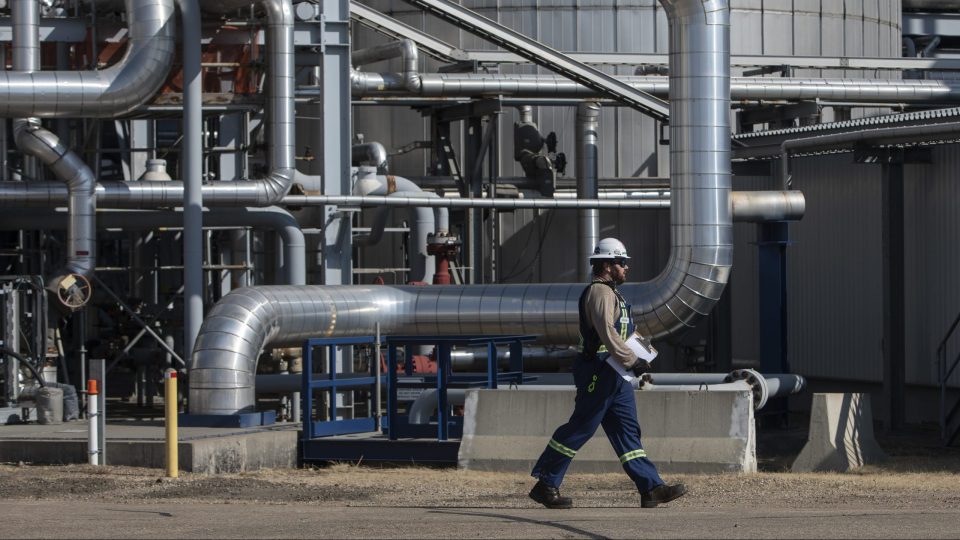



Workers at a hydrogen manufacturing facility in Edmonton, Alberta. CP Images photo
The AER projects that by 2034, Alberta will produce about 4.4 million tonnes of hydrogen, nearly half of it “blue” produced with CCS.
World hydrogen demand has grown, reaching 100 million tonnes in 2025 for the first time in history, according to the International Energy Agency’s Global Hydrogen Review.
The future outlook is uncertain, but the IEA projects world demand could be as high as 585 million tonnes in 2050.
Demand is rising from both traditional industrial uses and new and emerging applications such as transportation and aerospace, said David Billedeau, CEO of the Canadian Hydrogen Association.
“Any credible pathway that can deliver low-emission hydrogen should be pursued, and that includes natural hydrogen,” Billedeau said.
“While we’re at an early exploration stage, white hydrogen could complement other production pathways – accelerating hydrogen deployment while lowering costs and emissions intensity.”
Scaling up low-carbon hydrogen
Expanding conventional sources of low-carbon hydrogen is difficult. Green hydrogen costs significantly more than grey hydrogen, and scaling up green hydrogen remains a major hurdle.
“Even with a very large footprint – imagine 160 wind turbines – renewable energy can only produce about one-tenth the amount of hydrogen as a current industrial facility in Alberta produces with natural gas as a feedstock,” said Dr. Amit Kumar, director of the University of Alberta’s Centre for Hydrogen Innovation, Workforce Development and Outreach.
“From my perspective, developing any source of hydrogen is important, especially sources with lower carbon intensity,” Kumar said.
He said more research is needed into how natural hydrogen can be extracted, stored, transported and potentially liquefied for export, similar to natural gas.
“Those issues all need to be solved,” Kumar said.
Alberta’s opportunity
InnoTech Alberta sees its study as a first step towards a comprehensive evaluation of the province’s natural hydrogen potential.
While drilling new wells for hydrogen could be expensive, the researchers said repurposing existing oil and gas wells and infrastructure offers a practical way to cut costs.
That could mean producing hydrogen alongside natural gas, generating it underground in suitable formations, or combining hydrogen production with geothermal energy in high-potential areas.
Kumar sees parallels between the development of the oil sands and the early stages of natural hydrogen exploration.
“That’s an industry that was created in Alberta using technology developed here, and that’s what we want to repeat with hydrogen,” he said.
The unaltered reproduction of this content is free of charge with attribution to the Canadian Energy Centre.
Share This: