


 CDN NEWS |
  US NEWS







David Detomasi argues Canada must see energy as power, not just fuel, in a more dangerous world
By Ian Biana
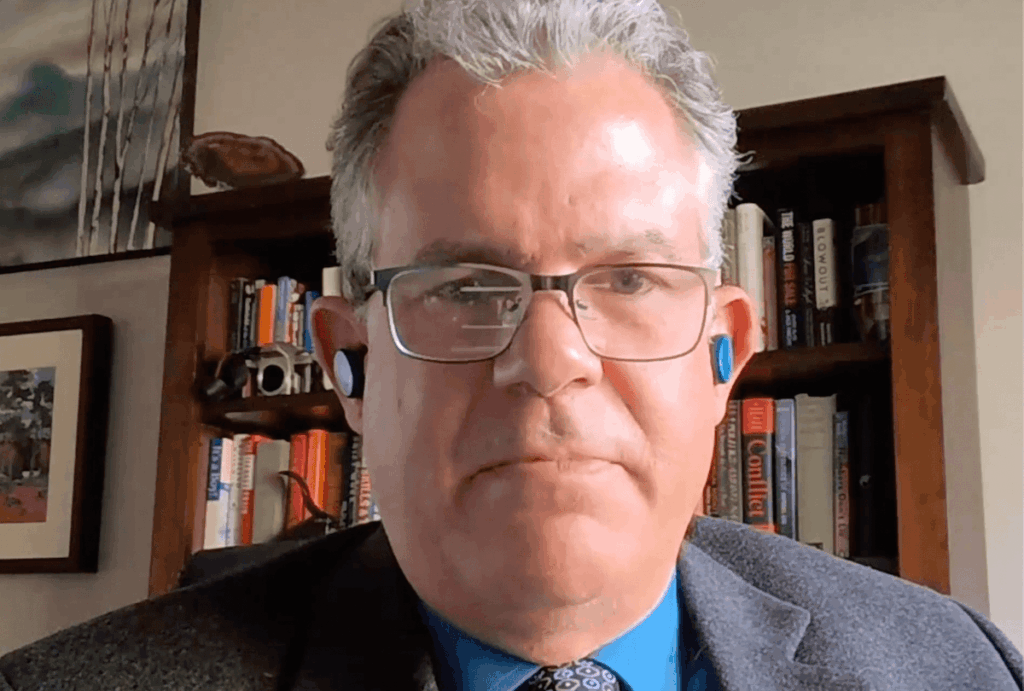
David Detomasi, Professor, Queen’s University Smith School of Business
By Resource Works
More News and Views From Resource Works Here
A professor who won’t drop the hard questions
David Detomasi has spent his career probing what he calls “the most politically consequential business in human history”: oil and gas. A professor of international business at Queen’s University Smith School of Business, he studies how energy shapes power, geopolitics and everyday life. His 2022 book, Profits and Power: Navigating the Politics and Geopolitics of Oil, set out to give readers a factual baseline before they choose their own views on the sector.
The conversation took place on the Power Struggle podcast, hosted by Stewart Muir. Watch the video on Power Struggle
Born in Calgary and raised in nearby Cochrane, he grew up assuming that living inside an oil economy was normal. It wasn’t until he went east for graduate school and then joined Queen’s that he realized many Canadians had no direct experience with the industry and were increasingly hostile to it. “People were yelling at me on the very first day about why are we studying this and this is bad,” he recalls of his classes.
In the conversation, Detomasi sounds less like an industry booster than a political realist. He accepts climate concerns as real and significant. But he insists that debates over Canada’s energy future must start with global facts: where energy comes from, who lacks it and how countries use it for leverage. His next book tries to answer four linked questions: what an energy superpower is, why Canada might want to be one, what it would take and how to explain that to Canadians.
“We have the ingredients” but not the story
Detomasi starts from a simple stock‑taking exercise. “We are the fourth-biggest producer of oil in the world, the fifth-biggest producer of natural gas,” he notes. Canada has hydropower expertise, emerging nuclear technology and some of the largest reserves on the planet. “We have the ingredients,” he says. “Some countries simply don’t have the ingredients and never will.”
So why isn’t Canada already what politicians have long promised – an “energy superpower”? The problem, he argues, is not geology but narrative and politics. For much of the Trudeau era, Ottawa saw energy “almost entirely through an environmental lens,” focusing on carbon and, to a lesser extent, impacts on Indigenous communities. That framing sidelined security and geopolitical considerations that dominate thinking in places such as Japan or Germany.
Becoming an energy superpower, he suggests, demands a long, patient project — not just slogans or a short-term export push. For now, he thinks many Canadians still hear a much narrower story: produce more, sell more, make Alberta richer and assume the benefits will trickle out somehow.
The world’s energy poverty and our comfortable blindness
Detomasi’s work returns again and again to one stark fact: “Two billion people in the world live in energy poverty.” Another roughly half of humanity has only intermittent or unreliable access to power. Only about one-quarter of the global population can count on energy “when and where they want.” He mentions unnamed African countries whose total electricity use matches “what California uses to heat its hot tubs.”
From Canada’s vantage point, this can be hard to grasp. Canadians flip light switches, fuel vehicles and run data centres with little thought about how any of it works or how vulnerable others are. “We are lucky in Canada in having so much of it,” he says. “Most people in the world don’t.” That comfort has allowed domestic politics to treat energy as optional, even undesirable, rather than as a foundational input into food systems, health care, industry and national survival.



For allies in East Asia, the calculation looks very different. Japan, for instance, must import almost everything it burns, and does so as an island state surrounded by powerful neighbours. South Korea and Malaysia face their own forms of exposure. Detomasi believes those countries would now pay something of a premium for reliability, especially after recent disruptions and Russia’s invasion of Ukraine. He even suggests they might help finance Canadian infrastructure in exchange for long‑term, secure supply.
Why the transition needs “everything”
In Detomasi’s classrooms, he sees many students arrive with what he calls a “four‑link chain” in their heads: net zero by 2050 means cutting carbon dioxide, which means less fossil fuel, which means stopping new oil and gas. The logic is tidy and emotionally powerful. It is also incomplete. “I think we’ve sold people a fairly simple belief that we can easily transition away from a carbon‑based era to one based on renewables,” he says. “We can do it quickly, we can do it relatively painlessly, and why haven’t we done it yet?”
The reality, as he sees it, is that global demand for energy “is going to go nowhere but up” for as far ahead as experts can see. Billions of people are still climbing the ladder to modern living standards. They will use more power to heat and cool homes, move around, run factories and feed themselves. In that world, he argues, “we’re going to need everything we can possibly get from any source for as long as we can see, globally speaking.”
Detomasi dislikes the domestic framing of energy politics as a zero‑sum game. A new pipeline isn’t a “win” for carbon any more than a new battery plant is a “win” for renewables. He sees that as a distraction from the harder question of trade‑offs: how to reduce emissions as fast as possible while also lifting people out of poverty and maintaining social stability. He pushes students, and by extension the public, to think in systems terms rather than in moral binaries.
The moral case for reliable Canadian energy
If Canada ever becomes an energy superpower, Detomasi insists, it will not be because it cleans up its own backyard and stops there. “What really matters for an energy superpower,” he argues, “is how you can influence someone else’s behaviour by how your behaviour works.” The key “someone else” in his mind is the big emerging economies – China, India, Southeast Asia – whose choices will swamp Canada’s emissions profile many times over.
He sketches three channels where Canadian policy could matter. First, by making customers richer through growth‑driving energy, which tends to increase willingness to pay for environmental protection over time. Second, by helping them switch from coal to natural gas and eventually to cleaner technologies, which offers the largest near‑term emissions gains. Third, by providing reliable, rules‑based supply so governments can plan decades ahead rather than lurch from crisis to crisis.
That reliability is not just an engineering attribute but a moral one in a world where crop failures, rationing and stalled development are live fears. Detomasi is wary of crude branding exercises. But he does think there is a “moral case for Canadian resources” rooted in stability, governance and an ability to improve outcomes abroad. The challenge is persuading both Canadians and foreign buyers that it is worth paying, and sometimes paying more, for that package.
Politics, pipelines and the next generation
None of this, in Detomasi’s view, can happen without more muscular political leadership at home. He sees Prime Minister Mark Carney’s recent rhetorical shift toward energy security as genuine, but warns that words must turn into concrete decisions. That likely means the federal government will have to take real financial risk on major projects such as new pipelines given the country’s topography, past cancellations and cautious shareholders.
Such moves would trigger resistance on at least two fronts: from the progressive wing of the governing party, where some members sincerely want to stop further fossil development, and from an impatient Alberta, where some now flirt with separatism. Equalization politics, old arguments about “petrodollars” and regional resentments all colour the debate. Detomasi does not downplay those tensions. He simply argues they should be fought on updated facts, not outdated narratives about Dutch disease or a looming petro-state.
He also spends time thinking about younger Canadians, who will inherit both the climate file and the infrastructure they decide to build or block. Many, he says, arrive in his classes “crises‑ed out,” overwhelmed by social media feeds full of environmental, housing, drug and geopolitical emergencies. His goal is to give them a clearer map of reality and a bit of hope that “there is a future for you” in solving hard problems rather than retreating from them.
Detomasi’s own future work will test whether that conversation can scale beyond the classroom. His next book aims to give Canadians a story about energy that is big enough to hold climate risk, global poverty, national prosperity and geopolitical responsibility at the same time. Whether readers embrace that story or reject it, he seems intent on making sure the argument, at least, runs on facts rather than comforting myths.
- Power Struggle audio and transcript
- Power Struggle website
- David Detomasi on LinkedIn
- Stewart Muir on LinkedIn
- Stewart Muir on X
Power Struggle on social media:
- Power Struggle on LinkedIn
- Power Struggle on Instagram
- Power Struggle on Facebook
- Power Struggle on X
Ian Biana writes for the Resource Works Accelerate team and can be reached at [email protected].
Share This:






















On The Verge: Energy Sector Primed for New Wave of Growth – ATB Economics