


 CDN NEWS |
  US NEWS







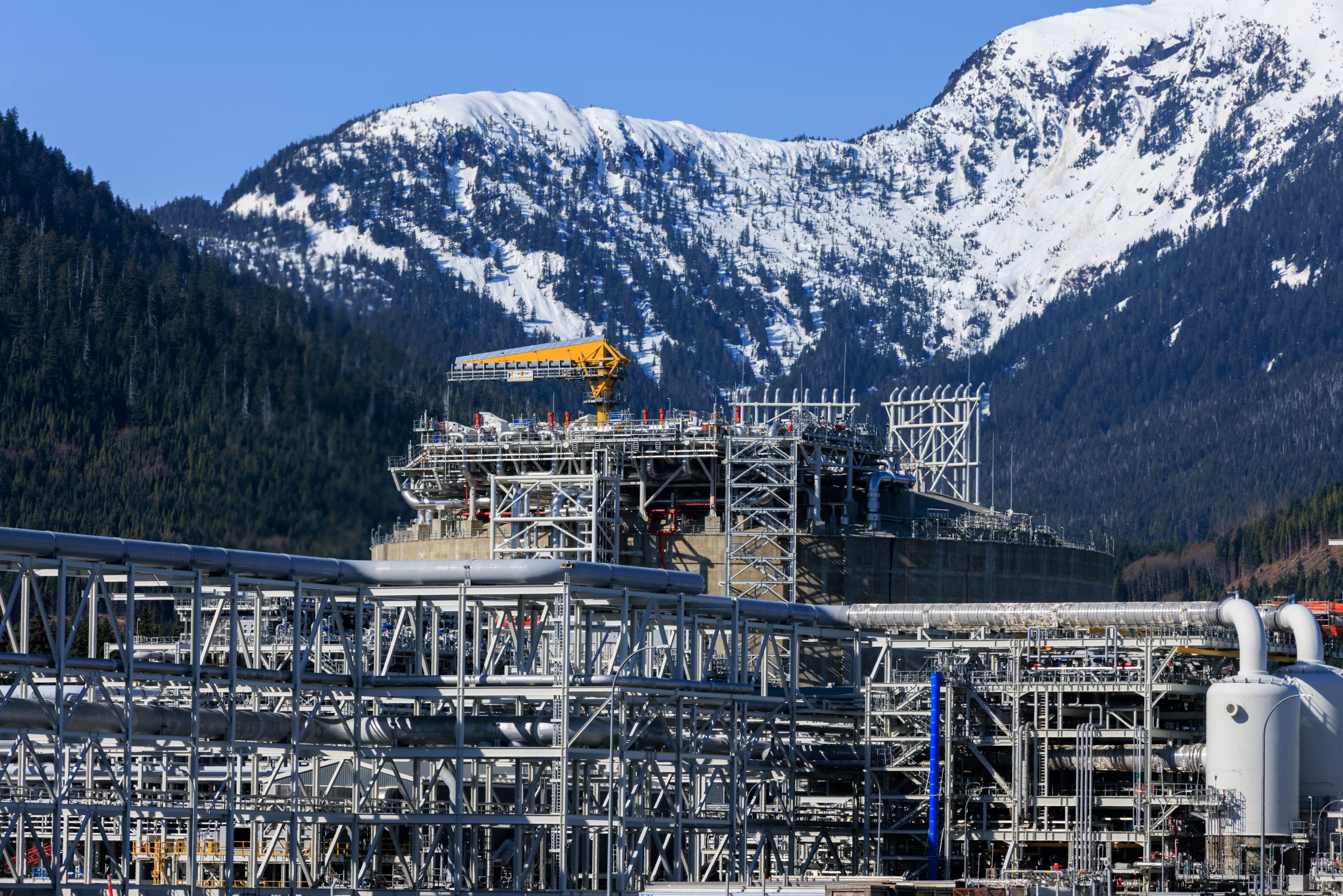
| Shell is exploring the sale of its 40% operating stake in LNG Canada, attracting competitive interest from Apollo, Blackstone, and KKR. Canadian pension funds are natural buyers for an asset that generates contracted revenue over decades. This analysis examines the ownership transition, the investment fundamentals, the breadth of Indigenous economic participation, and the global market context that makes LNG Canada the most significant energy infrastructure asset in Canada. |
The asset
LNG Canada Phase 1 is operational at Kitimat, British Columbia, with a nameplate capacity of 14 million tonnes per annum. First export cargo shipped in 2025. Coastal GasLink, the 670-kilometre pipeline connecting northeast B.C. gas supply to the terminal, is complete and flowing.1 Phase 2, which would double capacity to 28 MTPA, is before the federal Major Projects Office.
Phase 1 Capacity
14 MTPA, operational
Phase 2 (proposed)
14 MTPA additional
Coastal GasLink
670 km, complete and flowing
Shell Stake (for sale)
40% operating interest
Total Project Cost
~C$40 billion (Phase 1 + CGL)
First Nations Agreements
20 nations along CGL corridor
The buyers and their motivations
When we think about projects like LNG Canada, the headlines are usually about the physical infrastructure: the terminal, the pipeline, the ships. But none of it gets built without money, and in today’s world, where that money comes from is a global story. The capital behind a facility in Kitimat may originate in a pension fund in Sacramento, a sovereign wealth fund in Abu Dhabi, or a retirement savings plan in Leeds.
Understanding who is investing in LNG Canada, and why, matters as much as understanding how the gas gets from the Montney to the Pacific. Shell’s stake has drawn interest from a specific class of investor: large-scale infrastructure capital with long holding periods.2 LNG export facilities generate contracted revenue over decades, making them structurally attractive to investors who match long-duration assets against long-duration liabilities. This report profiles some of the Canadian and international infrastructure funds and pension plans that made LNG Canada possible.
Apollo Global Management
Apollo is a publicly traded firm (NYSE: APO) managing approximately US$700 billion in assets. It was co-founded by Marc Rowan, who serves as CEO and Chair. Apollo is not a private or secretive entity. It is regulated by the SEC, files quarterly earnings reports, and its shares are held by institutional investors worldwide. Its clients include public pension systems, corporate plans, sovereign wealth funds, insurance companies, endowments, and foundations across six continents. CalPERS has invested through Apollo funds.
In 2025, Aviva selected Apollo to manage capital under its default pension strategy for millions of U.K. savers. Apollo’s infrastructure platform targets contracted cash flows in developed markets, including water utilities, fibre-optic networks, and port infrastructure. Its interest in LNG Canada is consistent with that mandate: a built, operating terminal generating stable revenue over a multi-decade horizon.
Blackstone
Blackstone is the world’s largest alternative asset manager, with over US$1 trillion in assets under management. It is publicly traded (NYSE: BX) and led by co-founder Stephen Schwarzman as Chairman and CEO. Blackstone Infrastructure Partners raised US$14 billion in its inaugural fundraising from a base of public and private pension plans, sovereign wealth funds, insurance companies, and foundations. CalPERS has committed billions to Blackstone-managed funds across real estate and infrastructure. Blackstone’s infrastructure strategy focuses on operational assets with inflation-linked revenues across transportation, energy, communications, and utilities.
Blackstone’s infrastructure portfolio includes Invenergy, the largest independent renewable power generator in the United States, and a joint venture with NextEra Energy, the world’s largest developer of wind and solar energy. It has committed up to two billion euros to Eurowind Energy, a pan-European renewables developer, and raised US$5.6 billion for an energy transition-focused fund. LNG Canada sits alongside these assets in an infrastructure portfolio that spans the full energy spectrum.
KKR
KKR manages approximately US$600 billion in assets and is publicly traded (NYSE: KKR). Its Global Infrastructure Investors funds have raised capital from public and corporate pension plans, sovereign wealth funds, insurance companies, and foundations. KKR’s investor base includes state retirement systems, university endowments, and healthcare pension funds across North America, Europe, and Asia. The firm raised US$2.7 billion for its Global Climate Transition strategy and invests in renewable power, grid modernisation, and energy storage alongside conventional infrastructure.
KKR is already a co-owner of Coastal GasLink alongside AIMCo3, which manages over $115 billion on behalf of 31 Alberta pension, endowment, and government funds, including the pensions of Alberta’s public servants, teachers, and local authority employees. KKR’s interest in the LNG terminal itself would extend an existing position in the integrated LNG value chain from wellhead to tidewater.
Canadian institutional investors
Canadian pension funds are a natural class of buyer. AIMCo already has CGL equity. CPPIB, BCI, CDPQ, OTPP, OMERS, and HOOPP all hold energy infrastructure in other jurisdictions. Collectively, these funds manage the retirement savings of millions of Canadians. Their infrastructure portfolios already include toll roads, airports, water systems, electricity transmission, and renewable energy platforms in Australia, Europe, Latin America, and the United States. A Canadian LNG allocation provides geographic diversification within a familiar asset class and brings pension capital home to an asset built in this country. This is exactly the kind of long-duration, revenue-generating infrastructure that pension funds exist to hold.
Why LNG Canada attracts capital
- Construction risk retired. Phase 1 is built and operating. CGL is complete. The multi-billion-dollar construction phase is behind the project.
- Contracted revenue. Output committed under long-term Asian supply agreements. Multi-year contracts providing revenue visibility across commodity price environments.
- Feedstock security. The Montney formation is one of the largest, lowest-cost gas basins in North America. Dedicated pipeline. Decades of production capacity.
- Pacific Basin access. Only operating LNG terminal on Canada’s Pacific coast. Shipping advantage to NE Asia versus Gulf Coast (Panama Canal) or Middle East (Hormuz).
- Phase 2 optionality. A Phase 1 stake carries embedded optionality in Phase 2 at substantially lower development risk than greenfield.
Indigenous economic participation
Twenty First Nations along the CGL corridor signed benefit agreements with the project, providing revenue sharing, employment guarantees, and contracting preferences4. These are the largest set of Indigenous benefit agreements associated with a single infrastructure project in B.C. history. The Haisla Nation is building Cedar LNG, a floating LNG facility adjacent to LNG Canada and the first major Indigenous-owned LNG export project in Canada.5 In 2025, the federal Indigenous Loan Guarantee Program backstopped 38 B.C. First Nations acquiring a 12.5% equity stake in Enbridge’s Westcoast pipeline system.6



Ksi Lisims LNG, proposed for the Nisga’a Nation’s treaty lands near the Portland Inlet, represents another dimension of Indigenous-led energy development. The project is structured as a partnership between the Nisga’a Nation and Western LNG, with the Nisga’a holding a direct equity stake. If built, it would be the first LNG export terminal sited on Indigenous treaty lands in Canada. The direction of travel is from benefit agreements to direct ownership.
Not all Indigenous voices support LNG Canada. Hereditary leaders of some Wet’suwet’en clans have opposed Coastal GasLink. Their perspectives are entitled to respect. They do not represent all Wet’suwet’en people, nor the twenty nations with benefit agreements, nor the Haisla, nor the 38 nations now holding upstream equity. Indigenous economic participation in LNG infrastructure is growing, not contracting.
The global LNG market
Global LNG trade has grown in every decade since its inception. The IEA projects natural gas will remain the largest single source of electricity generation globally through 2050.7 Asian LNG demand is the primary driver: Japan, South Korea, China, India, and ASEAN are all significant and growing importers.
New supply from the U.S., Qatar, Mozambique, and Canada is sometimes characterised as oversupply. A more precise reading is that buyers now have more choices. Short-term price volatility is inherent to commodity markets. The relevant question is whether long-term contracted demand supports the asset over its multi-decade life. Every major energy forecaster says yes.
Natural gas produces approximately half the CO2 of coal per unit of electricity, with substantially lower particulate, sulphur, and nitrogen oxide emissions. Canadian LNG displacing Asian coal reduces global emissions.8 The Iran conflict has intensified attention to supply security, adding a geopolitical diversification premium to Pacific-origin LNG.
What this means for British Columbia
LNG Canada is the anchor of a regional economic transformation in northern B.C. Thousands of construction jobs have transitioned to hundreds of permanent operational positions. Government revenue from LNG facility taxes, carbon tax, and royalties will be measured in billions over the facility’s operating life. Twenty First Nations are receiving revenue, funding community infrastructure, and building administrative capacity.
The upstream gas economy
LNG Canada does not exist in isolation from the upstream gas sector that feeds it. The Montney formation of northeast B.C. supports annual capital spending of $8 to $10 billion across producers including Tourmaline, Ovintiv, ConocoPhillips, CNRL, and Shell (which is acquiring ARC Resources). The cumulative installed infrastructure in wells, gathering systems, processing plants, and compression represents an investment base exceeding $50 billion.
This upstream sector employs thousands of workers in the Peace River region and generates billions in annual production revenue and government royalties. LNG Canada is the demand anchor that underwrites continued upstream investment: without a Pacific export market, northeast B.C. gas competes solely for continental demand against lower-cost U.S. shale. The terminal converts a landlocked commodity into a globally traded one, raising the value of every molecule produced in the basin.
Propane, LPG, and the liquids spinoff
Not all natural gas formations are equal. The Montney, which is the source formation for Coastal GasLink and LNG Canada, is unusually rich in natural gas liquids. When Montney gas is processed, it yields significant volumes of propane, butane, condensate, and other liquids alongside the methane destined for the LNG terminal. This is a geological characteristic of the formation itself. Other major gas basins produce comparatively dry gas. The Montney does not. That distinction has created an entire parallel export industry.
AltaGas operates the Ridley Island Propane Export Terminal at Prince Rupert, shipping propane and LPG directly to Asian markets. The terminal exists specifically because the Montney produces liquids-rich gas in volumes that justify a dedicated export facility. As Montney production has scaled to meet LNG demand, the volume of liquids available for separation and export has grown with it. Prince Rupert has become a new trade hub for propane and LPG, a sector that barely existed in northern B.C. a decade ago. The economics are favourable: Asian propane prices carry a premium over North American prices, and Prince Rupert offers a shorter shipping route to Northeast Asia than any U.S. Gulf Coast or Middle Eastern competitor. Additional liquids fractionation and export capacity is under development.
The relationship is direct: LNG development drives Montney production, and Montney production yields liquids. More LNG terminals mean more gas processing, which means more propane, butane, and condensate flowing to Prince Rupert. Cedar LNG, Ksi Lisims LNG, and any Phase 2 expansion at LNG Canada would each increase upstream throughput and, with it, the liquids stream available for export. The northern B.C. corridor is becoming not just an LNG export hub but a diversified hydrocarbon export complex, with the Montney’s liquids-rich geology as the foundation of a trade sector that serves multiple Asian commodity markets simultaneously.
The emerging corridor
The project has catalysed broader investment across the northern corridor: Cedar LNG at Kitimat, Ksi Lisims LNG on Nisga’a treaty lands, port expansion at Prince Rupert, and supporting infrastructure throughout the region. LNG Canada is not an isolated facility. It is the foundation of an emerging industrial corridor from the Alberta border to tidewater, in which First Nations—the Haisla at Kitimat, the Nisga’a at the Portland Inlet, and the twenty nations along the pipeline corridor — are not bystanders but partners and, increasingly, owners. The corridor serves a region with more than $200 billion in operating and planned investment across LNG, upstream gas, propane and LPG export, critical minerals, forestry, and clean energy.
- LNG Canada, project overview and ownership structure. Shell (40%), Petronas (25%), PetroChina (15%), Mitsubishi (15%), Korea Gas (5%). ↩︎
- Reuters, Bloomberg, and Financial Post reporting, May-June 2026, on Apollo, Blackstone, and KKR competitive interest in Shell’s LNG Canada stake. ↩︎
- AIMCo and KKR co-ownership of Coastal GasLink pipeline. AIMCo annual report and KKR infrastructure portfolio disclosures. ↩︎
- Coastal GasLink benefit agreements with 20 First Nations along the 670 km pipeline corridor. TC Energy project disclosures. ↩︎
- Cedar LNG: Haisla Nation-led floating LNG facility, Kitimat. Environmental assessment approved. Advancing toward construction. ↩︎
- Federal Indigenous Loan Guarantee Program: $400M guarantee supporting 38 B.C. First Nations acquiring 12.5% equity in Enbridge Westcoast pipeline. May 2025. ↩︎
- IEA World Energy Outlook, Stated Policies Scenario: natural gas remains the largest single source of electricity generation globally through 2050. ↩︎
- Natural gas produces approximately 50% less CO2 than coal per unit of electricity generated, with substantially lower particulate, SO2, and NOx emissions. IEA, NRCan. ↩︎
Share This:





















INSIGHT: Canada’s Economy Falling Behind Despite Misleading Headlines – Fraser Insitute