


 CDN NEWS |
  US NEWS








By Jim Warren
Just one month ago, US President Donald Trump signed an order granting a cross-border permit to a pipeline project that could transport up to 550,000 barrels per day (bpd) of diluted bitumen (dilbit) from Hardisty, Alberta to Guernsey, Wyoming. The project, officially referred to as the Prairie Connector, will resurrect a large section of TransCanada Pipeline’s ill-fated Keystone XL pipeline.
Trump’s April 30 announcement has, no doubt, encouraged those Canadian oil industry analysts who argue that the 1.0 million bpd in new export capacity imagined in the Alberta-Ottawa pipeline MOU can be met and potentially exceeded by other means.
Two of the alternatives expected to reduce the necessity of building a new oil pipeline to Canada’s West coast involve projects that will increase exports to the US. Obviously, one of those alternatives is the newly permitted pipeline to Guernsey, Wyoming. And, a number of observers have speculated that Enbridge Pipelines will likely contribute to increasing exports to the US by making upgrades to its existing North American pipeline network.
Another addition to export capacity is planned by the Trans Mountain Corporation (TMC), which transports Alberta dilbit to its Pacific coast terminal at Burnaby, B.C. TMC claims to be in the process of making changes to its system that will increase the volume of oil it can transport by 360,000 bpd. That will increase its total capacity to 1.25 million bpd. While some of the oil transported by TMC may find its way to US refineries, much of it will be destined for the Asia Pacific region.
The Prairie Connector announcement is viewed as good news by pundits who imagine a pipeline guaranteed by an autocratic US president is more likely to get built than the one contemplated by the Alberta-Ottawa MOU. There are a lot of people on the Canadian prairies who don’t believe our prime minister really wants to see a new oil pipeline to the Pacific built. They argue that, as currently conceived, Mark Carney’s vision for the new pipeline promises to produce little more than a commercial disaster.
No worries, prominent industry analysts like Ron Wallace suggest the new export opportunities already in the works (i.e. increasing exports to the US and tweaks to the TMC) will reduce the urgency over getting a new pipeline to Canada’s Pacific coast—at least in the short-run.
Not so fast.
Other credible industry observers contend we still need to build that pipeline from Alberta to the Pacific because the approval awarded by one president can turn into a cancellation by the next.
Recent experience has shown getting pipelines built in the US, even with presidential support, is by no means a sure thing. The sorry fortunes of the Keystone XL provide a good case in point.
The Ill-Fated Keystone XL
TransCanada Pipelines’ Keystone pipeline was completed in 2010. The Keystone line transports 591,000 bpd of dilbit from Hardisty, Alberta to Steele City, Nebraska and from there to a transit hub at Patoka, Illinois. In June 2008, TransCanada sought regulatory approval for a second large pipeline that would transport 890,000 bpd of crude from Alberta to the US, that’s 51% more per day than the capacity of the original Keystone line. The newly proposed pipeline was the ill-fated Keystone XL.
The XL would take a more direct route south from Hardisty to Steele City than the original Keystone line. When completed it would be connected to other TransCanada pipelines that would carry the diluted oil sands crude to refiners in the US Midwest and the Texas Gulf Coast.
Getting the XL approved along its intended right of way in the US presented TransCanada with an avalanche of problems. There were several litigations launched by environmental activist and indigenous groups, protests along the right of way, and regulatory approval hurdles thrown up by the courts along with state and municipal governments.
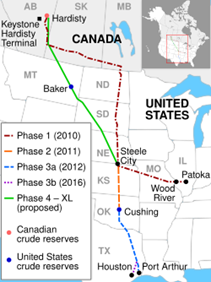
Keystone Pipeline system including completed sections (phases 1, 2, 3a, 3b) and the cancelled XL section (phase 4).
Source: Wikimedia Creative Commons file
The problems confronted by the XL project far surpassed the approval challenges faced by the original XL line. The reason for the difference is that by the time the XL was seeking approval the international environmental movement had launched its well-financed anti-Alberta oil sands campaign. Alberta’s oil sands became the focus for environmentalists who argued that the energy used to separate oil from sand made Alberta’s oil the dirtiest in the world.
Somehow TransCanada found the patience to cope with the challenges noted above for six years. In fact, litigation, protests and regulatory SNAFUs alone didn’t kill the XL. It required climate alarmists in two Democratic administrations to kill the pipeline—and they did it twice.
The Keystone XL was first approved in 2008 by the Steven Harper and George W. Bush administrations. On the advice of the US State Department, and its boss, John Kerry, the Obama administration killed the pipeline in November 2015. Donald Trump brought the project back to life during his very first week as president in January 2017. Joe Biden re-cancelled the pipeline the same day he was sworn in as president in January 2021. Biden’s decision turned out to be the final nail in the XL’s coffin. TransCanada had had enough—who could blame them for finally throwing in the towel?
There you have it, the XL was killed twice by the Democrats and revived once by the Republicans. Trump’s May 30 announcement constitutes his second effort to resurrect the XL, or at least a reasonable facsimile of it.
It is not for nothing that, Calgary Herald columnist , Chris Varcoe referred to the original Keystone XL project as the “Zombie Pipeline.”
Many of the same barriers to building oil pipelines in the US that frustrated and finally killed the original Keystone XL are still with us today. The anti-oil propaganda machine operated by environmental extremists is already getting fired up to attack the Prairie Connector. This past May, the influential environmental activist publication grist.org and the Corporate Knights (a publication which advocates for sustainable development) ran a lengthy feature article criticizing the project—A family of Wyoming oil tycoons is trying to revive Keystone.



No surprise, the article includes several misleading and factually incorrect statements about Alberta’s “Tar Sands.” It also describes presumably nefarious connections between the proponent for the US portion of new pipeline, the Bridger Pipeline LLC and Wyoming’s Republican Party.
Bridger Pipeline is owned by the True family. The company’s founder and family patriarch H.A. “Dave” True was a wildcatter who got into the oil business in Wyoming in the 1940s. The environmentalists’ criticism of Bridger claims the company has had 42 reportable oil spills since 2010. A listing of oil spills that have allegedly occurred on the company’s pipelines or oil production facilities.
The grist.org/Corporate Knights article provides a few details for three of the spills. The most serious of them deposited 30,000 gallons of oil into the Yellowstone River. “The town had to truck in bottles of drinking water after some residents noticed an odor in their tap water.”
For 39 of the alleged oil spills, they do not report the volumes involved or how promptly and effectively Bridger might have dealt with them. What caused them and how much any of them might have harmed the environment is not mentioned. That depth of assessment isn’t required by climate change crusaders and environmental zealots who view oil as inherently bad–any amount must be hazardous. The same article claims that because the new pipeline may be carrying oil from the “Tar Sands… the environmental consequences of a spill could be dire.”
Project Fundamentals
The pipeline proposal approved by Trump on April 30 is a partnership between the Canadian pipeline operator South Bow and the Wyoming-based Bridger Pipeline. The project is officially referred to as the Prairie Connector. However, friends of the proposed pipeline in the US sometimes refer to it as the “Bridger Prairie Connector.” Environmental activists are calling it “Keystone Light,” a name that hearkens back to their successful campaign to have the pipeline cancelled–twice.
South Bow is the pipeline subsidiary of the company formerly known as TransCanada Pipelines (which now calls itself TC Energy). In Canada, the Prairie connector will revive TransCanada’s 327 mile route for the original XL line from Hardisty, Alberta to the US boundary at the Monchy, Saskatchewan border crossing. Some 93 miles of pipeline was already built along that route prior to the 2021 cancellation of the XL. The buried pipe will be resurrected as part of the completed Prairie Connector.
Bridger will build the 622 miles of new pipeline running from Monchy to Guernsey, Wyoming. From Guernsey, the Canadian dilbit will be transferred to new and existing lines connected with pipeline networks capable of delivering it to refineries in the US Midwest and on the Gulf Coast.
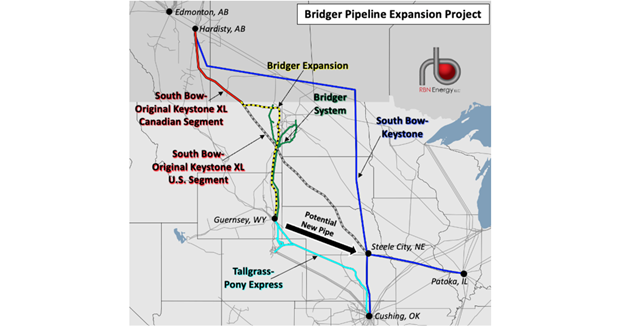
The map identifies the South Bow and Bridger contributions to the Prairie Connector pipeline, the original Keystone pipeline and the route of the US section of the cancelled Keystone XL.
A project blessed by Trump and Carney: What could possibly go wrong?
The first step on the path toward Donald Trump’s April 30 approval of the Prairie Connector pipeline was taken on Tuesday October 7, 2025. That was the day Mark Carney tacitly admitted he was having serious difficulty getting a new oil export pipeline built connecting Alberta to Canada’s West coast. He needed Trump’s help if he wanted to launch a pipeline in the foreseeable future.
The handshake sealing the two leaders’ intention to resurrect the Keystone XL took place in the president’s extremely gilded Oval Office.

Carney and Trump shake hands for the cameras at the Oval Office. CBC News photo Oct, 7 2025
https://www.cbc.ca/news/politics/carney-trump-keystone-revival-1.7653949
Thanks to President Trump there has been some progress on the regulatory front, i.e. the April 30 permit.
You’d think our prime minister would be embarrassed for failing to provide the tax and regulatory environment required to interest private investors in a new oil pipeline to the Pacific coast of the country he leads. Perhaps no less embarrassing, he has been required to put his elbows down and thank his tariff-imposing nemesis, Donald Trump, for approving the resurrected version of Keystone XL.
Despite the permit being issued, huge questions still need to be answered. Can Trump actually push the Prairie Connector through to completion before he leaves office in January 2029? We’ve already seen that environmental activists will be doing their utmost to get the project cancelled—lawsuits and protests galore can be expected. Despite Trump’s autocratic tendencies he has been generally careful to abide by the Courts of Appeals and Supreme Court decisions, suggesting some of the lawsuits could prove seriously disruptive.
Furthermore, Trump has infamously weaponized inconsistency when it comes to abiding by previously announced policy positions. He loves the pipeline today. Will he like it as much the next time he imagines Carney or Doug Ford have disrespected him?
Regardless of the political climate in the US today it is entirely within the realm of possibility that a Democrat will win the 2028 Presidential Election. Will the Democrats’ time out of office have had a moderating effect on their positions in favour of the green transition and radical emissions reduction policies? Not likely.
The resurrection of the XL project may have begun. But, hard experience shows lots can go wrong between now and the pipeline’s completion.
It seems to aptly describe the status of Keystone XL, North America’s Zombie pipeline.
Such is the current status of the Prairie Connector. Maybe we shouldn’t give up on demanding a new pipeline to the Pacific just yet.
Follow Jim Warren’s political, economic and social commentary on Substack.
Share This:






















On The Verge: Energy Sector Primed for New Wave of Growth – ATB Economics