


 CDN NEWS |
  US NEWS








Two-thirds among both rural & urban Canadians say they would oppose a data centre where they live
June 2, 2026 – As the federal government prepares to unveil its national artificial intelligence strategy this week, Canadians are asking governments to take a firm hand with the technology, while at the same time expressing profound doubt that public institutions are equipped to move quickly enough to keep up.
New data from the non-profit Angus Reid Institute finds two-thirds of Canadians (68%) adamant that it is the place of government to heavily regulate AI and tech companies, even if doing so slows development. One-in-six (16%) disagree and say that the government should leave this up to tech companies to self-regulate.
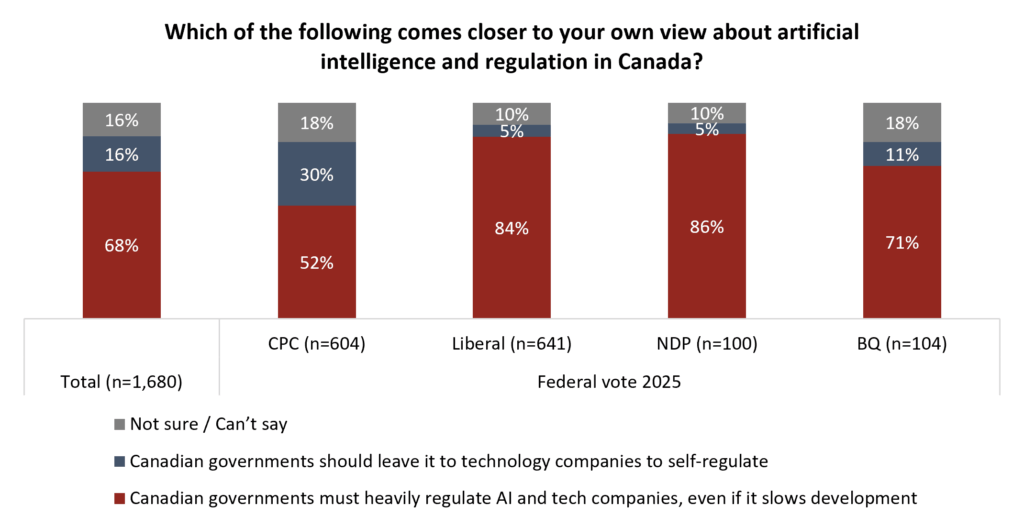
But with technology and implementation changing rapidly, many Canadians are even more skeptical of government’s ability to both regulate and successfully utilize AI. Three-quarters (74%) say no government is truly equipped to regulate AI quickly enough to keep pace with the technology while just 14 per cent have faith that it can be done.



Alongside this, seven-in-10 (70%) say Ottawa should be cautious about adopting AI because of the risk of unintended consequences, rather than actively investing in it to streamline public services and operations. The federal government has already announced both private and public integration of AI, with scaling being a significant priority in the coming years.
Canadians are also wary of the physical infrastructure required to power the AI boom. While nearly half (46%) say Canada needs domestic AI infrastructure to keep digital services under Canadian control, two-thirds (68%) would oppose a large AI data centre being built within a few blocks of where they live.
Majorities also say such facilities would be bad for energy and environmental sustainability (67%) and for neighbourhoods and surrounding communities (63%). With protests popping up in Vancouver after Telus announced two data centres in Metro Vancouver, these data underscore the forthcoming challenges facing governments and industry as they try to sell AI as both an economic opportunity and a public-interest project, while also reassuring wary populations their worst fears will be addressed.
More Key Findings:
- Asked about the economic benefits of data centre construction and positioning, enthusiasm is muted. Three-in-10 (29%) say this would be good for the businesses and economy in those areas, while 36 per cent disagree. Many are uncertain (35%)
- The strongest case for data centres, according to Canadians, is Canada’s ability to compete in AI and tech. Two-in-five (38%) say this would be a benefit of investing in data centres, while one-in-five disagree (20%). Again, a massive portion of the public is unsure (42%)
- Worry about jobs remains a huge obstacle to any government or company pushing for more AI integration. Asked about the impact of AI over the next decade, 45 per cent of Canadians say it will lead to significant job losses, while just three per cent say it will lead to significant gains. Another two-in-five (41%) expect mixed results with some added and some lost.
Link to the poll here: www.angusreid.org/
Share This:






















On The Verge: Energy Sector Primed for New Wave of Growth – ATB Economics