CDN NEWS |
  US NEWS







By Lennie Kaplan
Recent comments from Cenovus CEO Jon McKenzie, at the recent Global Energy Show suggesting that the Carney-Smith carbon tax will, in part, make the West Coast Oil Pipeline (WCOP) and the Pathways CCS Project uneconomic and uncompetitive appears to confirm my earlier fears about the impact of the Canada-Alberta MOU Implementation Agreement (IA) on the oil sands sector.
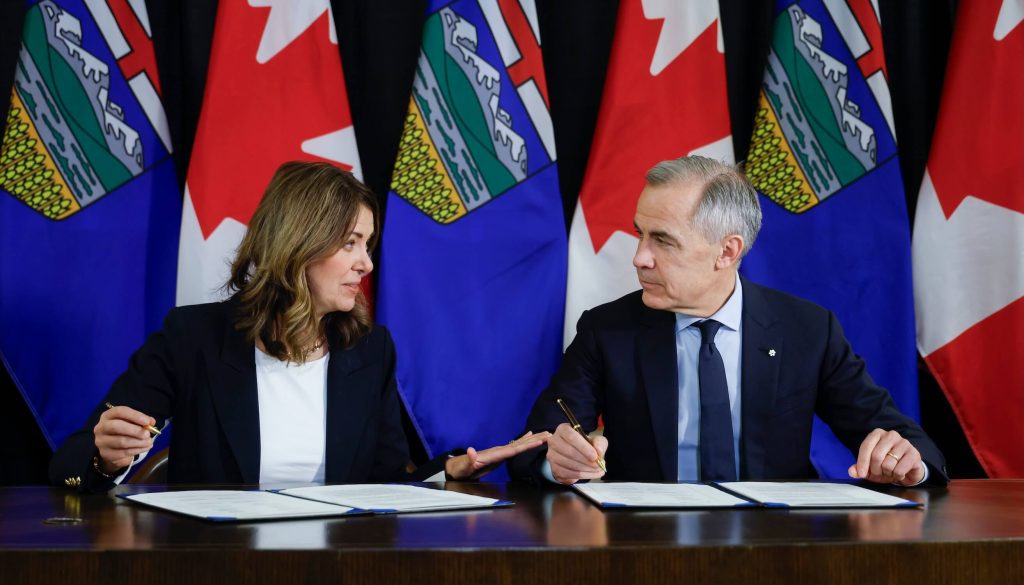
The misguided May 15 decision by Alberta Premier Danielle Smith to accept Ottawa’s demands to increase the province’s effective industrial carbon tax to $140 per tonne by 2040 will impose an estimated additional $33 billion in cumulative carbon costs (an average of $1.26 per barrel across all oil sands production) on the oil sands sector between 2030 and 2040. However, this initial $33 billion in estimated additional carbon costs is just a downpayment on an estimated $244 billion cumulative Alberta carbon tax bill (an average of $5.83 per barrel across all oil sands production) that will be imposed on the oil sands sector between 2030 and 2050. The estimated $244 billion carbon tax bill on the oil sands sector comes from full implementation of the Carney-Smith net zero emissions (NZE) agenda.
The $244 billion in cumulative additional carbon taxes between 2030 and 2050 could result in serious competitiveness issues for the oil sands sector possibly resulting in oil sands production constraints down the road, as oil prices eventually return to pre-Iran war levels.
It should be noted that average costs per barrel are costs across all oil sands production, and that marginal costs, the costs associated with producing one more oil sands barrel, probably is a better metric for making oil sands sector investment decisions, and will be higher than the average costs on a per barrel basis.
The results above are based on my preliminary modeling of the major elements of Prime Minister Mark Carney’s and Premier Danielle Smith’s May 15 agreement to escalate the Alberta carbon tax. They are based on a high oil sands production scenario, including new pipeline egress, as favoured by the Alberta government.
With the average supply costs for crude bitumen (mining and in-situ) projects sitting at between $62.50 and $66.50 Canadian per barrel, prior to the application of the latest rise in the Alberta carbon tax, a $5.83 per barrel average carbon cost increase under Carney-Smith NZE could drive oil sands project average supply costs up to between $68.35 and $72 35 per barrel. With oil prices eventually returning to pre-Iran War levels, this could be problematical for oil sands project economics, including net present value (NPV) and internal rates of return (IRR). The supply cost for an oil sands project is the minimum constant dollar price needed to recover all capital expenditures, operating costs, royalties, and taxes and earn a specified return on investment. The supply cost indicates whether the oil sands project is economically viable. This will have a knock off impact on the economic viability of both WCOP and Pathways CCS, as well.


Alberta’s rising carbon tax will take a greater bite out of oil sands total costs as the Carney-Smith NZE agenda is implemented. While the weighted average in oil sands supply costs have shown great improvement over the past two decades, a $5.83 per barrel increase in oil sands costs under the Carney-Smith NZE carbon tax could weigh heavily on over $150 billion in private sector investment decisions.
Oil sands companies make investment decisions, whether it be optimizations, expansions, or greenfields, pipelines, and emission reduction technologies based on a long-term planning perspective, not short-term gyrations in world oil markets, or some artificial deadline of a $140 carbon tax by 2040. Oil sands project have long-term production cycles and will be seeking clarity and certainty on Alberta’s carbon pricing regime between 2041 and 2050, before making final investment decisions. The Carney-Smith agreement on Alberta’s carbon pricing regime does not provide that clarity or certainty for oil sands producers, WCOP and Pathways CCS between 2041 and 2050.
The Alberta oil sands sector also competes for market share with other heavy oil grades, such as those found in some areas of the United States, in Russia, in Venezuela, and in Iran and Iraq, on costs and now on emissions intensity. Adding a new $5.83 per barrel cost to the costs already imposed on the oil sands through existing federal and Alberta government policies, rules and regulations could impact overall sector competitiveness, lead to some market share displacement, and result in constraints on oil sands production from business-as-usual (BAU).
The Alberta government knows full well the negative impacts of Carney-Smith NZE on industry competitiveness in terms of the increases to industry average and marginal costs arising from the application of the $140 carbon tax; effectively the precursor to much higher net zero Alberta carbon taxes, between 2041 and 2050, for industries, such as the oil sands. Since December 2025, Alberta Environment and Protected Areas (AEPA) have been conducting extensive modeling of the impact of the Alberta carbon tax on TIER compliance cost levels through 2050. But the Smith government will not share these documents with Albertans. Why?
In light of the negative impact on oil sands sector costs, and in the spirit of Alberta sovereignty within a United Canada, as championed by the Alberta government, the Carney-Smith NZE agenda, including its first act, the $140 Alberta carbon tax, must be put on the 2026 fall provincial referendum calendar. That way, Albertans can decide for themselves whether this perilous path towards NZE is worth pursuing.
I am confident that, when presented with full impact analysis information, including the impacts of Alberta NZE carbon taxes on industry costs and competitiveness, Albertans will tell the provincial government to scrap its commitment to NZE 2050 and come up with more realistic policies.
Lennie Kaplan was a senior manager in the fiscal and economic policy division of the Ministry of Treasury Board and Finance where he worked on cross-ministry initiatives evaluating the fiscal and economic impacts of federal and provincial energy and climate change policies.
Share This: