


 CDN NEWS |
  US NEWS







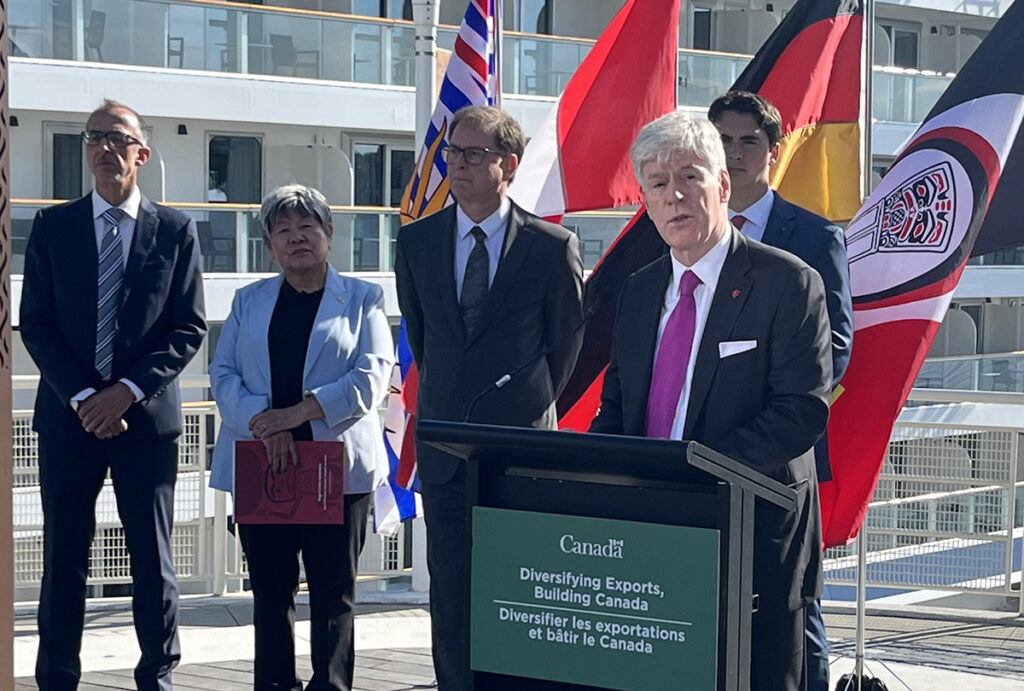
‘Canada and British Columbia are open for business’ — Natural Resources Minister Tim Hodgson. | Nelson Bennett Photo
By Resource Works
More News and Views From Resource Works Here
Reporters covering this morning’s press conference on a new 20-year offtake agreement between Ksi Lisims LNG and Germany’s SEFE might have wondered what the big deal was, especially given that it had been leaked the day before.
As Bloomberg reported yesterday, Germany’s SEFE (Securing Energy for Europe) has signed a 20-year offtake agreement with Ksi Lisims LNG for one million tonnes annually. Delivery to begin in the early 2030s.
That’s just 8% of Ksi Lisims’ nameplate capacity of 12 MTPA.
Shell and TotalEnergies also signed 20-year agreements with Ksi Lisims in 2024 and 2025 for 2 MTPA each, and there were no press conferences held for those agreements.
A premium for energy security
So what’s the big deal here? Why would a 1 MTPA offtake agreement warrant bringing in officials from Germany, Ottawa, Victoria and Nisga’a?
The big deal is what it signifies: Germany is so desperate for secure energy that it is willing to pay a premium for Canadian LNG to be shipped half-way around the world.
As Heather Exner-Pirot put it, “The risk premium is real.”
“Ladies and gentlemen, it’s clear: Canada and British Columbia are open for business,” federal Natural Resources Minister Tim Hodgson said this morning. “And ladies and gentlemen, the rest of the world is noticing.”
Global energy trade has become so fractured and uncertain by wars in Ukraine and Iran that Canadian energy – oil and gas – now has real environmental and risk premiums attached that Europeans are willing to pay.
Quebec eyes the LNG game
It’s so real, in fact, that Quebec apparently may now want in on the LNG game too. The Quebec government is now considering a proposal called Marinvest LNG.
That would be good for Western Canadian gas producers, because the gas for the Marinvest LNG project in Quebec would have to come by pipeline from Western Canada.
In reaction to today’s announcement, the Montreal Economic Institute (MEI) said it confirms long-term demand for Canadian LNG exports to Europe, and bolsters the argument for Norway’s Marinvest’s proposal.
“Stability and reliability are valuable when it comes to energy supply, and that is what Germany is reminding us of today,” said Gabriel Giguère, senior policy analyst at the MEI.
“If natural gas liquefaction terminals were to come online on the East Coast, it is clear that European buyers would take an interest, especially given the reduction in transportation costs that this would entail.”
The path to a final investment decision
Ksi Lisims LNG is still months away from a final investment decision on a project that is estimated to have a capital cost of $25 billion to $30 billion, including the Prince Rupert Gas Transmission line.
The offtake agreement announced today with SEFE brings the project a little closer to FID, but more offtake agreements will be needed.



I am told banks and investors will want up to three-quarters of production capacity spoken for through long-term offtake agreements before FID is taken.
But I wouldn’t be surprised to see other European buyers now signing offtake agreements with Ksi Lisims in the coming months.
“Our agreement with SEFE reflects growing
confidence in Ksi Lisims LNG, our commercial and engineering approach, and brings our
project a significant step closer to starting construction,” said Davis Thames, president of Western LNG, one of three partners in the Ksi Lisims LNG project.
Swapping cargos and global logistics
Just a few years ago, the primary market for Canadian LNG was Asia, and still is. But thanks to wars in Ukraine and Iran, the resulting energy crisis now has Europeans scrambling to secure natural gas from other, more reliable suppliers.
Getting the LNG to Germany from Prince Rupert may mean some carriers will have to transit through the Panama Canal. But some of those volumes may actually be swapped, Hodgson said.
He said the contracts are typically structured as free on board (FOB), which means the buyer takes possession of the cargo and can send it anywhere.
A Japanese buyer of an LNG cargo from the Middle East could swap that cargo, and have it go to Germany in exchange for an LNG shipment from B.C.
“If it’s on a smaller ship, it can flow through the Panama Canal,” Hodgson said. “If it’s a larger ship, it can go around South America or it could go around Africa. Or they could do what’s called a swap. That’s a common practice in global energy markets.”
Government backing and cleaner growth
Both the federal and provincial governments are fully behind the Ksi Lisims LNG project, which is among the B.C. projects included on the federal government’s Major Projects Office list.
“Once built, it will become Canada’s second-largest LNG facility, attracting nearly $30 billion in private sector investment and creating thousands of skilled careers for Canadians,” Hodgson said.
“It will contribute more than $15 billion in GDP to the Canadian economy in the coming 30 years.”
He also touted the fact that it will have some of the lowest carbon intensities in the world, owing to its electrification.
The B.C. government, through BC Hydro, is providing 600 megawatts of clean hydropower for the floating LNG facility, which will use electric drive.
Electrification means it will operate at 94% below the current global average carbon emissions intensity for LNG production, Hodgson said.
“This province is at the forefront of Canada becoming a clean and conventional energy superpower,” Hodgson said.
“It is also becoming a global example of a new model for energy development – one that prioritizes Indigenous partnership and cleaner growth.
“We are seeing unprecedented confidence in Canada as a place to invest.”
Nelson Bennett’s column appears weekly at Resource Works News. Contact him at [email protected].
Share This:






















On The Verge: Energy Sector Primed for New Wave of Growth – ATB Economics