


 CDN NEWS |
  US NEWS







Carney calls it ‘pragmatism,’ but deeper EU alignment could bury Canadian farmers, energy producers, and businesses under 170,000 pages of Brussels bureaucracy.
By Tammy Nemeth
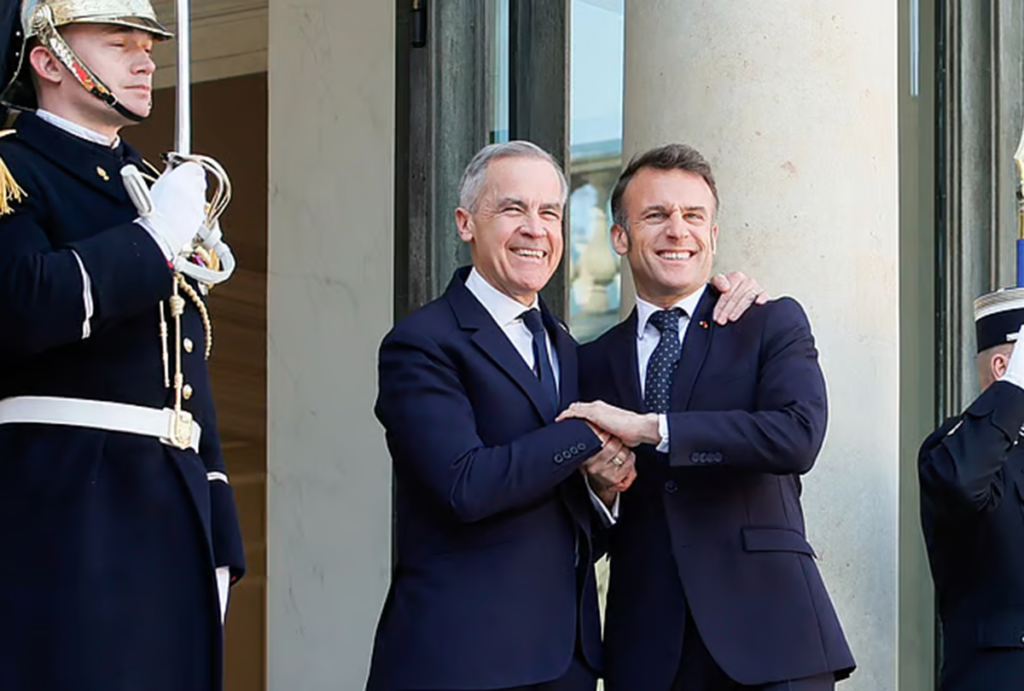
Prime Minister Mark Carney and French President Emmanuel Macron – Image courtesy of Twitter/X
Prime Minister Mark Carney made history last week as the first non-European leader invited to the European Political Community summit. His remarks were a familiar rehash of the bromides he delivered at Davos earlier this year: a world in “rupture,” the need to rebuild the international order “out of Europe,” and solemn warnings against a “transactional, insular, and brutal world.” He pushed for deeper integration in critical minerals, supply chains, and defence, as well as a new strategic partnership. Yet behind the lofty rhetoric lies a troubling reality. Carney claims to be guided by “pragmatism,” but his enthusiastic pursuit of deeper European Union (EU) alignment risks selling out Canadian sovereignty for a mountain of red tape and romantic symbolism.
The irony is difficult to ignore. Carney repeated in Armenia what he said in Davos, that “nostalgia isn’t a strategy.” Yet his approach to the EU reveals a deeply nostalgic, almost romantic view of Europe as a vibrant counterweight to North American realities. However, one need only look at the numbers to realize that Europe’s economy is in decline. Forecasts for 2026 project growth at 1% or less. Stagnation, demographic decline, high energy costs, and chronic competitiveness issues beset the EU. Why, then, would Canada seek tighter alignment with a bloc in decline when it already enjoys comprehensive trade access through CETA and ample multilateral channels?
Recent polls underscore public naivety about close ties to the EU. A Nanos Research survey for The Globe and Mail found nearly 60% of Canadians support or somewhat support Canada becoming a full EU member. A Spark Advocacy poll showed 25% view it as a good idea and 58% say it is worth exploring. Even some European publics in major member states lean favourably. These numbers suggest a mix of anxiety over US relations and a lack of debate about the practical downsides of deeper integration. For most Canadians, Europe conjures up pleasant notions of picturesque cities, good food, and beautiful architecture, with little awareness or understanding of the crushing regulatory machinery that would come with closer ties.
Canadian businesses should take note. On March 11, the European Parliament adopted a recommendation for enhanced EU-Canada cooperation, including regulatory alignment in trade, energy, environment, and other sectors. What would this mean in practice?



It means importing the full apparatus of the EU’s notorious model. As Andrew Coyne recently pointed out, full membership would require Canada to accept the full body of EU law, all 170,000 pages of it, with no permanent opt-outs from core climate policies. This includes the entire European Green Deal and the Fit for 55 package, which legally binds the EU and all member states to a 55% net GHG reduction by 2030 (versus 1990) and climate neutrality by 2050. New members must transpose directives into national law and apply regulations directly, often with only limited, temporary transition periods. For Canada, this would mean binding national targets on emissions, energy, transport, buildings, agriculture, and land use that override domestic priorities.
Adopting Mark Carney’s vision of deeper regulatory alignment with the EU would come at a steep cost to Canadian agriculture, particularly in the Prairie provinces. To meet the EU’s Green Deal and Farm to Fork targets, Alberta, Saskatchewan, and Manitoba farmers would face mandatory 50% cuts in pesticide use and risk, at least 20% reductions in fertilizer application, and a shift of agricultural land to organic production from under 5-10% today, all the way to 25% by 2030. Genetically modified canola, which dominates Prairie fields, would require costly segregation or outright phase-outs to satisfy the EU’s precautionary restrictions. Studies of similar policies project 10-20% yield declines, sharply higher production costs, and major economic hits to export-oriented operations already excelling in no-till soil conservation and carbon sequestration.
The oil and gas sector would fare no better. Fit for 55’s expanded Emissions Trading System (ETS), carbon pricing, methane rules, upstream caps, and the Carbon Border Adjustment Mechanism would pressure aligned countries toward equivalent standards. Alberta’s oil sands, with higher upstream emissions intensity, would face extra scrutiny under a precautionary philosophy often hostile to hydrocarbons, potentially encountering costly compliance rules, and de facto market barriers.
Mining, forestry, and petrochemical industries would also feel the pinch. Canadian mining, critical for Canada’s future in critical minerals, would confront the EU’s strict environmental impact rules and overlapping sustainability reporting that have stymied projects within Europe itself despite the bloc’s own Critical Raw Materials Act ambitions. Forestry would inherit the burdens of the EU Deforestation Regulation (EUDR), with its heavy due diligence and traceability requirements, which already impose compliance costs estimated at up to €2.6 billion annually across operators and threaten small-scale producers. Petrochemical and chemical sectors, already struggling in Europe, face the combined weight of ETS costs, REACH chemical regulations, and energy price disadvantages that have driven capacity closures and investment flight. The Draghi report and industry analyses are clear: excessive bureaucracy and regulatory layering have eroded Europe’s industrial edge in these exact sectors — precisely the flexible, export-oriented industries where Canada holds competitive advantages today.
Beyond these sectors, consider the broader package Canada would adopt: sweeping ESG rules like the Corporate Sustainability Reporting Directive (CSRD) and Corporate Sustainability Due Diligence Directive (CS3D) that impose massive Scope 3 tracking, human rights audits, and liability risks that burden value chains with paperwork and legal exposure. If Canadians think government red tape is bad now, EU-level bureaucracy is far worse. Even Europeans admit via the Draghi report that excessive rules and administrative burdens are strangling growth, yet the machine keeps adding layers. Canadian businesses would face ever-increasing compliance costs, slower innovation, and lost agility that far outweigh any marginal market access gains.
Carney bristles at flippant American talk of Canada as the “51st state,” yet he seems content to steer us toward becoming Europe’s twenty-eighth province — turning Canada back into a regulatory colony of distant bureaucrats. Canadians deserve better than imported stagnation dressed up as sophistication. Canada’s economic strength has always been its flexibility as a middle power, not its willingness to be an adjunct to Europe. Before we trade away that flexibility for nostalgia and symbolism, we ought to ask ourselves. Is this really in our national interest?
Tammy Nemeth is an energy analyst based in the UK.
Share This:






















INSIGHT: The Northern Shield Energy Corridor Provides Energy Security for All Canadians – Yogi Schulz