CDN NEWS |
  US NEWS







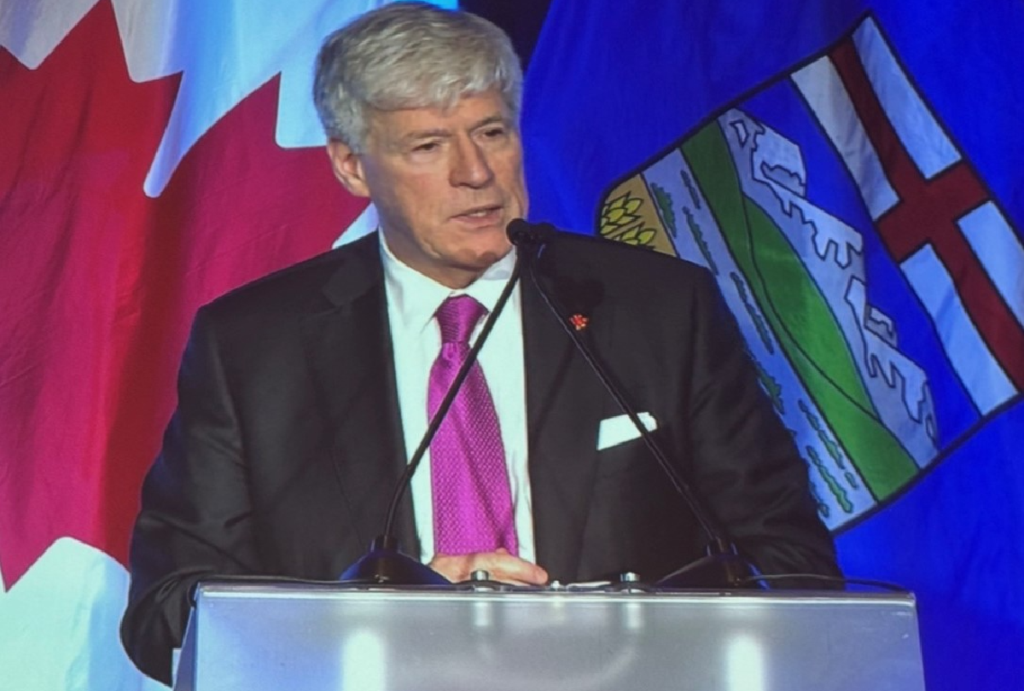
Minister of Energy and Natural Resources of Canada Tim Hodgson delivers a keynote address at the CAOEC Spring Luncheon in Calgary on May 1, 2026
By Yogi Schulz
At a May 1, 2026 luncheon hosted by the Canadian Association of Energy Contractors (CAOEC) and the Explorers and Producers Association of Canada (EPAC), Minister Tim Hodgson delivered a strong pro-energy message, emphasizing that Canada’s federal government now fully recognizes the energy sector as the driving force of national prosperity. He stated plainly that Canada is once again proud to be an energy superpower, with oil and gas forming the foundation of the national economy. He also mentioned emerging sectors such as hydrogen, helium, geothermal energy, and carbon capture, utilization, and storage (CCUS). The message was dramatically different from what Canadians heard from the previous Liberal government.
Minister Hodgson stressed in his keynote speech that energy contractors are central—not peripheral—to Canada’s economic success. He described drilling rigs and service rigs as the backbone of Canada’s energy security, noting that contractors not only build and maintain the country’s energy system but also reclaim sites responsibly after production. He praised the technical complexity, discipline, and safety culture required to operate successfully in the sector. He acknowledged the remote locations, narrow weather windows, and demanding conditions in which many energy production facilities operate.
A significant portion of his remarks focused on workers. On International Workers’ Day, Hodgson thanked the producers, rig workers, engineers, service crews, truck drivers, environmental specialists, and financial backers whose efforts support both family livelihoods and national prosperity. He noted that every active drilling rig supports about 250 full-time jobs across the well life cycle, while each service rig supports another 70 positions. Altogether, drilling and service rigs account for more than 80,000 Canadian careers. He also pointed out that these are long-tenure, highly skilled jobs, often sustained through apprenticeship and mentorship, and that they are especially vital in rural and Indigenous communities where they provide stable local employment.



Indigenous participation was another major theme. Hodgson acknowledged that Indigenous workers, businesses, and partnerships are increasingly critical to drilling, construction, environmental monitoring, and reclamation activities. He argued that projects are stronger and timelines more reliable when Indigenous engagement is meaningful and long-term rather than symbolic. He expressed confidence that Indigenous participation in energy contracting will continue to expand.
Economically, Hodgson underlined the energy sector’s broad impact, citing nearly $8 billion in annual industry spending in Western Canada and more than $9 billion in total economic output. That wealth, he said, helps finance public services such as healthcare, education, childcare, and infrastructure, creating a direct link between energy development and Canadians’ quality of life.
He acknowledged that the sector faces substantial challenges, including:
- Labour shortages.
- Rising equipment and transportation costs.
- The long learning curve required to train new workers in specialized trades.
In response, he announced the federal government’s new “Team Canada Strong” initiative to recruit, train, and hire up to 100,000 skilled trades workers over the next five years. The program will provide paid pathways into the trades and a $5,000 bonus to workers who complete their Red Seal certification.
Hodgson also highlighted new policy support for industry growth. The federal government has expanded the Investment Tax Credit to include enhanced oil recovery projects. This move is intended to stimulate more drilling activity and strengthen Canada’s economic resilience. More broadly, he said Ottawa has shifted from debating whether major energy projects should be built to determining how they can be built faster, more predictably, and more responsibly.
He concluded by stressing that regulatory certainty enables capital investment, which in turn creates prosperity. With new offshore oil and gas exploration activity in Nova Scotia and renewed momentum in New Brunswick, in addition to continuing development in the west, Hodgson argued that Canada is entering a new era of energy development. The new era is built on workers, Indigenous partnerships, and a renewed national commitment to energy expansion.
Share This: