CDN NEWS |
  US NEWS









Prime Minister Carney’s Canada Strong Fund is a long overdue step but its success hinges on Indigenous economic participation and ironclad discipline
By Stewart Muir
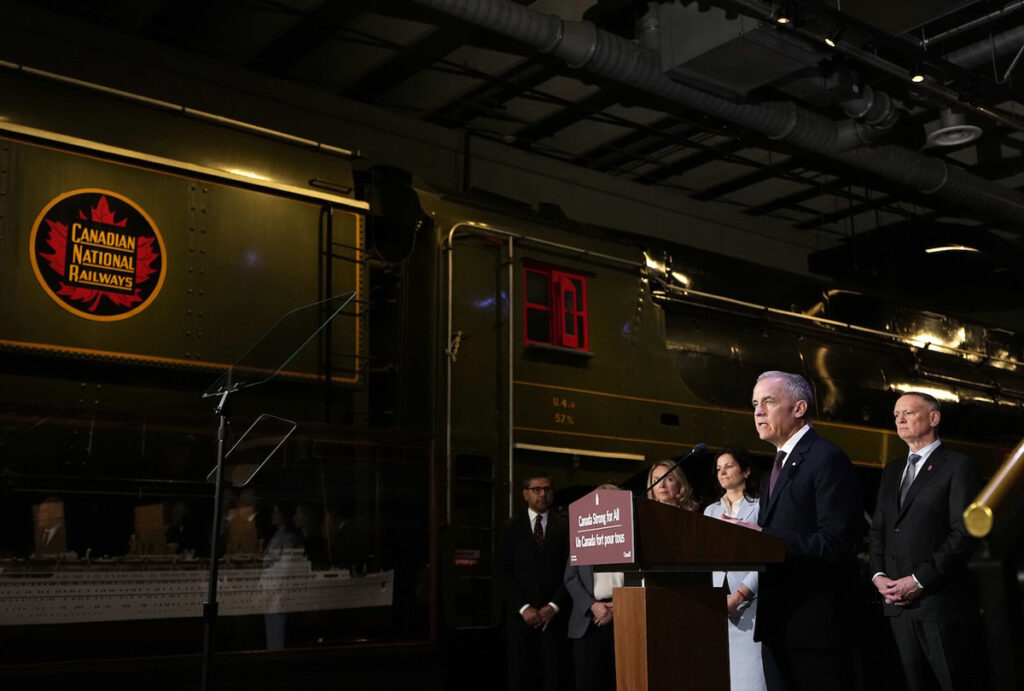
Prime Minister Mark Carney speaks from a lectern beside a Canadian National Railways locomotive at the Canada Science and Technology Museum, during an announcement on the Canada Strong Fund, Canada’s first sovereign wealth fund in Ottawa on Monday, April 27, 2026. THE CANADIAN PRESS/Justin Tang
By Resource Works
More News and Views From Resource Works Here
So Canada has a sovereign wealth fund now. Welcome to the club (only about forty years late).
On Sunday, Prime Minister Carney stood up and announced the Canada Strong Fund, $25 billion to start, professionally managed, arm’s length from the government, investing alongside the private sector in energy, critical minerals, and infrastructure. It will have a CEO, an independent board, and, in a twist that would have been unthinkable even five years ago, retail Canadians will be able to buy in.
I have to admit, it felt like hearing that someone you’ve been yelling at for decades to go to the dentist has finally made an appointment. Thank you. Overdue. Let’s talk about whether you’re going to the right dentist.
Because sovereign wealth funds are not all built the same. And the details of this one will determine whether Canada joins the serious table or just sets up a very expensive pantomime.
I’ve been thinking about this for a long time. More than a decade ago, I contributed to policy development for a sovereign wealth fund concept in British Columbia, back when the idea was that LNG revenues would eventually need a permanent home. Resource Works has published extensively on the subject since. And recently, in a Power Struggle podcast conversation with legalist Radha Curpen, we got into something that I think is actually the more radical idea: that the next major pipeline or transmission corridor in Canada may require a sovereign-type authority as the entity that builds and owns it. Not because government is better at building things – it manifestly is not – but because a sovereign entity is the one thing that pipeline opponents cannot demarket, cannot divest from, cannot pressure through shareholder campaigns, and cannot drag into the same reputational warfare that has stalled or killed every major private-sector pipeline proposal in the last fifteen years.
That’s the idea worth chewing on. But first, the comparators.
Norway’s Government Pension Fund Global – $1.7 trillion, the granddaddy – works because Norway made a simple decision early: the money goes in, it gets invested globally, and politicians don’t touch it. The fund is the backbone of Norwegian national unity. Everyone benefits. Everyone knows it. It took discipline, and it took starting when the oil was flowing, not after.

Saudi Arabia’s Public Investment Fund – roughly $930 billion – is a different animal. It’s a development fund, not a savings fund. It builds things: NEOM, the Red Sea resorts, the tech investments. PIF is essentially the vehicle through which Saudi Arabia is trying to build a post-oil economy using oil money. Ambitious, occasionally bonkers, but undeniably effective at deploying capital at scale into transformative projects. That’s closer to what Carney seems to have in mind with the Canada Strong Fund.
Alaska’s Permanent Fund – about $80 billion – does something neither Norway nor Saudi Arabia does: it writes cheques directly to citizens. Every Alaskan gets a dividend. It’s wildly popular, politically untouchable, and it has made the fund a permanent feature of Alaskan life. The lesson: when people have a personal stake in the fund, they defend it.
And then there’s Alberta. The Heritage Savings Trust Fund was set up in 1976 with enormous promise and has been a masterclass in what not to do. Successive governments raided it, failed to top it up, and used it as a political football. It sits at roughly $24 billion – a fraction of what it would be if Alberta had shown the discipline of Norway. It’s the cautionary tale, and Carney’s team should have it tattooed on their forearms.
So where does the Canada Strong Fund land? The $25-billion starting point is meaningful but not transformative. The arm’s-length structure is essential – the moment a minister can direct investment decisions, the fund becomes a patronage machine. The retail investment component is clever: it gives Canadians a stake, which gives the fund political durability. And the focus on energy, critical minerals, and infrastructure is exactly right for the moment.
But here’s what I’m not hearing yet, and it’s the thing that will determine whether this fund actually works or becomes another well-intentioned Ottawa creation that disappoints: Indigenous economic participation.
Canada in 2026 is not Norway in 1990. The resource projects that this fund will invest in – LNG terminals, pipelines, transmission corridors, critical mineral mines – are being built in partnership with First Nations who are equity owners, not just consulted parties. Thirty-eight First Nations own 12.5 per cent of Enbridge’s Westcoast pipeline system. The Nisga’a are leading a $20-billion LNG project. The Haisla are building Cedar LNG. The First Nations LNG Alliance has signed a memorandum of understanding with Japan.
If the Canada Strong Fund does not build Indigenous economic participation into its governance, its investment criteria, and its ownership structure from the outset, it will be designing a twentieth-century institution for a twenty-first-century reality. The financial minds who are presumably settling down to the task of designing this thing need to understand that the era of building resource infrastructure without Indigenous peoples at the ownership table is over. Not because it’s politically fashionable, but because it’s the only model that actually works – the only one that survives court challenges, regulatory reviews, and the sustained campaigns of well-funded opponents.
Which brings me back to the pipeline question. Radha Curpen is right: building major infrastructure in Canada now requires something beyond engineering and regulation. It requires legitimacy – the kind that comes from sovereign authority, from Indigenous ownership, and from a structure that opponents cannot pick apart through shareholder pressure and marketing campaigns. A sovereign wealth fund that invests in pipeline corridors, with First Nations as co-owners and the Crown as the entity of record, may be the only model that actually gets the next one built.
Norway didn’t get rich by being cautious. It got rich by being disciplined. Canada has the resources, the partnerships, and now, apparently, the fund. The question is whether we have the discipline – and the imagination – to build it right.
Or whether we’ll do an Alberta.
Stewart Muir is president and CEO of Resource Works.
Share This: