


 CDN NEWS |
  US NEWS







Deep uncertainty around public policy fiscal management and Indigenous relations is causing international investors to exercise caution on greenfield projects
By Karen Graham

Karen Graham, MA, MPP, Principal of KMG Strategy
By Resource Works
More News and Views From Resource Works Here
It should not be normal in a country self-described as an “energy superpower” that Canada’s Energy Minister Hodgson’s recent approval of Enbridge Inc.’s C$4 billion Sunrise Expansion Project of its British Columbia natural gas mainline generated national headlines, on repeat. This week, Shell’s acquisition of ARC Resources Ltd. for C$22B made legitimate international headlines, and is interpreted as a definitive signal that the former (together with equity partners) will proceed with LNG Canada’s Phase 2 to double LNG output to ~28 million tonnes per year.
The British Columbia government’s newfound embrace of all things natural gas and LNG – including endorsement of these projects – is borne partly out of desperation to champion some visible job-creating activity as projects like BC Hydro’s Site C dam and LNG Canada’s Phase 1 construction are completed, while it stares down the worst public fiscal performance in the province’s history, largely of its own making.
The reality behind the announcements
The Sunrise project takes place entirely in BC, from capital investment to Indigenous equity partnership to a 2,500-person construction workforce. ARC Resources’ gas and liquids business is located near Shell’s upstream resources in the Montney formation of northeastern BC. The BC government promptly sought to shape these announcements as a success for its “Look West” strategy (or “plan” – called both in the same news release). The government glosses over some inconvenient facts, pointed out by Resource Works’ Stewart Muir on a recent podcast with another “ARC” – energy analysts Jackie Forrest and Peter Tertzakian of ARC Energy Research: the royalty rate hike recently proposed by the Eby government, and the cumulative effects framework (the “Blueberry decision”) negotiated for the province’s northeast that could limit the number of wells drilled.
Are these investments the product of factors outside British Columbia’s purview? Yes, and yes. The global constriction of gas supply, and more favourable federal government signals (including purported fast-tracking LNG Canada Phase 2 through the Major Projects Office) have had more influence on these developments than any about-face by the Eby government. The BC claims of billions of dollars of investment and tens of thousands of new jobs prompts a closer look at whether British Columbia really is an “investable” jurisdiction for energy and resource sectors.
The productivity of the resource backbone
By way of answer, consider the deeply sobering account presented to Resource Works’ municipal decisionmaker event on April 15, 2026 by Dr. David Williams, Vice President of Policy at the Business Council of BC. The resource sectors that provincial NDP government(s) studiously sought to ignore (or demonise as being contrary to the objectives of CleanBC and other provincial climate policy schemes) for much of the past seven years are the province’s most productive, and the backbone of exports.



The oil and gas extraction sector alone “pays the bills” in productivity terms of $1,064 (real GDP) per hour worked, with the utilities sector coming a distant sector at $244 per hour worked (2024) (all-industry average is $63/hr). Energy represents 15% of BC’s exports, of which natural gas is the second largest category generating ~$2.1 billion annually.
Oil and gas extraction was one of only two private sector categories to retain growth in 2024 exceeding population growth (the other being transportation and warehousing); the rest were quasi- or fully-public sector: health care and social assistance, utilities, and public administration grew faster than population growth (3% in 2024) (left chart). And employment growth declined or failed to meet all-industry average growth (2019-2025) of a tepid 1.6% in every private sector category bar professional services and finance & insurance. Public sector categories saw employment growth of 3.8%-4.5% (right chart).
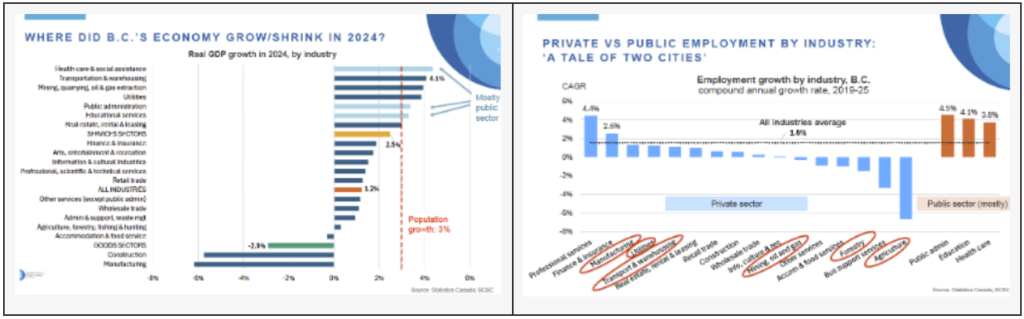
Source: BCBC, April 15, 2026.
A chilling effect on greenfield investment
Abysmal stewardship of “backbone” resource sectors, together with flashing warning lights on the public balance sheet (downgrades by three bond-rating agencies on a record-breaking $13.3 billion deficit with no plan to rebalance) are signalling to international investors in an energy-starved world to exercise caution on investment plans in BC.
Cause for caution is significantly increased by the Eby government’s evident incapacity to resolve the myriad issues in 2025-26 (and beyond?) around Aboriginal title declarations, and operative clauses of the provincial Declaration of the Rights of Indigenous Peoples Act. Court decisions and inept policymaking are producing limbo for private property rights and every law on British Columbia’s books. Note that neither the Enbridge looping project nor the ARC Resources acquisition entail new “greenfield” development on the landbase: each investment is calibrated to de-risk capital commitments and position for future growth, limiting exposure to the uncertainty of BC’s policy framework(s).
Is British Columbia “investable” right now? BCBC’s Williams calls BC’s economic outlook “subdued” and notes private sector performance is very weak.
Just when Canada and the provinces need to send predictable signals to the world as a matter of national resilience in response to a meltdown in the US relationship – including but not only natural gas pipelines and related LNG export projects – British Columbia faces multiple homemade crises. Do not expect natural resource investors to greenlight greenfield projects while deep uncertainty around public policy, fiscal management, and Indigenous relations persists.
The views expressed in this article are those of the author, Karen Graham, and do not necessarily reflect the views of the Advisory Council as a whole.
Share This:






















BUYER BEWARE! OPINION: Iceland and Norway Keep Saying No to Europe. Canada Should Too – Tammy Nemeth