


 CDN NEWS |
  US NEWS







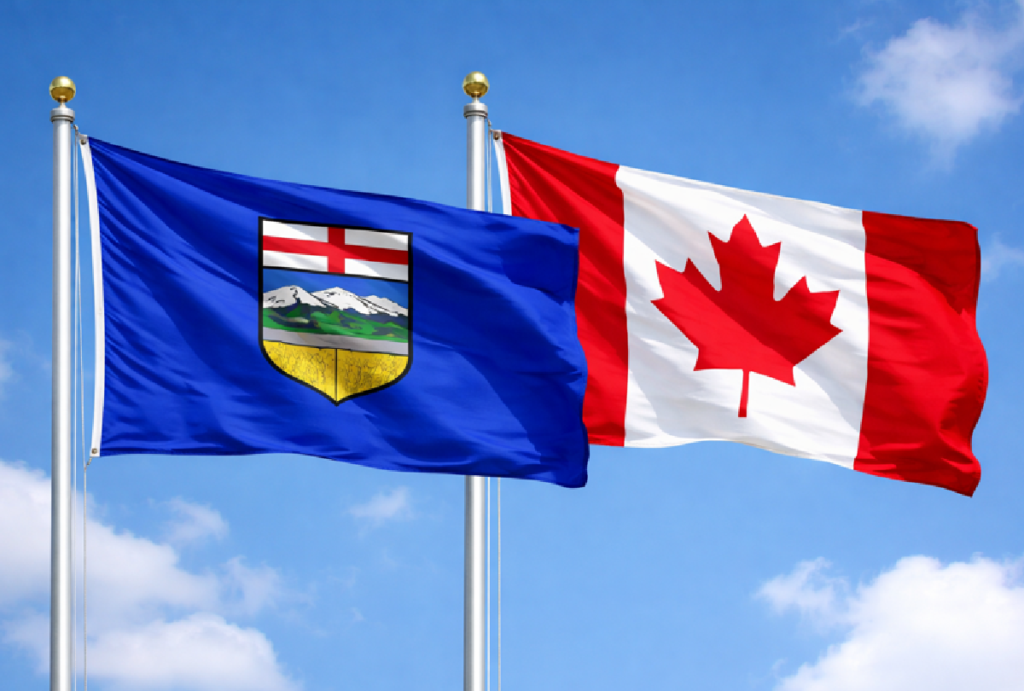
Last year, the Carney government and Smith government in Alberta adopted a memorandum of understanding (MOU) to “strengthen energy collaboration and build a stronger, more competitive, and more sustainable economy.” That MOU recently took a large step forward with an additional agreement clarifying elements of last year’s pact.
In broad strokes, the original MOU struck a deal where the Alberta government agreed to enact a raft of greenhouse gas (GHG) emission controls in exchange for a heavily-caveated “promise” of someday being permitted to build a pipeline to the British Columbia coast to export an additional million barrels per day of its oil to Asia. GHG control commitments by Alberta included enhanced (higher) carbon taxes, enhanced (tighter) methane controls, and new massive investments in a project to capture CO2 emissions from oilsands production and bury those emissions deep underground, a process known as carbon capture, utilization and storage (CCUS).
The new agreement puts some meat on the bones of the MOU and expands/adds some elements including signing onto a new federal agenda of comprehensive electrification of Canada’s energy systems.
Under the new agreement, Alberta agrees to a steep increase in its industrial carbon tax, which will increase from the currently fixed price of $95 per tonne of CO2 (or equivalent GHG) emitted to an escalating tax level that will take it to $130/tonne by 2040, a somewhat less stringent regime of increase from the original MoU but still a major increase in carbon taxation in Alberta, which is now locked in through 2040.



In addition, Alberta reaffirms it will strengthen methane emission controls and recommits to the CCUS project known as Pathways, run by the Oil Sands Alliance, a coalition of Canada’s largest oil companies. Preliminary starting price estimates for this project—again, a project absolutely required as a prerequisite for any potential pipeline to Pacific waters—are now around $24 billion and points north.
Overall, a cynic might observe, the new agreement has Alberta agreeing to massive expenses in the pursuit of GHG controls from the oil patch, and complete submission to the federal government’s aggressive GHG control regime, in exchange for some heavily-caveated federal promises of more prompt (and potentially more certain) regulatory approval for a potential million-barrel-per-day pipeline to carry Alberta bitumen to a west coast export outlet for sale to Asian markets.
In other federal policy adventures, the Carney government has just introduced Powering Canada Strong: A National Strategy for an Electrified Canadian Economy. In the new agreement, Alberta is to be wedded to the new electrification of everything strategy, with agreements to double its electricity grid by 2050 by expanding nuclear, wind, solar, geothermal and lower-carbon forms of generation—none of which make use of Alberta’s oil and gas resources or technological know-how.
Alberta also commits to “identify the projects, technologies, and investments needed to achieve net-zero emissions in Alberta by 2050” further locking Alberta into that overarching federal GHG control policy structure, which virtually guarantees the extinction of oil and gas production in Canada. Finally, Alberta will “Better enable investment for renewables and expand supply of electricity for AI and data centre projects.” The latter, ostensibly necessary to the larger project of electrification of everything.
The new Canada/Alberta advancement agreement locks in, clarifies, expands and puts meat on the bones of the original MOU, suggesting it was more than just words on a page or pixels on a screen. And the future of Alberta’s energy economy has its new straightjacket; its new payment plans for Canada’s climate; new wide-ranging non oil-and-gas electrification policies; and some slightly stronger promises that someday Alberta will be allowed to expand its oil production for export to Asia by a million barrels per day (although it’s unclear that this will be economically viable, given the other cost-inflating parts of the MOU).
Facing increased Alberta separation agitation, Premier Smith, especially, and Carney left-handedly, will spin the daylights out of this new agreement, as some kind of win-win for Alberta and Canada. But a more hard-eyed look suggests that under the MOU and the new agreement, Alberta’s oil and gas sector is clearly being kept on the Trudeau-era’s promised “phase-out” pathway to extinction, and not one of future continuance, much less growth. That’s not any kind of win-win for Alberta, regardless of any spin.
Share This:






















On The Verge: Energy Sector Primed for New Wave of Growth – ATB Economics