CDN NEWS |
  US NEWS







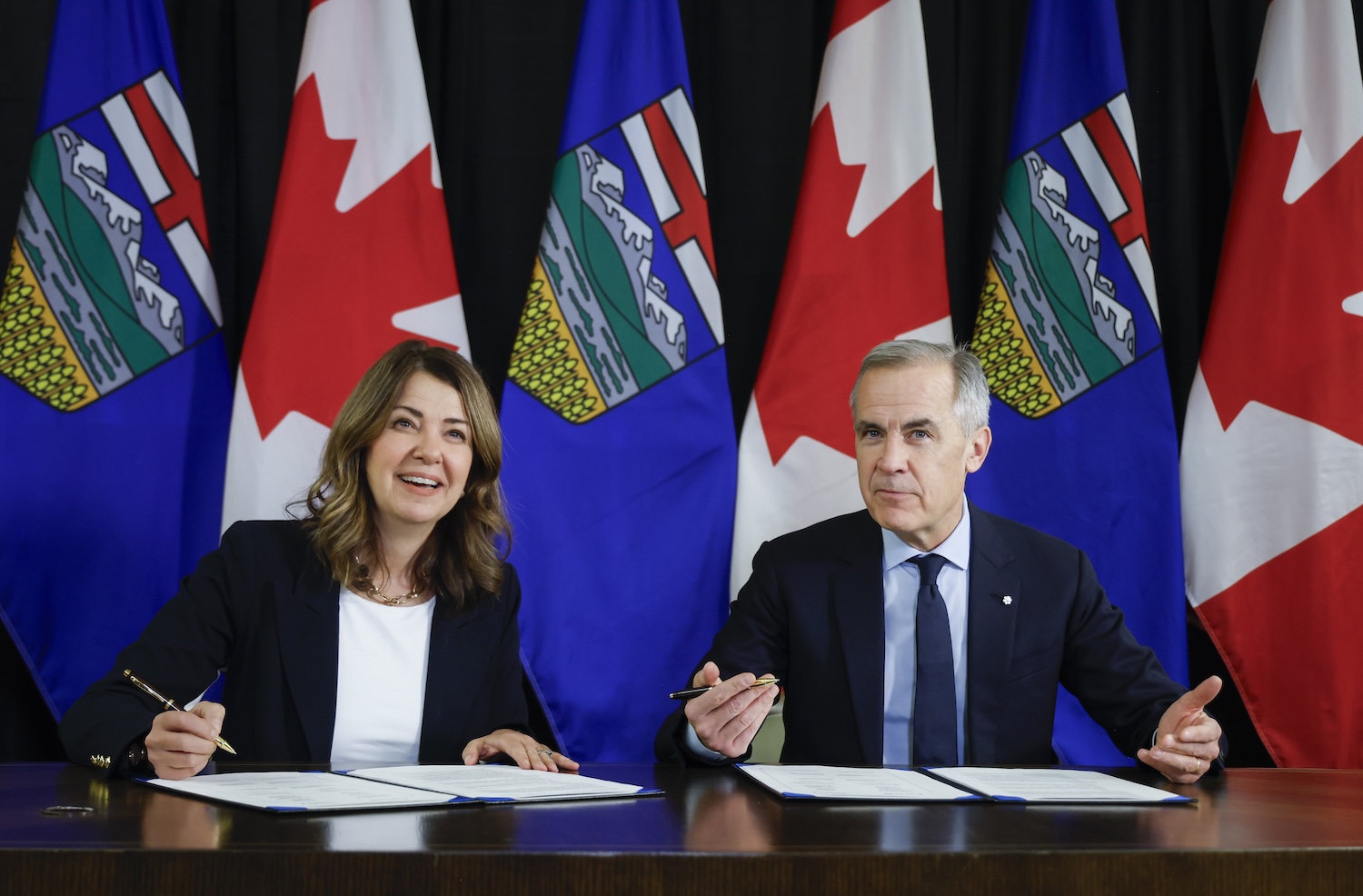
Prime Minister Mark Carney and Danielle Smith were all smiles last week when they signed a new agreement setting the price for industrial carbon taxes in Alberta.
Pipeline and $20 billion carbon capture project to follow. At least that’s the plan.
But the folks who would actually pay for all this – Alberta oilsands producers – weren’t smiling.
“The announced industrial carbon tax, while lower than the current industrial carbon tax, still maintains uncompetitive costs on the Canadian oil sands industry,” the Oilsands Alliance said in response to the new tax rates.
“No other major oil producing nation faces a similar tax.”
In case Carney hadn’t noticed, the global energy crisis has bumped the climate crisis to the bottom of the doomsday scroll. Carbon taxes of any kind may be one of those luxury beliefs we can no longer afford.
There is a real danger here that neither the west coast pipeline nor the $20 billion carbon capture project that are part of the grand bargain with Alberta will ever be built because, once, again, Canada made it unaffordable.
If there is one good thing to come out of last week’s announcement, it could be that B.C.’s resource sector will get some tax relief.
Presumably, B.C. will need to adjust its own industrial carbon tax schedule to match Alberta’s.
Rather than hit a headline price of $170 per tonne by 2030, as per the Trudeau era scheme, the new industrial carbon price for Alberta will be just $115 per tonne in 2030, rising to $140 per tonne by 2040.
British Columbia has long had the highest carbon prices in Canada, and there’s no federal law preventing it from maintaining those higher prices.
But now that Ottawa and Alberta have agreed to a lower industrial carbon price schedule for Alberta, the B.C. government could come under pressure to adjust its own industrial carbon pricing system to match Alberta’s.
Both Ottawa and B.C. scrapped the consumer carbon tax, but have maintained carbon pricing for heavy emitting industries.
A new pricing benchmark
On Friday, Ottawa and Alberta signed an agreement on a new industrial carbon pricing scheme for Alberta. It is a key component of making both a new pipeline and carbon capture in Alberta economically feasible.
“The industrial carbon price will be substantially lower than the previous federal policy,” Premier Danielle Smith.
Rather than hit a headline price of $170 per tonne by 2030, as per the Trudeau era scheme, the new industrial carbon price for Alberta will be just $115 per tonne in 2030, rising to $140 per tonne by 2040.
That’s the headline price. The “effective price” – i.e. the actual market value of carbon credits and offsets in Alberta – will be $130 in 2040.
“This deal has the potential to deliver meaningful investment in decarbonization as carbon prices escalate through the 2030s,” said Michael Bernstein, CEO of Clean Prosperity.
“It replaces an old policy regime that wasn’t working with a new approach that can deliver both emissions reductions and economic growth.”
British Columbia reacts
Last week, while announcing four new wind power projects, B.C. Energy Minister Adrian Dix lamented the fact that the Carney government might be letting Alberta set the benchmark for industrial carbon prices for the rest of Canada.
He was responding to reports that Alberta and Ottawa were negotiating new carbon prices without any other provinces in on the negotiations.
“Either they’re providing a special deal, in the competitive market between provinces, to one province, or alternatively they’re negotiating the deal for the whole country with just one province,” Dix said.
While the agreement announced last Friday is specific for Alberta, Jill McNight, the Liberal MP for Delta, said her government does plan to consult with other provinces on industrial carbon pricing.
“The Prime Minister…did say that we are going to be consulting with the provinces with the intention of having consistency in the terms of the federal backstop,” she said.

These federal benchmarks establish a minimum price. B.C. might well be able to maintain the current higher pricing schedules, if it so chooses, though it will no doubt feel pressure to bring industrial carbon pricing in line with the new, lower benchmarks.
“I expect if B.C. wants to negotiate its own agreement and timeline, there would be lots of opportunity to do so,” said Heather Exner-Pirot, director of Energy, Natural Resources and Environment at the Macdonald-Laurier Institute.
The new Alberta timeline
A major sticking point for Alberta in its ambitions to get a new pipeline to the West Coast built, along with a $20 billion carbon capture project, has been industrial carbon pricing.
Whereas the previous federal price was scheduled to increase by $15 per tonne every year, the new Alberta price rises annually by smaller increments of $5 and $3 per tonne.
The Alberta industrial carbon price will rise from today’s $95 per tonne to $100 per tonne in 2027 and stay there for three years.
It will then rise to $115 per tonne in 2030, and increase by only $3 per tonne for the next few years until it hits $130 per tonne in 2030.
After that, the headline price will rise until it hits $140 per tonne in 2040. The effective price will be $130 per tonne in 2040.
The actual price that industries pay will vary sector by sector in terms of stringency under Alberta’s Technology, Innovation and Emissions Reduction (TIER) system.
The new scheme includes “sector-specific stringency factors” for large emitters, like oil sands extraction and the electricity sector.
Contracts for difference and market certainty
The lower carbon prices are needed because the carbon credit market on which they are based is oversupplied, the Alberta and federal governments stated.
“When we signed the MOU in November, an oversupply of credits had driven prices as low as $20 a tonne – $75 below the headline price,” Prime Minister Mark Carney said at last Friday’s announcement.
As part of the new agreement on carbon pricing, Alberta and Canada will introduce a new “contracts for difference” (CFD) scheme to bolster the carbon credit market.
“CFDs provide project developers with greater certainty that carbon credit values will remain predictable over the long term, enabling investment decisions,” a government backgrounder states.
Industrial carbon pricing has been a main sticking point for the oilsands producers who are expected to put up $20 billion for a carbon capture project that is a condition for building a new pipeline.
Smith said she thinks Alberta’s energy sector will be able to live with the new carbon pricing regime.
“The early feedback we’ve got from the industry is that they believe that this slower ramp up is going to be manageable for the companies that are going to be exposed to it,” she said.
Responding to Friday’s announcement, Premier David Eby said Ottawa was rewarding “bad behaviour.”
“It cannot be the case that the projects that get prioritized in Canada are those where a Premier threatens to leave the country,” he said.
Advancing the West Coast pipeline
Now that the carbon pricing question has been settled, Ottawa and Alberta plan to advance the proposed West Coast pipeline along the following timelines:
- Alberta will submit its pipeline application to the Major Projects Office on or before July 1, 2026;
- Canada will pursue the designation of the oil pipeline as a project of national interest for approval under the Building Canada Act by October 1, 2026; and
- Canada and Alberta will “continue to engage with British Columbia immediately in a trilateral discussion on the pipeline application.”
All of this will happen “while fully respecting Canada’s duty to consult obligations with Indigenous Peoples as required by Section 35 of the Constitution Act,” the agreement states.
As yet, an exact route for a new pipeline has not yet been determined.
While a pipeline to Prince Rupert is the preferred route, it’s also possible that a second expansion to the Trans Mountain pipeline could be chosen.
Despite Ottawa’s pledge to engage with B.C., it may be that Ottawa will simply have to override B.C., as Eby reiterated that his government remains opposed to lifting an oil tanker ban on the north coast to facilitate a pipeline to the north-west coast.
“Our government’s opposition to any repeal of the North Coast tanker ban has not changed,” he said.
Nelson Bennett’s column appears weekly at Resource Works News. Contact him at [email protected]
Share This: