CDN NEWS |
  US NEWS









Chris Varcoe: Province still prefers a new oil export pipeline that goes to a deepwater port in northern British Columbia — not one to southern B.C.
By This Article and More From Chris Varcoe Here
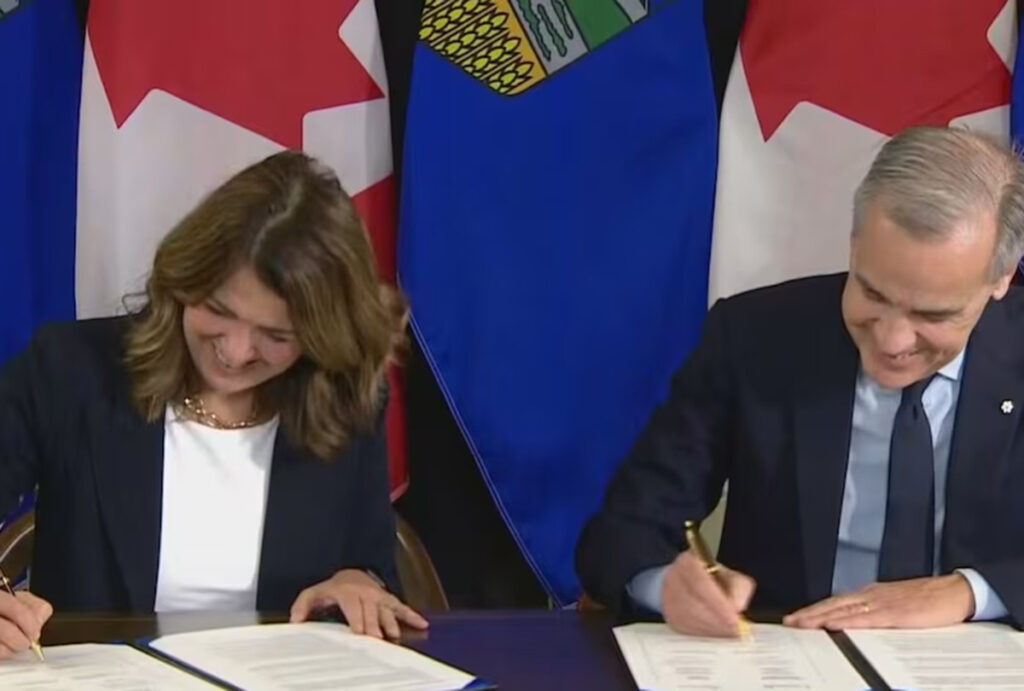
Premier Danielle Smith sounds confident about getting the remaining key pieces of the Alberta-Ottawa energy accord across the finish line, but it also appears the endeavour is growing more complicated by the day.
On Thursday, Smith indicated Alberta still prefers a new oil export pipeline that goes to a deepwater port in northern British Columbia — not one to southern B.C.
Speaking to reporters, Smith noted that some opposition to the Trans Mountain expansion (TMX) project last decade focused on the increased tanker traffic tied to more crude shipments leaving the Westridge Marine Terminal in Burnaby, B.C.
Developing a new oil pipeline to the lower B.C. mainland, as some have suggested, would only increase the traffic at the Port of Vancouver, she noted.
“In a very congested port like that, is there an appetite for a doubling, once again, of that amount of traffic? So that’s why I am a bit skeptical that that would be the appropriate route,” Smith said in Edmonton.
“We’re looking for a route that would get us to a deepwater port with very little navigation needed for channels, and a rapid way of getting to South Korea and Japan and other Asian markets.
“And when you look further up the coast, you can cut three days off trans-Pacific transit, so that’s why we still favour some of the sites where you would get (to) a deepwater port — and we’re very conscious of the fact that there is a lot of congestion already in that port (in Vancouver).”
Smith made the comments following a report in the Globe and Mail this week, indicating federal sources would prefer a pipeline route that would transport oil to the Port of Vancouver, rather than northern British Columbia, where a federal tanker moratorium exists.
Since last summer, Smith has repeatedly spoken out in favour of a new greenfield bitumen pipeline being built that could move one million barrels per day to the Port of Prince Rupert for export to Asia.
It is actively working on a proposal for a pipeline, and looking at three various routes in northwest B.C. The government expects to submit its proposal to the federal Major Projects Office this summer for consideration.
The pipeline is one of the key elements in the landmark memorandum of understanding (MOU) signed by the federal and provincial governments last November, although the British Columbia government opposes a pipeline to northern B.C., as do some Indigenous communities.
Under the accord, Prime Minister Mark Carney’s government declared an Alberta bitumen pipeline to Asian markets a priority and a project of national interest, if paired with a carbon capture and storage network in the oilsands.
Agreements on key parts of the MOU were reached before an April 1 deadline, although two pieces are still being negotiated, three weeks after the initial timeline elapsed.

It includes a trilateral agreement between both governments and industry on the $16.5-billion Pathways carbon capture network, and an understanding to boost the province’s industrial carbon price to an effective rate of $130 a tonne under Alberta’s Technology, Innovation and Emissions Reduction (TIER) system.
The industrial carbon price was frozen at $95 a tonne of emissions last year, and carbon credit prices have been trading below that level.
Any final agreement is expected to address the date for reaching the higher price, and the potential use of a contracts for difference by government to lock in future carbon prices. It’s unclear how these contracts would ultimately be used to ensure an effective floor price for carbon is $130 per tonne, according to a provincial official.
“We are making progress. I did have to intervene a couple of days before the April 1 deadline to understand why our teams had not been able to reach an agreement,” Smith said.
“The broad strokes of what we’re all aiming for (are) in the MOU — an effective price of $130 — it’s just a matter of how quickly we get there, and what the stringency will be and the benchmarking on the industry.”
Smith also indicated that the province has to ensure any contracts for difference “don’t end up costing the industry, or Alberta taxpayers or Alberta ratepayers a significant amount of money.”
“Canada and Alberta continue to make good progress on all the elements of the MOU, including on carbon pricing and the Pathways Project,” Charlotte Power, a spokeswoman for federal Natural Resources Minister Tim Hodgson, said in a statement.
“From the federal government’s perspective, discussions on carbon pricing are occurring separately from Alberta’s development of a pipeline proposal.”
Mount Royal University political scientist Duane Bratt said it’s clear the negotiations are complicated, but he believes both sides are striving to reach a deal, as there’s too much at stake to have the MOU fall apart.
“Both Carney and Smith, for different reasons, are on the same page on how important it is to get a deal done,” Bratt said.
“This is a high-wire act, but I think they’re operating in good faith.”
The oil and gas industry is awaiting the results of the negotiations with anticipation and promise, “but also nervousness of what it might say,” Kevin Birn, Canadian oil markets chief analyst with S&P Global Energy, said Thursday.
“In any negotiation there can be differences of opinions,” he added.
“I think the proof is in the pudding — and we’re still cooking or making the pudding.”
Chris Varcoe is a Calgary Herald columnist.
[email protected]
Share This: