CDN NEWS |
  US NEWS







By Jim Warren
Small modular reactors (SMRs) are less common than you might think
One of the most amazing things about small modular nuclear reactors (SMRs) is how few of them actually exist. According to the latest information published by the World Nuclear Association, there is one SMR operating in eastern Russia, and another in China. And there is a worldwide total of just two SMRs currently under construction—one in Russia and one in Canada.*
*(See World Nuclear Association, Small Modular Reactor (SMR) Global Project Tractor)
Sure, there are probably 100 or more SMR designs in various stages of development. Some exist in theory, some as blueprints, and some have their own promotional websites. There are dozens of SMR projects seeking regulatory approval or getting their financing arranged. And, several are slated to be under construction within the next few years.
But, that’s it. If you want to see a real life SMR in operation, prepare to travel to China or Siberia
Despite the fact so few SMRS exist in the real world, many reputable manufacturers of large conventional nuclear power plants offer SMRs for sale. In fact all of the wannabe SMR manufacturers whose reactors are being considered for purchase by governments and electrical power utilities in Canada have successful track records in the nuclear industry. The companies currently being considered by Canadian buyers include Westinghouse Electric Company, GE Vernova Hitachi Nuclear Energy, and CANDU Energy.
Still, an inveterate cynic might ask how prospective SMR buyers can hope to pick winners and losers from a population of manufacturers who’ve never actually built one?
As you might have guessed the technical ability required to build small reactors has been around for decades. How else could they have managed to fit reactors into nuclear submarines? Literally thousands of SMR-sized and smaller reactors have been successfully employed for military and scientific purposes around the world since the early 1950s. Indeed, there have already been a few SMR-sized versions of Canada’s CANDU reactors built for electrical utilities.
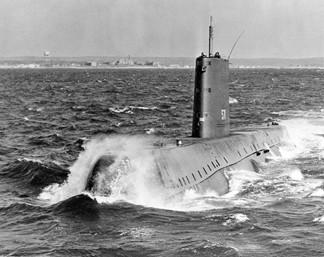
Westinghouse Electrical, now owned by Brookfield and Saskatchewan uranium producer Cameco, has been building small nuclear reactors for decades. It built the reactor that powered the USS Nautilus, the world’s first nuclear-powered submarine, launched in 1954.
US Navy photo
But, as is the case in other facets of life, size isn’t everything when comes to SMR technology. There is much more to SMRs than simply having a lower megawatt generating capacity than conventional nuclear power plants. Yes, SMRs are smaller. They have a generating capacity one third as high as what large conventional reactors can generate.* The important distinction separating SMRs from the small reactors powering submarines and facilities like remote military radar stations is the application of modular construction systems.
*For a detailed definition of SMRs, specifications and technologies, see World Nuclear Association (2026, 03 24) Small Modular Reactors
Conventional full-size nuclear power plants have an average electrical generating capacity of 1,000 megawatts (mw). Most SMR designs are for power plants that have a 300mw capacity. One megawatt of power plant generating capacity will provide sufficient electricity to supply 600 to 1,000 homes. The number of households that can be supplied depends on factors like climate conditions. Some regions require extensive periods of air conditioner operation and there are places where electrical power is widely used for home heating in winter months.
By the way, nuclear submarines have been powered by a wide range of reactor sizes with generating capacities ranging anywhere from 10mw to 200mw.
The benefits of modular construction
A key characteristic of SMR technology is that reactor components or modules are built using serial replication production methods in factories. The idea is that modules constructed in one or more factories can be readily transported by road or rail to nuclear power station sites for final assembly. The factory-style manufacturing systems employed are expected to significantly reduce the costs of reactor construction. They combine the benefits of assembly line production with the ability to send reactors anywhere in the world for relatively quick assembly.
Another benefit is price. SMRs are currently selling for around CAD $5.2 billion per 300mw power plant, whereas conventional 1,000mw nuclear plants currently sell for around US $17.5 billion.
In addition, a power company anticipating demand growth can purchase an SMR for one-third of what a full-size reactor costs. One 300mw reactor plant may be all that is required to meet increasing electricity demand expected in the near term. Additional 300mw units can be installed if and when a subsequent increase in demand appears to be on the horizon. Why spend nearly US $18 billion on a 1,000mw reactor plant that will be running at half of its nameplate capacity several decades into the future when a far less expensive 300mw SMR will do?
SMRs can also play a role in northern and remote regions servicing mines and communities currently reliant on diesel fuel for power generation—a feature undoubtedly attractive to emissions mitigation zealots.
Politics and conflicts of interest
It turns out that cost and technological issues aren’t the only challenges associated with the adoption of SMR technology. There are instances when political considerations and conflicts of interest can influence the selection of the SMR models and manufacturers chosen by provincial governments and utility companies.
This is Canada after all—where governments, federal Liberal governments in particular, have consistently demonstrated varying degrees of incompetence, conflicts of interest and other forms of malfeasance when it comes to procurement. Think the ArriveCAN app or military procurement—precisely when can we expect to see those new jet fighters?
Sometimes, even at the provincial level, government procurement decisions might seem surprisingly odd or mysterious.
Alberta’s nuclear power plans
Alberta’s long-term electrical energy production plans include nuclear power. The province has indicated that when it goes nuclear it will purchase four conventional 1,000mw reactor plants. Alberta is the outlier when it comes to its manufacturer selection intentions. Ontario Power Generation and Saskatchewan have included 300mw SMRs to be purchased from a US manufacturer in their nuclear power plans. Despite the fact Alberta plans to go big and to buy Canadian, a brief look at the province’s reactor selection process provides insights that apply to the adoption of both large and small reactors in other provinces.
Alberta is looking at two models—the CANDU MONARK and the Westinghouse AP1000. The manufacturers of both models can lay claim to Canadian ownership.
CANDU reactors were conceived and manufactured by the federal Crown Corporation, Atomic Energy of Canada Ltd. (AECL) beginning in the 1950s and early 1960s. In 2011, the Montreal-based engineering firm SNC Lavalin purchased the CANDU-related holdings of AECL. The Justin Trudeau Liberals were big fans of SNC Lavalin. The firm could literally do nothing wrong insofar as Team Justin was concerned—hence, the infamous SNC Lavalin scandal of 2019. In 2023, SNC Lavalin changed its name to AtkinsRéalis
Canada’s Parliamentary Ethics Commissioner found Prime Minister Trudeau guilty of interfering in a federal prosecution when he demanded that Canada’s Attorney General drop its prosecution of SNC Lavalin on bribery related charges emanating from its foreign activities. What irony, the former darling of the federal Liberals is now on the shortlist to supply reactors for conservative Alberta.
Today, it looks like AtkinsRéalis has lost some its former cachet among Liberals. It may not be the federal Liberals’ manufacturer of choice when it comes to nuclear reactors. This brings us to Westinghouse Electrical, the other reactor manufacturer on Alberta’s short list.
In 2019, Westinghouse Electrical was purchased by Brookfield, a firm in which Prime Minister Mark Carney is heavily invested, and Cameco, Saskatchewan’s homegrown uranium mining success story. Brookfield’s subsidiaries, Brookfield Asset Management Ltd. and Brookfield Renewable Partners share Brookfield’s controlling ownership stake of 51% in the Westinghouse Electric Company. Cameco holds all of the remaining 49% interest. The purchase price for Westinghouse Electrical was $8.2 billion, less than half the selling price for a new 1,000mw reactor. The reactor business went through a real tough time after the Three Mile Island, Chernobyl and Fukushima incidents—hence reactor manufacturing companies were available at bargain prices for several decades.
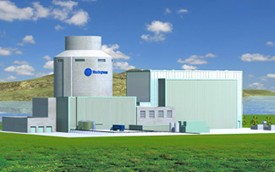
Westinghouse Electric AP1000 nuclear plant
Computer-generated Westinghouse promotional image.
Alberta has short-listed the only two Canadian companies that sell both SMRs and conventional nuclear reactors. Saskatchewan and Ontario, on the other hand, are planning to employ US made GE Hitachi SMRs in their nuclear power plans.
Kudos to Alberta for shopping locally. Nevertheless, given the political baggage associated with AtkinsRéalis and Westinghouse, Alberta’s shortlist selections are a bit of a surprise.
Oh well, such is Canada, where it’s getting increasingly difficult to do business with any large low emissions energy business that Brookfield doesn’t own a part of or with any big Quebec-based firm that hasn’t been lavishly favoured by Ottawa.
The Alberta government’s all-Canadian approach is a nod to cooperative federalism, which is certainly a good look when compared with the anti-Alberta positions taken by politicians like B.C.’s premier, David Eby and federal Liberal cabinet minister Steven Guilbeault.
On the other hand, cynics and wild-eyed conspiracy theorists might view Alberta’s decision to shortlist Westinghouse Electric as an exercise in sucking up to the prime minister.
Saskatchewan’s unique energy mix
Saskatchewan makes more use of coal to generate electricity than any other province. Approximately one-third of the province’s electricity is supplied by coal-fired electrical power generating stations, which are fueled with locally available lignite coal. The province has announced it does not intend to comply with federal regulations, like Steven Guilbeault’s clean electricity standards or his 2030 deadline for eliminating coal from electricity production.


Additionally, the province has indicated it plans to rehabilitate and upgrade several of its older coal-fired generating units and to keep them operating for two or more decades.
So far federal regulators have looked the other way, the province’s Crown-owned electrical utility, SaskPower, has thus far not been penalized by Ottawa and the provincial cabinet minister responsible for the utility has not been arrested.
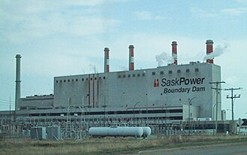
SaskPower’s Boundary Dam Power Station has four coal-fired electrical power generators one of which is a carbon capture and sequestration unit.
There are a few reasons that explain why Saskatchewan has been given a pass, thus far. One rationale is that the province has very limited options available for low emissions power generation that could replace the coal-fired plants. SaskPower has exhausted its hydro-electric opportunities and Saskatchewan’s natural gas fields are nearly depleted. SaskPower has fostered a good deal of wind and solar power generation, but has reached the point where additional deployment of intermittent renewable sources of energy could compromise the corporation’s ability to meet baseload demand.
A second factor that has helped forestalled a federal rebuke is the province’s commitment to eventually adopt nuclear power generation, phasing out coal as its nuclear plants come on stream. Perhaps it helps that the province has announced it is considering the purchase of one or more Westinghouse Electric reactors as part of its nuclear power production mix.
Westinghouse seems like a good fit given that it is 49% owned by Saskatoon-based Cameco, the province’s largest uranium mining company. And, choosing Westinghouse might even help improve relations with Ottawa given that Brookfield owns the majority stake in the company. (Details regarding the SMRS and full size reactors being considered for purchase by SaskPower are provided below.)
The province brags about being one of the world’s largest producers of uranium with vast un-tapped reserves. Failing to support Cameco, one of the province’s homegrown business superstars would prove to be politically challenging.
The high purchase prices for nuclear reactors are obviously a concern for a relatively small population province like Saskatchewan. It has just 1.3 million people available to share the cost of reactors. Purchasing a new full-size 1,000mw reactor, worth approximately US $17.5 billion, would be a stretch for a provincial government with a total annual revenue stream of only CAD $21 billion.
In October 2025, the Saskatchewan government announced that SaskPower intends “to consider” the purchase of two or more 300mw SMRs from GE Hitachi, a US firm headquartered in Wilmington, North Carolina. This is the same SMR model selected by Ontario Power Generation (OPG). It appears that the GE Hitachi BWRX 300 was identified for consideration by Saskatchewan because of an agreement between OPG and SaskPower to jointly assess SMR options and to capitalize on any synergies and cost savings arising from choosing the same supplier.
Subsequently, on January 18, 2026 the province announced that in addition to the GE Hitachi SMRs already under consideration, SaskPower had inked an MOU with Cameco and Westinghouse Electrical “to explore technical and commercial pathways to deploy Westinghouse’s reactor technology, including the advanced AP1000mw [a large conventional reactor] and its AP300mw SMR for long-term electricity supply planning.”
Talk about hedging your bets and keeping your options open.
Back to the drawing board?
On April 15, SaskPower and Ontario’s Bruce Power announced they have signed a memorandum of understanding that states Bruce Power is prepared to share its expertise in nuclear power generation, project development and long-term reactor operation with SaskPower.
The agreement with Bruce Power suggests that after investigating Saskatchewan’s nuclear power options for several years SaskPower now recognizes evaluating small and large reactor options might be beyond its capabilities. Bruce Power is an Ontario-based private sector nuclear power utility that supplies electricity to a portion of the province apart from the portion supplied with electricity directly by Ontario Power Generation.
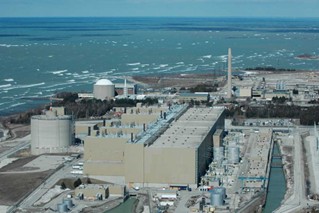
One of Bruce Power’s two four-reactor nuclear power stations located on the shore of Lake Huron
Photo: Chuck Szmurlo
Brian Zinchuk, editor of the Saskatchewan energy publication Pipeline Online, has speculated that the MOU could signal that Bruce Power and SaskPower intend to cooperate in the group purchase of a fleet of reactors.
The idea of a multi-province group purchase of reactors, perhaps involving Alberta, Saskatchewan and Bruce Power might indeed produce savings. But if the bulk-buying scheme means everyone has to buy from the same manufacturer, it is doubtful Saskatchewan would participate unless Westinghouse Electrical was the chosen manufacturer. As noted above, Saskatoon-based Cameco owns 49% of Westinghouse Electrical and the provincial government will be expected to support the home team. On the other hand, when SaskPower decided to consider purchasing GE Hitachi SMRs it was likely a result of joint consultations with another Ontario-based utility, OPG.
Ontario’s SMR commitment
In May 2025, Ontario Power Generation (OPG) announced it had begun construction on the first of four Hitachi BWR X 300mw SMRs it is installing at its new Darlington power generating station. The New Darlington Station is adjacent to the OPG’s existing Darlington power generating facility located near the community of Bowmanville on the north shore of Lake Ontario.
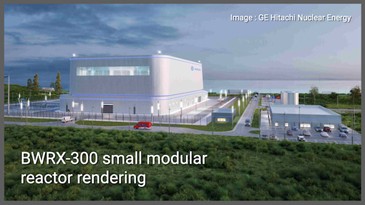
Ontario Power Generation is purchasing four of the GE Hitachi BWRX 300 SMRs depicted in this image. The first 300mw reactor plant is currently under construction. It will be the first SMR built in a G7 country. Saskatchewan is currently considering the purchase of two more BWRX 300 SMRs.
The OPG announcement boasted that its first SMR would be the first small modular reactor to be built in any G7 country. It is one of only two SMRs under construction globally. Site preparation for the first SMR unit actually began in December of 2022. The total purchase price for the four reactors is $20.9 billion or $5.2 billion per 300mw reactor unit.
Neither of the two companies in the SMR business claiming significant Canadian ownership, Westinghouse Electrical and CANDU Energy, was selected by OPG. This is particularly interesting, given Ontario’s long experience with CANDU reactors. OPG currently has a fleet of eight large operational CANDUs (Bruce Power also has eight CADUs). Furthermore, CANDU manufacturer AtkinsRéalis is marketing its own 300mw CANDU SMR. While AtkinsRéalis’ corporate headquarters are in Montreal, its CANDU Energy Inc. subsidiary has its head office in Mississauga, Ontario.
CANDU energy has deep roots in the province and existing supply chains which include many Ontario-based companies. It also has employees and contractors with extensive experience working with OPG, assisting with reactor upgrades and maintenance.
An article published this month in World Nuclear News suggests that CANDU Energy may have a stake in OPG’s SMR project but does not indicate what CANDU’s role is or the scope of its stake in the project might be. Involving CANDU Energy in the project would make sense given its expertise and supplier connections developed during decades of operation in Ontario.
Questions have undoubtedly been asked as to why an American reactor manufacturer was selected over an Ontario-based subsidiary of a Canadian firm. There are a number of reasonable rationales that might explain why CANDU reactors weren’t selected.
For example, OPG may have decided that having a single reactor supplier is a serious supply chain vulnerability, which could be readily resolved by adding an additional reactor manufacturer to the list of vendors it relies on.
I don’t know much about the political culture of Ontario, so I’m left wondering about what happened to “elbows up” and Doug Ford’s buy Canadian rhetoric. Will the Trump administration allow GE Hitachi to import steel for the reactor modules to its US factory from Stelco in Hamilton?
Perhaps the Doug Ford government gets a pass on not buying CANDU’s Canadian made SMR given that he wasn’t premier when OPG made its initial selection and Donald Trump hadn’t yet launched his tariff war. But that doesn’t mean Ontario can’t insist that the SMRs include as much Canadian content as possible including Canadian steel.
The question is moot anyway—It’s far too late in the game change suppliers for the first four SMRs. Maybe CANDU will have a good shot at winning the contract to build the next four.
Regardless of the reason(s) CANDU’s SMR wasn’t selected it still would have been a disappointment for the company. International sales for CANDU reactors have been rather sluggish since the 1980s but the company is actively seeking new sales for large conventional reactors and SMRs. As of 2025, two new conventional CANDUs were under construction in Romania. Being shortlisted by Alberta in its reactor manufacturer selection process is a welcome turn of events for the company.
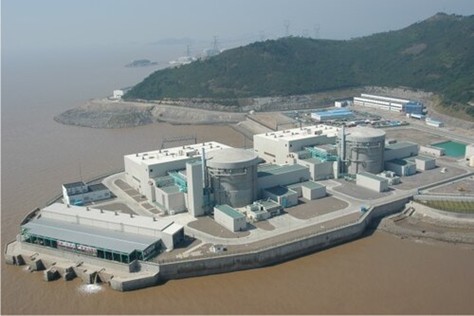
Artist’s rendering of the two 600mw CANDU nuclear power plants at the Zhejiang, China power station.
AECL photo
Nuclear technology, much like new forms of digital technology such as AI, isn’t something most people us are prepared to study in any great depth. Perhaps that’s why governments and electrical utilities have been able to pick winners and losers in the field of SMR technology without generating much public controversy. Sure it’s within the realm of possibility that the supplier choices made by Alberta, Saskatchewan and Ontario are all about selecting the best technology available for meeting their practical needs. However, given the information we’ve just examined, it would be naive to imagine the selection process hasn’t been influenced by political considerations.
-30-
Share This: