


 CDN NEWS |
  US NEWS







By Yogi Schulz
I’m impressed by the courage of Premier Tim Houston’s Progressive Conservatives in Nova Scotia. They lifted a ridiculous, decade-long moratorium on hydraulic fracturing last year. Perhaps the province’s difficult financial position prompted the provincial government to lift the moratorium. Now they are determined to have an energy producer drill the first exploratory wells this summer.

I’m baffled that Nova Scotia, a have-not province, turned its back on billions of dollars of Crown Royalties that offshore natural gas generated until 2018 after 25 years of exploration and production.
Environmentalists have panicked many citizens into believing fracking is dangerous by greatly exaggerating the small risks associated with fracking oil and natural gas wells. In reality, these risks are very low, comparable to risks of other industrial activities, especially when conducted competently.
Many environmentalists falsely claim that banning fracking will reduce oil and natural gas production to reduce greenhouse gas (GHG) emissions into the atmosphere. If only progress on climate change were that simple.
Some environmentalists and the citizens they have successfully panicked have successfully lobbied politicians to enact fracking bans in numerous countries, including Germany, France, Spain, and Australia. The adverse impacts of such bans include:
- Immediately reducing energy-industry-related economic activity.
- Not decreasing fossil fuel consumption because refiners will source crude oil from another supplier.
- Not decreasing GHG emissions despite claims that fracking bans will do so.
- Increasing oil and natural gas production by producers with poorer environmental, safety, and governance (ESG) records.
- Increasing the prices of fossil fuels.
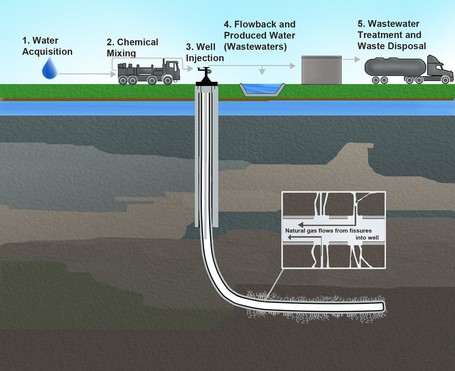
This article challenges the supposed harms fracking causes and demonstrates that fracking is a low-risk industrial activity. Nova Scotians can rest easy that their natural gas production will be safe and bring prosperity to the province. This sketch from the Barn Owl Trust illustrates the steps in the fracking process.
Fracking produces no GHG emissions
Some environmentalists falsely claim that GHGs are released into the atmosphere by fracking operations. No GHG emissions are produced during fracking.
Fracking is a process used to complete oil or natural gas wells. It injects water, sand, and small volumes of chemicals such as salt, citric acid, benzene, or lead to increase permeability in the producing formation.



Atmospheric contamination from fracking is impossible for multiple reasons, including:
- Fracking does not bring any fluid to the surface. Fracking is about injection.
- Once the well is placed on production, it will initially produce mostly the water injected during the fracking operation, with no GHG emissions.
- Once oil production begins, associated natural gas, or methane, will be produced along with the oil. In many cases, this natural gas is transported for sale and not released into the atmosphere. See the production topic below for details.
- At natural gas wells, the gas is transported for sale rather than released into the atmosphere, because that would be throwing money away.
Some purists point out that the pumper trucks that inject fracking fluid burn diesel, which emits CO2 into the atmosphere. That’s true, but it’s an infinitesimally small fraction of the billions of truck miles driven each year.
Fracking does not contaminate groundwater
Some environmentalists falsely claim that underground methane migration, supposedly induced by fracking, causes groundwater contamination. Such contamination is next to impossible for multiple reasons:
- The vertical distance between the surface and the horizontal length of the pipe in the sketch above is typically two to three thousand meters of impermeable rock. We know the rock is impermeable because it has kept oil and natural gas in place for millions of years, preventing them from migrating.
- While fracking aims to create fissures in the producing formation, the pressure exerted by the frack fluid is insufficient to crack thousands of meters of impermeable rock into the groundwater formation near the surface.
- Surface casing is cemented to prevent the drilling and production operations from contaminating the groundwater. The vertical length of the pipe shown in the sketch above is the surface casing. Surface casing length typically varies from 300 to 900 meters.
You can read supporting analysis for these points in the EPA’s Study of Hydraulic Fracturing and Its Potential Impact on Drinking Water Resources. It’s worth noting that, in a few extremely rare cases, groundwater contamination has occurred due to improper casing cementing.
The widely publicized Gasland video shows a homeowner using a match to light the water coming from a kitchen faucet on fire. The narrator then claims that fracking in the neighbourhood introduced methane into the water well. This claim is totally false. In the video, no one ever asks if the flame was also present in the weeks, months, or even years before fracking operations commenced in the neighbourhood. The truth is that methane has been present since the water well was constructed years before fracking started. The methane comes from narrow, non-commercial coal seams in the surface sediment layers near the bottom of the water well, typically at depths of 50 to 100 meters. When someone opens the kitchen faucet, the water flowing out contains small amounts of methane. There is no smell. The smell we associate with methane is a chemical added to natural gas by the distribution utility as a safety measure to warn us of a potentially explosive leak.
Fracking does not cause perceptible earthquakes
Some environmentalists falsely claim that fracking causes dangerous earthquakes. Fracking can trigger small, barely perceptible earthquakes near the well. Barely noticeable earthquakes are those that measure under 3.0 on the Richter scale. These small earthquakes also occur frequently naturally all over the earth and cause no damage.
After fracking operations became widespread in Oklahoma, USA, the frequency of light-to-moderate earthquakes increased. However, an investigation by regulators found that these earthquakes were caused by wastewater injection, not by fracking.
Fracking wastewater does not contaminate groundwater
Some environmentalists falsely claim that fracking wastewater contaminates groundwater resources that homeowners, industry, and agriculture use. Fracking does create wastewater volumes. However, as shown in the sketch above, these volumes are trucked to a wastewater disposal facility. At the wastewater disposal facility, wastewater from fracking is injected deep underground into a formation capable of holding it. No one dumps fracking wastewater into rivers and streams.
Conclusion
Claiming that fracking causes environmental impacts is without a factual foundation. Nova Scotians can rest easy that their upcoming natural gas production will be safe. It will also bring prosperity and energy security to the province.
Canada produces oil and natural gas to the highest ESG standards in the world. Therefore, Canada has among the lowest methane and CO2 emissions rates from oil and natural gas production compared to other producing countries. Canada’s oil and gas production volume ranks about 5th globally, while our CO2 emissions rank 22nd.
Yogi Schulz has over 40 years of experience in information technology in various industries. He writes for Engineering.com, EnergyNow.ca, EnergyNow.com and other trade publications. Yogi works extensively in the petroleum industry to select and implement financial, production revenue accounting, land & contracts, and geotechnical systems. He manages projects that arise from changes in business requirements, the need to leverage technology opportunities, and mergers. His specialties include IT strategy, web strategy, and systems project management.
Share This:






















INSIGHT: The Northern Shield Energy Corridor Provides Energy Security for All Canadians – Yogi Schulz