CDN NEWS |
  US NEWS







By Yogi Schulz
The Oil Sands Alliance Pathways CCUS project, with an estimated capital cost of $20 billion, is a bad deal for everyone involved.
Key Highlights:
- The oil sands giants don’t want to pay for the project because no country other than Canada is thinking about mandating CCUS.
- Canadian taxpayers don’t want to pay for it, even though they will under the current fiscal arrangements proposed in the Canada-Alberta MoU.
- No crude oil customer is willing to pay a premium for crude oil knowing that the producer paid for CCUS to reduce CO2 emissions.
Here’s why the Pathways CCUS project is a bad deal for everyone.
Expensive taxpayer-funded fiscal arrangements
Canadian taxpayers are paying, not oil sands producers.
The federal government has agreed to provide 50% tax credits to members of the Oil Sands Alliance for the Pathways CCUS project. The province of Alberta has already agreed to provide a 25% grant. That’s 75% of the capital cost being covered by taxpayers.
The three parties are currently haggling over who will pay the remaining 25%. Protracted haggling is one reason the self-imposed April 1, 2026, deadline for a deal was not met. The taxpayer will likely pay even more when a deal is finalized.
No incremental production value
Some Canadians wrongly believe the Pathways CCUS project will increase crude oil production through an Enhanced Oil Recovery (EOR) scheme. EOR injects captured CO2 to enhance crude oil production in another reservoir by increasing formation pressure. Unfortunately, EOR is not part of the Pathways CCUS project.
This belief started with a federal policy change in 2025 that allowed EOR projects using carbon capture to qualify for federal investment tax credits. Since the Pathways CCUS project isn’t an EOR scheme, it isn’t eligible for this tax credit, and it doesn’t boost crude oil production anywhere to offset its substantial costs.
Modest environmental value
Unfortunately, the CO2 emissions that will be captured are much less than most Canadians suppose.
The Pathways CCUS project will capture most of the CO2 produced from over 3 million barrels of oil sands production per day. Currently, that’s about 80 million metric tons of CO2e per year. However, oil sands production accounts for only 20% of related CO2 emissions. Consuming that crude oil, often by burning, produces 80% of the CO2.


Environmentalists accuse the oil sands giants of doing little on CCUS. That’s true because:
- Their customers don’t want to pay for it.
- No country other than Canada is thinking about mandating CCUS.
- Their shareholders see no value in CCUS for themselves.
Overall, the Pathways CCUS project will contribute about a 10% reduction in Canada’s total CO2 emissions. While that modest amount might earn the federal government some bragging rights at international climate meetings, it’s a rounding error in global CO2 emissions.
Questionable economic value
The Pathways CCUS project will generate significant economic value as it spends the $20 billion in capital costs to build the processing facilities and related pipeline.
Then the operating costs of the Pathways CCUS project will reduce:
- Producer margins.
- Crown royalty income.
- Corporate taxes.
Oil sands producers would be better off spending their contribution on expanding production. Similarly, Canadian taxpayers would be better off reducing public debt than paying for the project.
A better alternative
Oil sands producers and Canadian taxpayers would be better off by:
- Cancelling the Oil Sands Alliance Pathways CCUS project.
Continuing the efforts of oil sands producers, as planned, to reduce their GHG emissions intensity, as shown in the chart below.
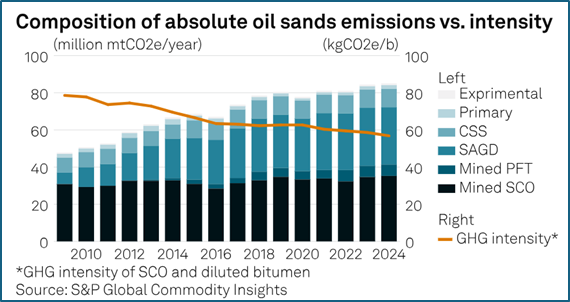
Source: Absolute Canadian oil sands emissions continue on a slower growth track, October 28, 2025
Continuing to reduce the GHG emissions intensity of oil sands production means Canada can remain a source of high-ESG crude oil.
Yogi Schulz has over 40 years of experience in information technology in various industries. He writes for Engineering.com, EnergyNow.ca, EnergyNow.com and other trade publications. Yogi works extensively in the petroleum industry to select and implement financial, production revenue accounting, land & contracts, and geotechnical systems. He manages projects that arise from changes in business requirements, the need to leverage technology opportunities, and mergers. His specialties include IT strategy, web strategy, and systems project management.
Share This: