


 CDN NEWS |
  US NEWS









“Canada must act now to prevent a looming electricity shortage.”
By Geoff Russ
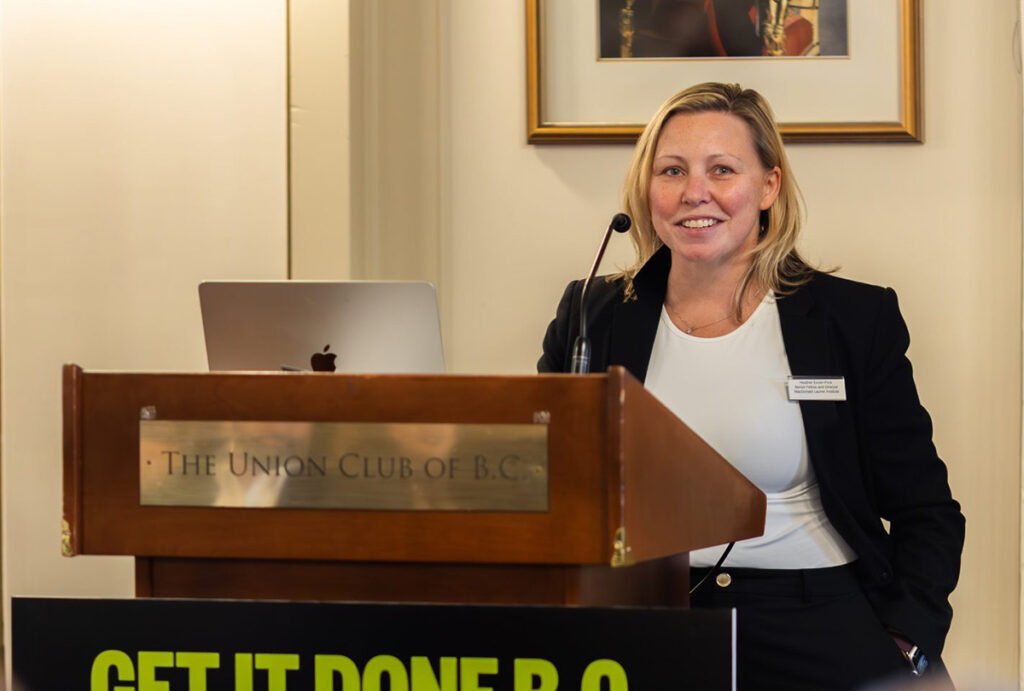
Heather Exner-Pirot, the author of Blackout, speaking last year at Get It Done BC, a Resource Works event held in Victoria.
By Resource Works
More News and Views From Resource Works Here
British Columbia still markets itself as Canada’s hydro powerhouse, but a new report argues the province is closer to a power squeeze than many politicians have acknowledged.
In Blackout, a March 2026 paper for the Macdonald-Laurier Institute, Heather Exner-Pirot says Canada is moving from electricity abundance to managed scarcity just as demand rises from population growth, electrification, industrial expansion and AI data centres. The report’s argument is national, but the British Columbia sections are some of its most revealing.
The paper says drought has cut hydro output in British Columbia, Quebec and Manitoba, helping push Canada into net electricity imports from the United States for the first time in the modern era in spring 2024. By the end of 2025, Canada had become a regular net importer, and BC Hydro, long associated with surplus hydro power, was among the utilities that slipped into net imports.
“Yet this long-standing surplus is now at risk,” Exner-Pirot writes.
That is the core argument of the report, and in B.C. it is hard to shrug off. The province still has some of the lowest household power prices in Canada, but BC Hydro’s approved rate increase is 3.75 per cent a year for 2026-27. That is not a crisis on its own. It is, however, a reminder that the era of seemingly effortless cheap power is fading.
The generation deficit and Site C
Exner-Pirot notes Canada generated 622.2 million megawatt hours of electricity in 2024, down slightly from the year before and below the 649.4 million MWh peak reached in 2017. In B.C., the clearest symbol of the squeeze is Site C. The project received environmental approval in 2014 and was commissioned in 2025, but its cost nearly doubled from $8.8 billion to $16 billion.

Normally, finishing a dam that size would ease the pressure. Exner-Pirot argues the opposite. She says B.C. still has a generation deficit and strong industrial demand, and is expected to announce another hydroelectric project in 2026. That is a striking conclusion for a province still digesting Site C sticker shock. It is also the point in the paper that should command the most attention in Victoria.
Rationing power for a new era
The report is at its sharpest when it turns to data centres. Vancouver, Exner-Pirot notes, would otherwise be an attractive destination for AI infrastructure. Instead, B.C. and BC Hydro announced in January 2026 that large AI and data-centre projects would have to go through a competitive process for access to clean electricity under Bill 31 and new regulations. Mining, LNG, forestry, manufacturing and hydrogen for domestic use are outside that process.
In plainer language, B.C. is already deciding which big new loads get power first.
“Scarcity leads to higher prices,” Exner-Pirot writes.
Her broader case is that Ottawa and the provinces, over roughly two decades, put sustainability ahead of reliability and affordability, then assumed the old surplus would cover the gap. She is especially critical of the federal Clean Electricity Regulations and argues Canada needs steadier rules, more climate pragmatism and a stronger climate for private investment in generation and transmission.
Readers can dispute parts of that diagnosis, especially the report’s shots at federal climate policy. But the B.C. evidence is hard to wave away. A province built on hydropower is importing electricity, rationing major new demand and preparing, if Exner-Pirot is right, to reopen the politically difficult question of another big dam.
“Canada must act now to prevent a looming electricity shortage,” she writes.
That may sound dramatic. In British Columbia, it reads more like a warning that arrived before the politics did. Power used to sit in the background of B.C. politics. It is moving to centre stage, and not a moment too soon.
Geoff Russ is a writer for Resource Works, a non-partisan organization that champions responsible resource development in British Columbia and Canada. Reach Geoff at [email protected].
Share This:





















NEW EPISODE #14: WATCH: 3 MINUTE HISTORY CANADA – The National Energy Program – Trudeau’s Energy Bomb on Alberta