CDN NEWS |
  US NEWS







Imports exceed the output from the new Site C dam
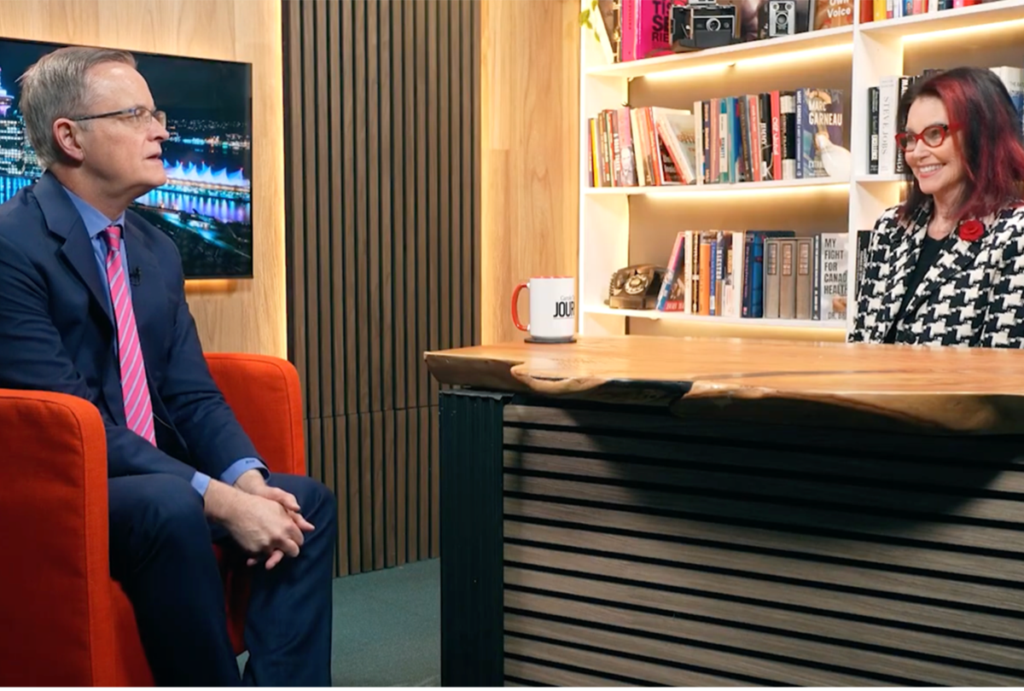
Barry Penner and Carole Taylor
By Resource Works
More News and Views From Resource Works Here
In his latest warning, Barry Penner, chair of the BC-based Energy Futures Institute, says BC imported more electricity in 2025 than the Site C power dam can generate.
“So even with Site C coming on in the middle of last summer, we still ended up importing more than the entire Site C dam would produce in a typical year if we had normal water.
“And that’s part of the story here: We haven’t had normal water flows in British Columbia for three or four years now. And this winter is not looking very encouraging either. . . . We’re shaping up to have a very disappointing snowpack again this year.”
The irony of exporting gas to import power
Penner cited continuing BC purchases of power from the US, and added: “The ultimate irony is some of this electricity we’re importing comes from the natural gas we are exporting. So we sell them the natural gas, they burn it to create electricity and we buy it back as a value-added product.
“So they get to realize, you know, (the) economic benefits of transforming it into electricity, generating jobs and taxes in the United States as we buy it back.
“But we are not allowed here to use our natural gas to produce electricity.”
A growing backlog of industrial demand
Penner went on to say that under BC’s CleanBC program, the province has effectively banned the use of natural gas for generating new power, and at the same time is pushing adoption of electric vehicles.
“You add those two things together and you are talking about the need for multiple Site C dams (for) new electricity generation if we aren’t going to be dependent on the United States for electricity supply.”
All this in a podcast discussion with Carole Taylor, who was BC’s finance minister in the Gordon Campbell Liberal government from 2005 to 2008. Penner held several cabinet posts for Campbell and then Liberal Christy Clark.
Penner later went on to question BC’s plan to spend $348 million on electrification programs (and to maintain electric vehicle mandates) while depending on power imports, and with its budget projecting a record deficit of $13.3 billion deficit. “The government is subsidizing electricity demand we can’t currently meet with money we don’t currently have.”
Earlier, Penner had reported that 2025 was the third year in a row that BC depended on imported power.
Soaring demand and trade dispute risks
“Despite political pronouncements about the importance of ‘standing on our own two feet’, British Columbia continues to import substantial amounts of electricity from the US. This isn’t a one-off — it’s the third year in a row that BC has been a net importer of electricity from jurisdictions that rely predominantly on fossil fuel generation for their power supply.”
Penner has noted increased demand on Hydro for more and more power. “We know there’s a large backlog of unserved electrical demand waiting in BC Hydro’s connection queue, totaling 7,291 megawatts, or six times the maximum output of the Site C dam.
“Of that, 6,962 MW were industrial loads such as mines, LNG facilities and data centres — a 193 MW increase from 2024.”
(And we at Resource Works have previously pointed out that the US is facing its own challenges to meet soaring domestic needs for power, and BC faces the risk that the Trump administration could suddenly decide to limit exports of power. BC Hydro itself has raised the question of “potential limitations on access to US markets because of the current trade dispute.”)


The North Coast Transmission Line project
Now Penner adds: “And with the trade deal announced . . . by Prime Minister Carney to cut tariffs on Chinese-made electric vehicles, it begs a question about where the additional electricity will come from.”
Penner’s warnings come as BC Hydro begins negotiating with nine First Nations who seek benefits from Hydro’s planned North Coast Transmission Line (NCTL). Hydro has long promised “an opportunity for First Nations co-ownership of the North Coast Transmission Line.”
The NCTL project includes new 500-kilovolt transmission lines and infrastructure from Williston Substation near Prince George to Skeena Substation in Terrace. Later, a new line would run from there to the Bob Quinn Substation farther north. And there would be new transmission infrastructure in the Prince Rupert area.
The project would deliver power to mines and other resource projects, and the Port of Prince Rupert. Further extension would serve the planned Nisga’a Nation Ksi Lisims LNG project.
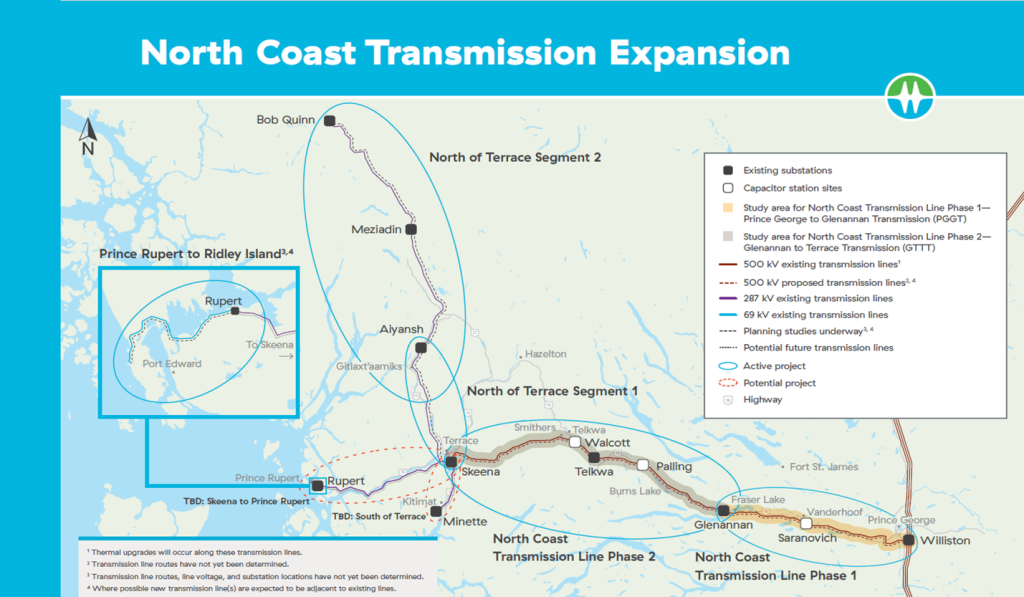
Map from BC Hydro
Economic promises and escalating costs
The BC government says: “Twinning the existing line from Prince George to Terrace and out to Bob Quinn Lake will unlock tens of billions of dollars in real, shovel-ready industrial projects across northwestern B.C., including the north coast.
“Once operational, the NCTL project is expected to create approximately 9,700 direct full-time jobs, contribute nearly $10 billion per year to GDP and generate approximately $950 million annually in public revenues for the province and municipal governments. . . .
“There are significant opportunities in British Columbia’s traditional natural resource sectors, including mining, natural gas and LNG, and in emerging sectors, such as data centres and artificial intelligence (AI).”
And it added: “Additionally, it will help prevent two to three million tonnes of carbon emissions annually, supporting B.C.’s climate goals while powering economic growth.”
Funding gaps and domestic load requirements
While Hydro has not given a recent cost estimate for the NCTL, it spoke in 2023 of $3 billion. Last October, there were media reports that the bill would be more like $6 billion, for the line from Prince George to Terrace. And critics say that all Hydro customers could be billed extra to pay for the new lines.
There has been no estimate for the next stage, from Terrace to Bob Quinn Lake. BC is reportedly negotiating with Ottawa for federal funding for this. (Last November the federal Canada Infrastructure Bank loaned $139.5 million to BC Hydro for early works on the initial NCTL project.)
Back to Penner with Carole Taylor: Penner notes how BC Hydro speaks of exporting power, not just importing it. “But when you subtract the number of electrons that we’re selling from the number of electrons that we’re importing, we’re importing far more than we’re selling. . . .
“According to BC Hydro’s own annual report . . . they say it’s imported for ‘domestic load requirements.’ That’s the phrase, domestic load requirements. The word requirements doesn’t mean optional. It means necessary. So that’s why we’ve been a net importer.”
The hidden carbon cost of imported electricity
And Penner had more to say on BC’s ban on using natural gas to generate power: “We still have some natural gas electricity. . . There still is a 275-megawatt power plant in Campbell River called Island Generation . . . and that plant has run in periods when we’ve been in a real crunch. . . . but under the CleanBC policy we’re supposed to get rid of that asset.
“Certainly the mayor of Campbell River doesn’t think it makes sense. It’s a significant taxpayer in the community and he would like to see that plant remain as part of their community and the jobs that come with it. But there’s been no clear indication from the government what they’re planning to do, other than the existing policy is to get rid of it.”
Penner adds that while BC applies clean-energy requirements in BC, the province doesn’t count emissions from the imported electricity.
“If my interpretation of it is correct, in the most recent year that they have the data available, which is for 2023, the greenhouse gas emissions associated with the imported electricity was 5.3 million tonnes. If that was added to our provincial calculation, that would increase BC’s greenhouse gas total by 8%. But we don’t count it.”
As for CleanBC, incidentally, the BC government’s own modelling showed that CleanBC would shrink the provincial economy by $28 billion in foregone GDP.
Don MacLachlan is a writer for Resource Works, a non-partisan organization that champions responsible resource development in British Columbia and Canada. Reach Don at [email protected].
Share This: