CDN NEWS |
  US NEWS







Trade diversification, energy exports, and why execution – not posture – now defines Canada’s global credibility
By Stewart Muir
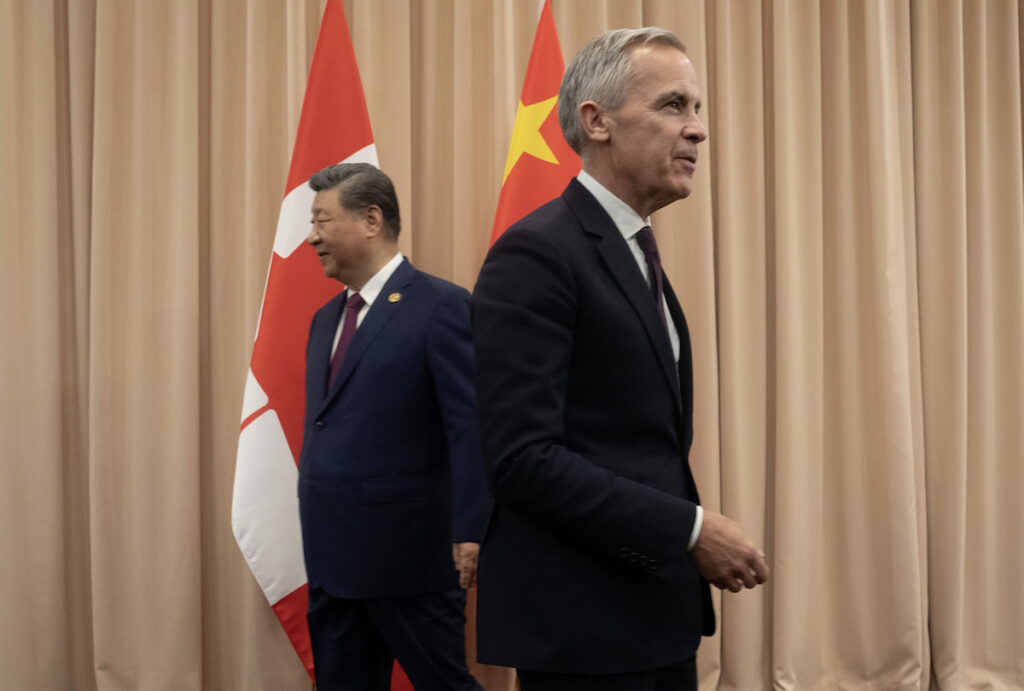
Canadian Prime Minister Mark Carney, right, and Chinese President Xi Jinping make their way to their seats after shaking hands at the start of a meeting in Gyeongju on Friday, Oct. 31, 2025. THE CANADIAN PRESS/Adrian Wyld
By Resource Works
More News and Views From Resource Works Here
Next week, the Prime Minister heads to China. That alone will set off the usual Canadian reflexes – moral anxiety, geopolitical hand-wringing, and the tired suggestion that trade diversification is something we can wish into existence without building or shipping anything. This trip deserves a more adult reading, especially as a natural-resource story.
Canada’s diversification problem is not theoretical. It is physical. It turns on pipes, ports, permits, and whether the country can still execute. On that score, one fact now towers over the rest.
Since the middle of 2024, when the Trans Mountain Expansion Project came into service, Canada has been exporting crude oil to Asian markets – including China – in volumes that were previously impossible. This is not a footnote. It is a structural shift.
The TMX effect
For the first time, Canadian heavy oil has moved to China in large, sustained quantities via tidewater. The results have been straightforward and positive. Canadian producers have secured higher netbacks. Federal and provincial revenues have risen. Shipping capacity has proven reliable. Buyers have shown up. The world has absorbed Canadian barrels without drama.
This matters because crude oil remains Canada’s largest and most abundant export commodity. No other sector combines scale, reliability, and immediate global demand in quite the same way. If Canada is serious about growth, fiscal stability, and strategic relevance, energy exports are not optional. They are foundational.
And oil is only part of the ledger.
Beyond the barrel
From Canadian ports, copper concentrate and refined copper flow to Asian smelters. Potash feeds global agriculture. Gold, base metals, and industrial minerals underpin manufacturing and electrification. Add agri-food exports and forest products, and the picture becomes clear: Canada’s trade relationship with China is already deeply resource-based. The question is not whether this is appropriate. It is whether Canada will manage it competently.



Security concerns cannot be dismissed, nor should they be exaggerated into paralysis. The South China Sea is unstable. Supply chains are contested. Canada’s relationship with the United States – our dominant customer, ally, and constraint – is complex and, at times, brittle. Over-reliance on a single market has been a strategic vulnerability for decades. That vulnerability did not disappear because it became uncomfortable to discuss.
Triangulation, not alignment
The task, then, is triangulation – not alignment. Canada must trade with China without illusions, diversify without naivety, and maintain U.S. ties without surrendering economic agency. That requires leverage. Leverage comes from being able to deliver what the world needs, at scale, through infrastructure we control.
This is where the Prime Minister’s visit takes on practical significance.
A credible Canadian message in Beijing is not a lecture. It is an offer grounded in reality: Canada can be a stable, rules-based supplier of energy, critical minerals, and food, provided our domestic systems allow projects to proceed on predictable timelines. That credibility has been strengthened, not weakened, by Trans Mountain’s success.
Indigenous leadership as a competitive advantage
There is another dimension Carney will need to address – Indigenous leadership in resource development.
Across Canada, First Nations are moving from the margins to the centre of major projects, as equity partners, operators, and strategic decision-makers. This is not symbolic. It is structural. Indigenous ownership improves project durability, local consent, and long-term stewardship. International partners notice this. They should.
If Canada presents Indigenous economic leadership as a core feature of its resource model – rather than an afterthought – it strengthens our case as a modern supplier that understands legitimacy as well as logistics.
The verdict
None of this requires romanticism about China, nor hostility toward the United States. It requires candour. Canada cannot diversify trade without building infrastructure. We cannot fund social programs without export revenues. We cannot claim global relevance while treating projects as philosophical exercises.
Carney’s trip will not solve these tensions. But it can acknowledge them honestly. For policymakers, industry leaders, and communicators watching closely, the constructive path is clear enough: trade diversification follows capacity. Capacity follows execution. Execution follows political will.
Canada has begun, at last, to show it can still deliver. The world is responding. The question now is whether we will keep going.
Share This: