


 CDN NEWS |
  US NEWS






This Article and More by Chris Varcoe Here
Alberta does not intend to build or pay for a new pipeline to the B.C. coast, but wants to get the ball rolling so the proposal can be put on the federal major projects list to be fast-tracked
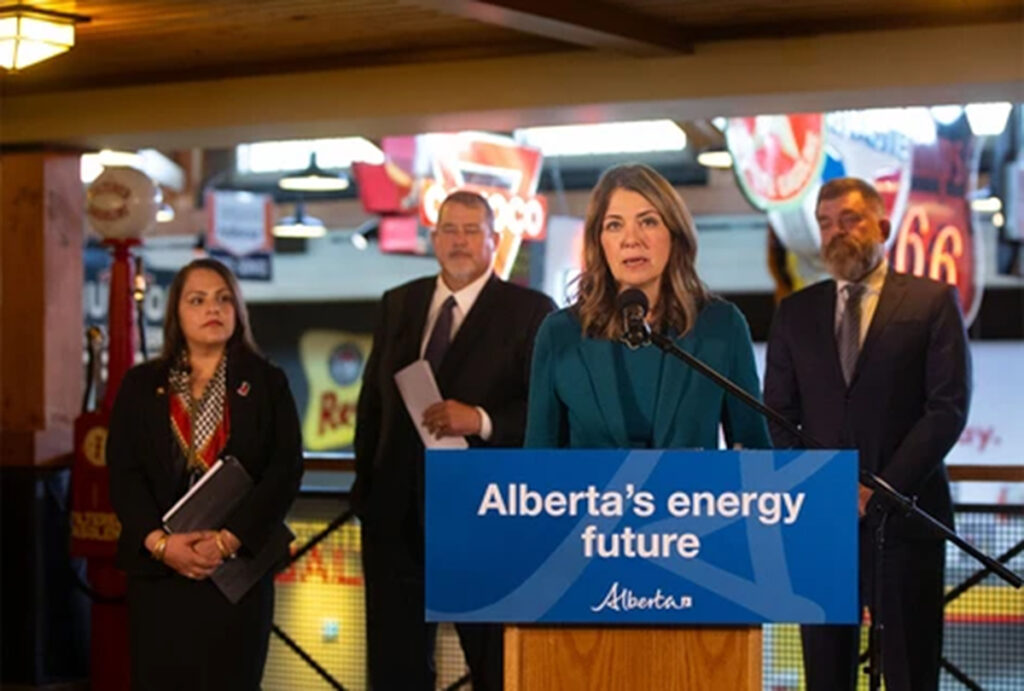
Premier Danielle Smith speaks accompanied by Minister of Energy and Minerals Brian Jean, Minister of Indigenous Relations Rajan Sawhney, and Alex Pourbaix, executive chair of Cenovus Energy, at a press conference in Calgary on Wednesday, Oct. 1, 2025. Brent Calver/Postmedia
Is the logjam about to be broken over Ottawa including a new oil pipeline on to its major projects list — or has the stalemate just begun?
On Wednesday, the ball landed squarely back in the federal government’s lap over the issue of adding an oil pipeline proposal on to Ottawa’s inventory of nationally significant projects that should be expedited for approval.
The Alberta government announced it will lead a technical advisory group that includes pipeline companies — and the province has committed to spending $14 million — to conduct planning, front-end engineering and design work for a proposed West Coast pipeline.
As the proponent, it intends to formally apply to the major projects office by next spring, although the premier wants to see it added to the federal list by mid-November.
Alberta does not intend to build or pay for a new pipeline to the B.C. coast — it hopes a private sector proponent will emerge once the initial groundwork is done — but wants to get the ball rolling so the proposal can be put on the federal major projects list to be fast-tracked.
For months, Premier Danielle Smith has been pushing Ottawa to include the pipeline concept, pitching a development that would move one million barrels per day (bpd) from the province to the Port of Prince Rupert for export.
The response from the Carney government has been there’s nothing to consider yet — that there’s no official proposal, nor a private-sector company willing to back the idea.
Smith and industry leaders responded that no company would propose a project and invest money designing a mega-project as long as the existing West Coast tanker ban was still in place and the oil and gas emissions cap was adopted — what it deems to be a cap on production.
When the first batch of major projects was released by Prime Minister Mark Carney last month, an oil line was not included.
It’s led to a chicken-and-egg dilemma, in the premier’s words — to get investment in new oil production, you need a pipeline. To get a new pipeline, you need investment in new production. And for that to happen, some federal rules will have to change.
With Wednesday’s move, that dilemma of not having an official proponent may have been cracked, at least from the province’s perspective.
“I would hope that we would have this on the major projects list by the time the prime minister announces his next batch of projects before Grey Cup,” Smith told reporters.
“We have to get a signal from the federal government that they’re going to work with us, rather than block us, as they have for the past 10 years.”
The technical advisory group will get help from existing pipeline operators Enbridge, South Bow and Trans Mountain Corp., but there is no commitment from them to participate in building the proposal.
The group’s work will help determine issues such as the route, pipeline size, cost, and it will start early engagement with Indigenous communities.

The technical advisory panel includes a number of experienced industry leaders, including Cenovus Energy executive chair Alex Pourbaix, who previously worked at TC Energy and was the executive in charge of proposed oil pipelines Energy East and Keystone XL when they were being examined.
Alberta’s aspirations to build a new pipeline have been fuelled by Smith’s desire to double provincial oil and gas production in the future. The province produced about 4.3 million barrels of oil per day in July.
However, rising output means pipeline capacity out of Western Canada is filling up again, which could cause the price discount on Western Canadian Select (WCS) heavy oil to widen again, just a year after the startup of Trans Mountain pipeline expansion.
Both Trans Mountain and Enbridge are working on plans to optimize their own systems to add some incremental export capacity later this decade, which would provide producers with some breathing room.
Yet, at some point, a new pipeline will be needed if output grows.
Energy economist Peter Tertzakian estimates the Canadian energy industry and governments forfeited US$49 billion over 15 years because of the discount on heavy oil.
“It is important that somebody take the lead in thinking about how to build the pipeline,” Tertzakian, founder and president of Studio.Energy, said Wednesday.
Pourbaix, who joked that he has the “scars on his back” from the past failure of Keystone XL and Energy East to be built, believes that economic realities and other considerations will lead to a different outcome for a new line — and that producers would increase output to fill it.
“There has been a concern that there wasn’t a proponent. Now we have a proponent,” added Adam Waterous, executive chair of oilsands producer Strathcona Resources.
We’ll soon find out if the federal government is serious about considering a new oil pipeline, which is already facing opposition from environmental groups, the B.C. government and some First Nations.
There is still a long road to travel on Alberta’s quest to see a new oil pipeline built, such as determining the design, the route, how much it could cost and Indigenous participation and ownership.
And who will ultimately build and pay for a greenfield pipeline?
Smith believes the private sector would take on the venture, once it gets on to the federal list and is approved.
“To be clear, Alberta taxpayers will not be on the hook to build this pipeline, but this initial investment is crucial to get this important work underway,” she said.
The journey for a new oil export pipeline has only just begun.
Now, the Carney government has to decide what the path ahead will look like.
Chris Varcoe is a Calgary Herald columnist.
[email protected]
Share This:





















COMMENTARY: I Have Some “Dam” Questions – William Lacey