CDN NEWS |
  US NEWS







By Ron Wallace and T. Nemeth
Observers might be forgiven for comparing the new minority Carney government as a novice rider struggling to control a bicycle built for two. A new rider may have arrived, but a substantial overhang of political and economic baggage from existing policies, combined with passengers from the previous regime, may yet present substantial navigational challenges for the government.
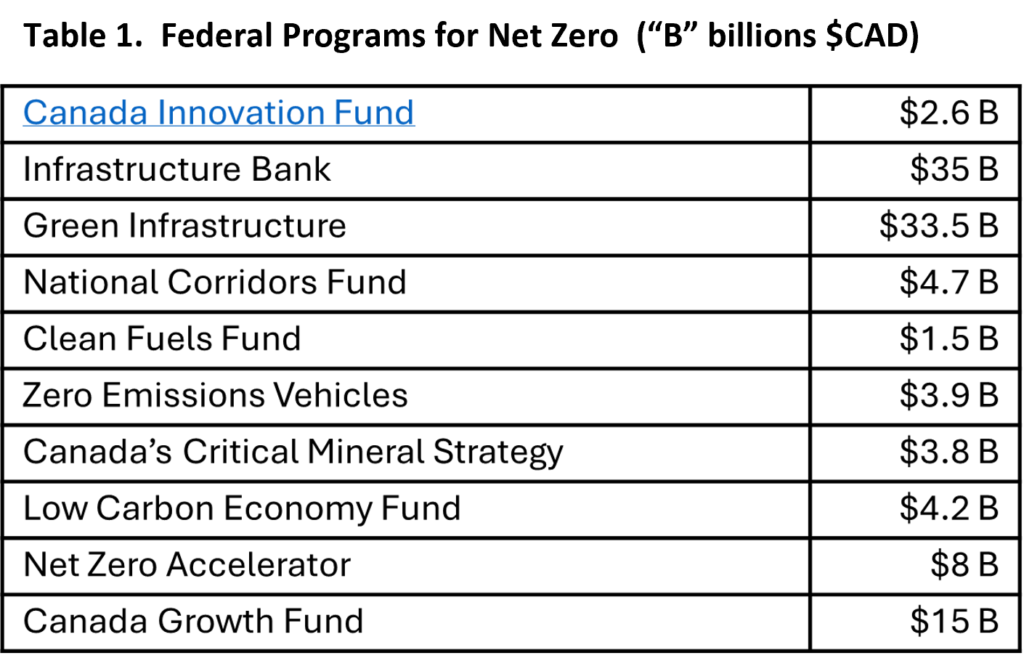
The Trudeau governments’ policy commitments, including net zero commitments and regulatory reforms, have left a complex legacy. Measures like electric vehicle (EV) mandates, substantial subsidies for battery manufacturing, the Impact Assessment Act, and the overall pursuit of net zero emissions have been blamed for sluggish GDP growth and the shelving of major energy projects, particularly in Western Canada. Programs like the Canada Innovation Fund ($2.6B), Infrastructure Bank ($35B) and Net Zero Accelerator ($8B), alongside subsidies for EV giants like Volkswagen ($20B) and Honda ($15B), represent a significant financial commitment (see Tables 1 and 2). Many of these initiatives have underperformed, leaving Carney with a costly policy overhang that has contributed significantly to anemic Canadian GDP growth.
Many Canadians may be wondering, and are rightfully confused, about how a Carney government intends to “thread the policy needle” between the major legislative commitments for net zero made by the previous government and achieving Carney’s pronouncements about making Canada an energy superpower.
Carney, a co-founder of the Glasgow Financial Alliance for Net Zero (GFANZ) and former UN Special Envoy for Climate Action and Finance, might seem naturally aligned with these policies for net zero. However, his early moves as Prime Minister in 2025 seem to signal, at least superficially, a shift. In March, he reset the consumer carbon price to zero, and in May he tabled a motion to repeal that portion of the carbon tax law entirely – a strategic pivot undoubtedly crafted to win voter support. This effectively eliminated a cornerstone of the previous governments’ climate policy but it raises questions about how Carney plans to reconcile his global climate credentials with domestic political realities.
Carney appears committed to making Canada a global leader in emissions-reduction technologies, but his proposals have been met with concerns. His proposed changes to the Canadian industrial carbon pricing regime or Output-Based Pricing System (OBPS), which applies in provinces and territories that do not have equivalently stringent regimes, aim to streamline functionality and perhaps harmonize national standards, promote Carbon Capture and Sequestration (CCS) and integrate technologies like Direct Air Capture (DAC). Such measures would generate carbon offset credits to complement eligibility for the federal Carbon Capture, Utilization and Storage (CCUS) Investment Tax Credit (ITC) and align with a proposed Carbon Border Adjustment Mechanism modeled on EU policies. Furthermore, Carney has endorsed six clean technology investment tax credits established by the previous Liberal government, specifically for carbon capture, utilization and storage (CCUS), hydrogen and clean electricity initiatives. Last, but not least, is his implied support for the highly contentious Senate Bill S-243. the Climate-Aligned Finance Act.
Against this overhang of ambitious federal climate policies, there remain long-simmering federal-provincial tensions rooted in jurisdictional disputes such as the Impact Assessment Act (IAA) (or Bill C-69). The Supreme Court of Canada’s (SCC) 2023 ruling on the IAA deemed parts of it unconstitutional, citing federal overreach into provincial jurisdiction as an “impermissible intrusion“. That same year, the Federal Court overturned Canada’s ban on single-use plastic having deemed the policy to be “unreasonable and unconstitutional” highlighting the limits of federal authority under the Environmental Protection Act where it considered that the government acted outside of its authority by issuing a Cabinet Order to broadly classify plastics as a toxic substance.
Subsequently, proposed Clean Electricity Regulations (published in November 2024) have been strongly opposed by Alberta, arguing that Canada’s constitution under Section 92A grants exclusive jurisdiction to the province for the generation and production of electrical energy. Accordingly, on April 30, 2025 Alberta filed a reference case with the Alberta Court of Appeal to challenge the constitutionality of those Regulations.



Carney’s “energy superpower” rhetoric must also contend with economic realities. The Trudeau government’s heavy subsidies and regulatory burdens have deterred investment in traditional energy sectors, particularly oil and gas, which remain critical to Canada’s economy. Any move to regulate oil and gas sector emissions would probably also be met with similar court challenges. These actions arrive at a time when Alberta has grown increasingly impatient with various attempts to “reset” Federal-Provincial relations. Illustrative of those growing jurisdictional tensions over the division of Federal-Provincial powers, the December 2022 Alberta Sovereignty within a United Canada Act is designed to defend:
“…. Alberta’s interests by giving our province a legal framework to push back on federal laws or policies that negatively impact the province. The act will be used to address federal legislation and policies that are unconstitutional, violate Albertans’ charter rights or that affect or interfere with our provincial constitutional rights.”
The material program commitments and centrally-planned “Made in Canada” green subsidies of the Trudeau government (Table 1), many of which were developed by re-appointed members of Cabinet, represent a significant economic, financial and policy burden for the Carney government. Many of these subsidy programs and “investments” have not, to say the least, performed as anticipated (Table 2).

Carney’s vision of an energy superpower is at odds with a federal climate agenda that prioritizes net zero over hydrocarbon development, exacerbated by central planning strategies that distort markets and fuels regional discontent. In the national interest, to be prepared to respond to an Alberta negotiating team formed by Premier Smith and the work of an “Alberta Next” panel, Carney needs to reconsider many of Trudeau’s policies designed to regulate, if not compel, questionable mandates like those set for electric vehicles and rescind them. At the same time, substantive good-faith negotiations between his government and the provinces would enhance not just regulatory, but investment, certainty in Canada.
It will be interesting to observe who is steering a federal bicycle built for two: Carney or his predecessor?
Tammy Nemeth is a U.K.-based energy analyst. Ron Wallace is a former Permanent Member of the National Energy Board.
Share This: