


 CDN NEWS |
  US NEWS









By Jake Fuss and Grady Munro
Some analysts compare Canada’s fiscal health with other countries in the Group of Seven (G7) to downplay concerns with how Canadian governments run their finances. And while it’s true that Canada’s finances aren’t as bad some other countries, the data show Canada’s finances are deteriorating fastest in the G7, and if we’re not careful we may lose any advantage we currently have.
The G7 (Canada, France, Germany, Italy, Japan, the United Kingdom and the United States) represents seven of the world’s most advanced economies and some of Canada’s closest peer countries. As such, many commentators, organizations and governments use Canada’s standing within the group as a barometer of our fiscal health. Indeed, based on his oft-repeated goal to “build the strongest economy in the G7,” Prime Minister Carney himself clearly sees the G7 as a good comparator group for Canada.
Two key indicators of a country’s finances are government spending and debt, both of which are often measured as a share of gross domestic product (GDP) to allow for comparability across jurisdictions with various sized economies. Government spending as a share of GDP is a measure of the overall size of government in a country, while government debt-to-GDP is a measure of a country’s debt burden. Both the size of government in Canada and the country’s overall debt burden have grown over the last decade.
This is a problem because, in recent years, government spending and debt in Canada have reached or exceeded thresholds beyond which any additional spending or debt will most likely harm economic growth and living standards. Indeed, research suggests that when government spending exceeds 32 per cent of GDP, government begins to take over functions and resources better left to the private sector, and economic growth slows. However, the issues of high spending and debt are often downplayed by comparisons showing that Canada’s finances aren’t as bad as other peer countries—namely the rest of the G7.
It’s true that Canada ranks fairly well among the G7 when comparing the aforementioned measures of fiscal health. Based on the latest data from the International Monetary Fund (IMF), a new study shows that Canada’s general government (federal, provincial and local) total spending as a share of GDP was 44.7 per cent in 2024, while Canada’s general government gross debt was 110.8 per cent of GDP. Compared to the G7, Canada’s size of government ranked 4th highest while our overall debt burden ranked 5th highest.

But while Canada’s size of government and overall debt burden rank middle-of-the-pack among G7 countries, that same study reveals that Canada is not in the clear. Consider the following charts.
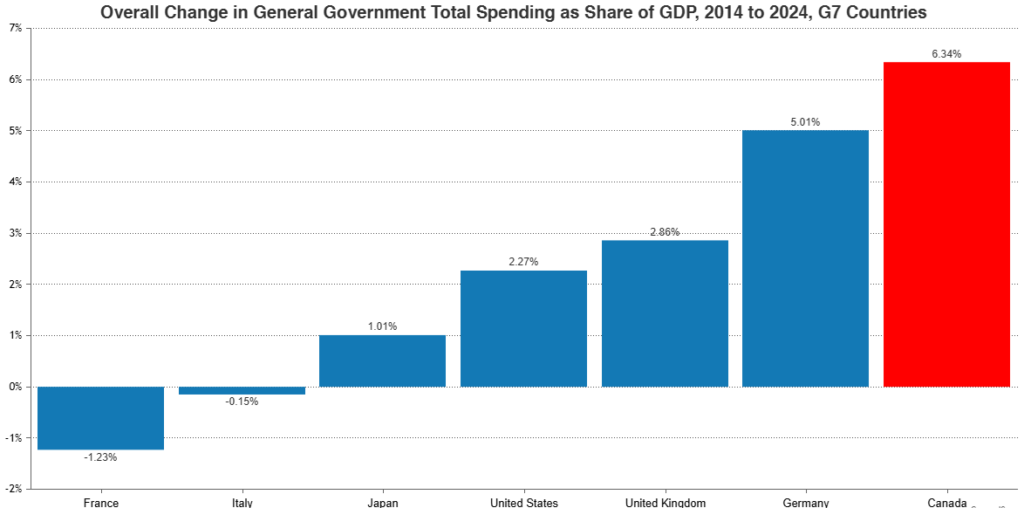
The first chart shows the overall change in general government total spending as a share of GDP in G7 countries from 2014 to 2024. Canada observed the largest increase in the size of government of any G7 country, as total spending compared to GDP increased 6.34 percentage points over the decade. This increase was nearly three times larger than the increase in the U.S., and both France and Italy were actually reduced their size of government during this time.
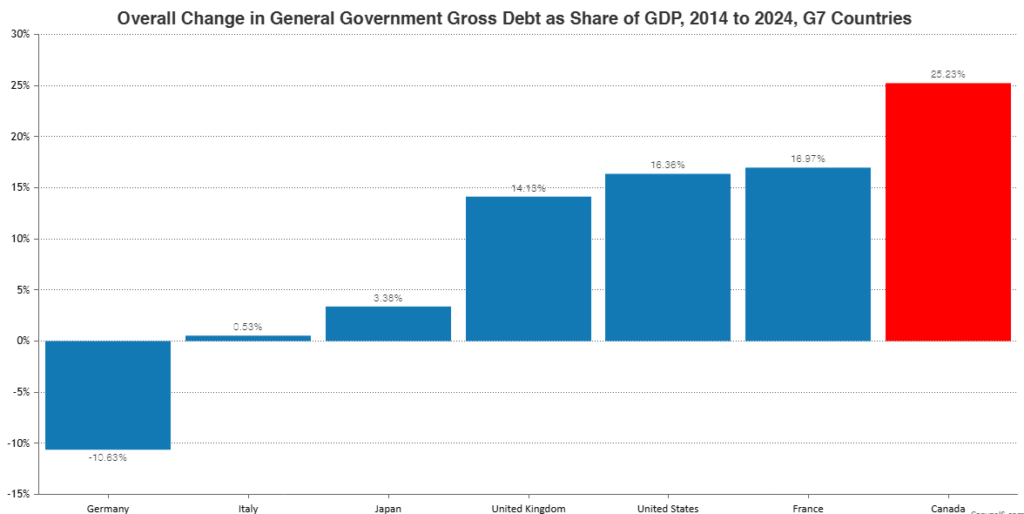
The second chart shows the overall change in general government gross debt as a share of GDP over the same decade, and again Canada experienced the largest increase of any G7 country at 25.23 percentage points. That’s considerably higher than the next closest increases in France (16.97 percentage points), the U.S. (16.36 percentage points) and the U.K. (14.13 percentage points).
Simply put, the study shows that Canada’s finances have deteriorated faster than any country in the G7 over the last decade. And if we expand this comparison to a larger group of 40 advanced economies worldwide, the results are very similar—Canada experienced the 2nd highest increase in its size of government and 3rd highest increase in its overall debt burden, from 2014 to 2024. Some analysts downplay mismanagement of government finances in Canada by pointing to other countries that have worse finances. However, if Canada continues as it has for the last decade, we’ll be joining those other countries before too long.
Share This:























COMMENTARY: Hot Air and Fires in Ontario Mean its Climate Panic Time in Central Canada: That’s Never Good News for Supporters of Conventional Energy Production – Jim Warren