CDN NEWS |
  US NEWS







By: Jake Fuss and Grady Munro
Defence Minister Bill Blair recently claimed the federal government could “absolutely” achieve the North Atlantic Treaty Organization (NATO) defence spending target of 2.0 per cent of gross domestic product (GDP—a measure of the size of the economy) by 2027. However, the dismal state of Canada’s finances makes this accelerated timeline very costly to Canadians.
First, some background. In 2014, Canada (along with the other NATO members) formally pledged to increase spending on defence up to a target of 2.0 per cent of GDP by 2024. At the time, Canada spent 1.01 per cent of GDP on defence. A decade has passed and Canada has failed to fulfill that pledge. Indeed, based on the current defence spending plan and the latest GDP projections, Canada’s defence spending is expected to reach just 1.34 per cent of GDP ($41.0 billion) in 2024/25.
Based on the latest spending estimates from NATO, Canada is one of only eight NATO members (out of 31 in total) to spend less than 2.0 per cent of GDP on defence. As the large majority of the alliance has now met the spending target, and President Donald Trump has called for the target to be raised even further to 5 per cent of GDP, Canada will have to dramatically increase defence spending (lest we be at complete odds with our allies).
However, meeting the NATO 2.0 per cent target by 2027/28 would require billions more in annual federal spending (see the following figure).
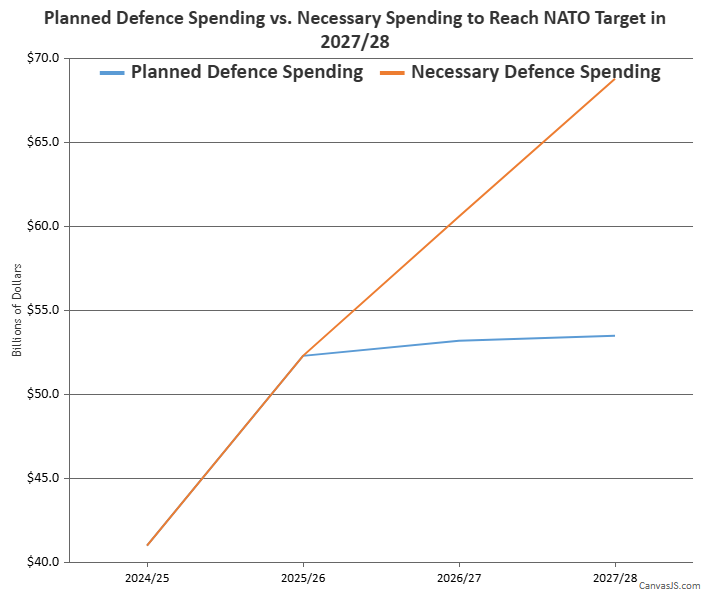


Over the next three years, according to the Parliamentary Budget Officer (PBO), the federal government will increase defence spending from a projected $41.0 billion in 2024/25 to $53.5 billion in 2027/28—with the majority of this increase occurring in the first year. This means, based on the current plan, Canada’s defence spending would only reach 1.55 per cent of GDP by 2027/28.
To reach 2.0 per cent of GDP in 2027/28, the government would need to spend $68.8 billion on defence during that fiscal year. Assuming the initial jump remains the same, this implies the government would need to increase annual defence spending by $16.5 billion from 2025/26 to 2027/28—$15.3 billion more than currently planned.
The federal government plans to run four consecutive budget deficits from 2024/25 to 2027/28 that add up to $151.9 billion in expected borrowing. In other words, the government already plans to spend more than it collects in revenues. Assuming the government adopts the spending plan shown in the above figure, reaching the NATO target by 2027/28 would require an additional $22.7 billion in borrowing.
Increasing the amount borrowed will impose substantial costs on Canadians. In the near-term it results in higher debt interest payments. Government must pay interest on its debt—same as a family with a mortgage—and rising interest costs leave less money available for programs and services. For perspective, largely due to past borrowing under the Trudeau government, federal debt interest payments are expected to equal all Goods and Services Tax (GST) revenues (and then some) in 2024/25. Longer-term, an increase in borrowed money will also burden future generations of taxpayers who will likely face higher taxes to pay for today’s spending.
Clearly, borrowing money to fund higher defence spending will only worsen the state of federal finances, meaning Canada is in a lose-lose situation when it comes to meeting the NATO 2.0 per cent target—risk the consequences of further disappointing our allies or take on billions more in debt.
Instead, Ottawa should identify and cut wasteful spending and use those savings for national defence. Simply put, smaller and smarter government spending could help get Canada out of this lose-lose situation.
Share This: