


 CDN NEWS |
  US NEWS







The products on that initial list weren’t disclosed

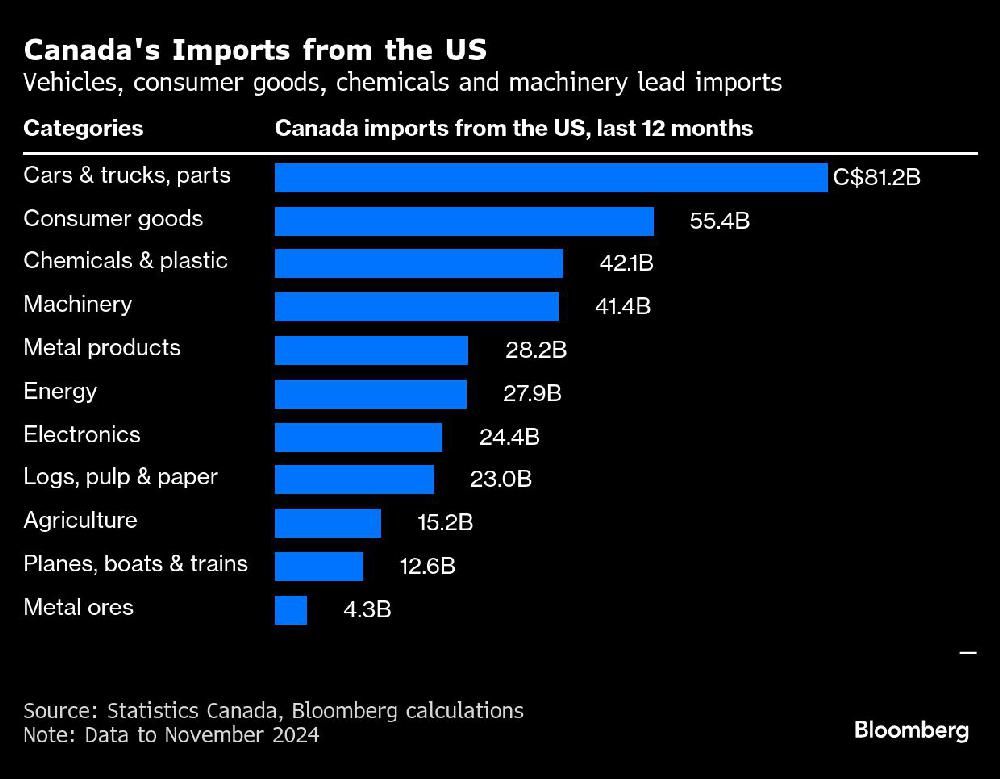
Canada has drawn up an initial list of $150 billion of U.S.-manufactured items that it would hit with tariffs if U.S. president-elect Donald Trump decides to levy tariffs against Canadian goods, according to an official familiar with the matter.
Canada imported $487 billion of U.S. goods in the 12 months to November, so the retaliatory tariffs would cover nearly a third of the value of the products the northern nation buys from its southern neighbour.
Prime Minister Justin Trudeau and the premiers of Canada’s provinces met in Ottawa on Wednesday to plot a strategy for dealing with U.S. protectionism.
Premiers of 12 of Canada’s 13 provinces and territories agreed to a statement saying they will “work together on a full range of measures to ensure a robust response to possible U.S. tariffs.” But Alberta Premier Danielle Smith balked, saying she couldn’t agree to two ideas that have been floated — placing export taxes on energy exports, or reducing those exports.
Ontario Premier Doug Ford — who manages the province that is the heartland of Canada’s auto industry — said the country’s political leaders will need to stand together in the face of Trump’s escalating threats. Last week, the president-elect mused about using “economic force” to eventually turn Canada into a U.S. state.



“When Donald Trump comes at us, he’s not going to say, ‘Well, let’s not worry about Ontario, they’re good people, or Alberta.’ He’s coming full tilt at Canadians as a whole,’” Ford said. “And that’s one thing we have to understand. We need to be united.”
In his opening remarks at the meeting, Trudeau stressed a positive message, saying that Canada and the U.S. have opportunities to build “partnerships” on energy. Canada has the critical minerals needed to fuel the transformation of the U.S. economy, the prime minister said.
“If they don’t get them from Canada, they’ll get them from China,” Trudeau said.
Still, regional and political divisions within Canada are proving an obstacle to the country’s ability to present a united front. Alberta’s Smith — a conservative who has fought Trudeau and his Liberals on a broad range of issues — said she’d take whatever action is needed to protect her province from “destructive federal policies” such as curtailing or placing tariffs on energy supplies to the U.S.
Alberta provides most of Canada’s roughly 4 million barrels of daily oil exports to the U.S. Those shipments account for more than half of U.S. crude imports.
Meanwhile, Ontario’s Ford arrived at the meeting wearing a blue hat emblazoned with the words “Canada Is Not For Sale” and said he was a “strong believer” in retaliatory tariffs.
“You can’t let someone hit you over the head with a sledgehammer without hitting them back twice as hard, in my opinion,” he said.
With assistance from Erik Hertzberg
Share This:




















REALITY: Carney’s EU Deal Threatens Alberta, Energy, & Sovereignty – 170,000 Reasons to Reject Canada’s EU “Associate Membership”