


 CDN NEWS |
  US NEWS







By Paul Day
Slow start
The slow start is not unique to Canada. As in Europe and the United States, the Canadian government has taken time to clarify the quantity of hydrogen subsidies, as well as the eligibility criteria, leading to some frustration within the clean hydrogen industry.
“The fact that we have taken so long to legislate an ITC (investment tax credit), and there’s no clear application process, is hard,” says Ivette Vera-Perez President and CEO of Canadian Hydrogen Association.
“You cannot say that it’s only late in Canada. It’s everywhere.”
The Clean Hydrogen Investment Tax Credit (CHITC) was first introduced in the 2022 Fall Economic Statement, though was not passed into law until June of this year.
The CHITC was passed with the Clean Technology ITC, CCUS ITC, and the Clean Technology Manufacturing ITC. Together they represent CAN$93 billion in federal incentives by 2034-35, and will play an essential role in attracting investment, supporting Canadian innovation, and creating jobs, the government says.
The accord with Germany was originally signed in 2022, with a commitment to, among other things, begin exporting clean Canadian hydrogen to Europe by 2025.
While progress has been made, it’s unlikely exports will be ready to begin by next year.
“I have been in Germany with our members, and we have made a lot of progress,” says Vera-Perez.
A functioning export industry by next year was unrealistic for such a nascent industry, she says, but the goal has motored project proponents and the whole industry so it can be ready as soon as possible.
“There has been a lot of enthusiasm and optimism in the sector as a whole and occasionally there are those who think we will be developed much quicker. We must be realistic. We need to recognize that we are building a new industry, and that takes time,” she says.
Export markets
Canada is a net exporter of electricity, generating just 2% of global production while being one of the top exporters, sending some 9% of its power abroad.
Exporting hydrogen, however, poses its own challenges.
“It’s a good policy, but there are a lot of difficult factors; the liquefaction process associated with hydrogen, a lack of availability of ammonia carriers, and then the costs associated with re-gasifying on the other side,” says Kyle Hayes, Partner at Foley & Lardner who serves as Co-Chair of the firm’s Hydrogen Practice.



Other uncertainties include how to stimulate demand and find the off-takers for the subsidized gas produced.
“The lack of a robust universe of off-takers, creates a snowball effect in that … it generally means a lack of financing, and therefore it somewhat limits the universe of viable producers to strategics, who do not necessarily want to dip their toes in the water alone, and so you reach this impasse,” says Hayes.
New and developing technology also means some methods for hydrogen production aren’t included in the ITC, a loophole that could, potentially, sink certain innovations.
Aurora Hydrogen, which has signed Memorandums of Understanding (MoU) in Edmonton, Alberta, is working on methane pyrolysis and microwave technology.
The method is considerably more efficient and, as such, a much more economical method of clean hydrogen production than electrolysis or steam methane reforming (SMR), according to Aurora Hydrogen CEO Andrew Gillis.
The technology has a patent in Canada and the United States, and the company in July received CAN$3 million from the government to scale production, and another CAN$1 million from the not-for-profit NGIF Accelerator.
However, methane pyrolysis is not included in the ITC, Gillis says.
“There is a lot of emerging technology that we think is going to be really important, but the regulators haven’t necessarily caught up to that yet,” says Gillis.
Uneven development
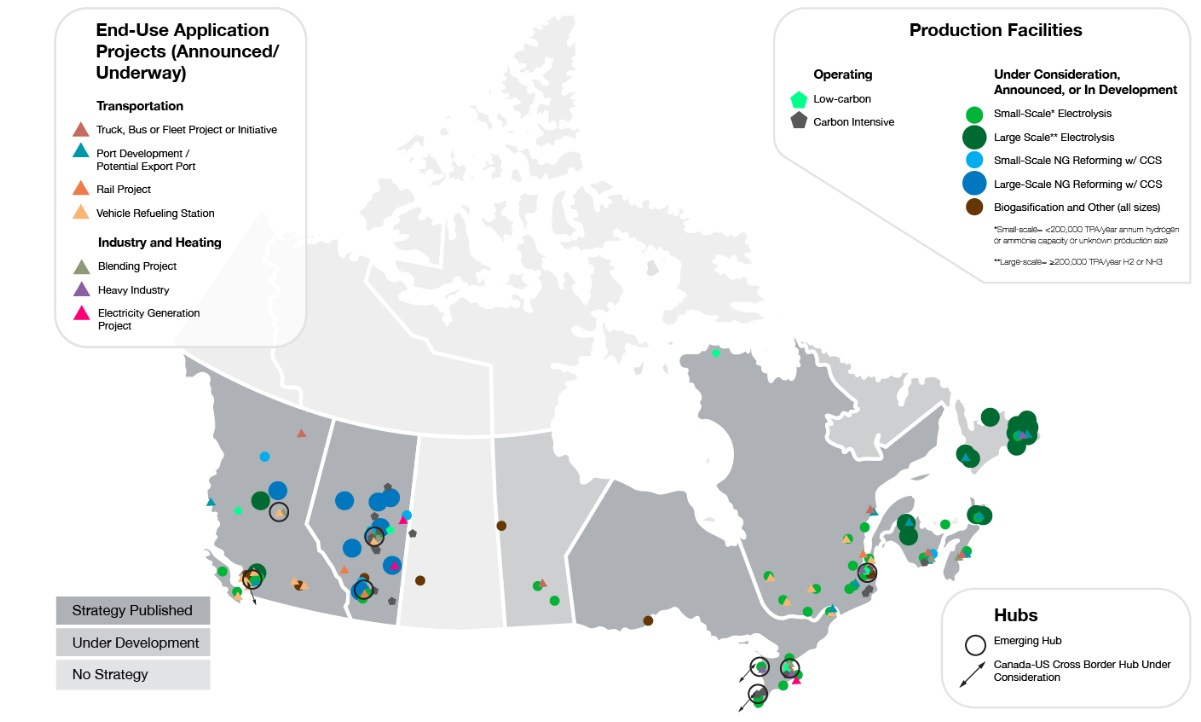
Canada, the second largest country in the world by landmass but with a population that is half the size of Britain, has seen an uneven distribution of hydrogen projects between Nova Scotia, on the Atlantic coast, and British Colombia (BC), on the Pacific Coast and almost 6,000 km away.
Some of the greatest advances in clean hydrogen production have been seen in BC and Quebec, each of which receive around 90% from hydroelectricity, while heavily-forested Quebec has also begun work on production from biomass.
Alberta, an oil- and gas-rich province, has taken steps toward the production of hydrogen via SMR, much of which is being funneled toward the massive agriculture sector for fertilizer production.
Regional use of clean hydrogen is low-hanging fruit for decarbonizing hard to abate industries, according to President and CEO of Source3 X Ayaz Khokhar, with larger scale projects contingent on developing infrastructure and transport such as by Canadian National Railways on west coast export projects.
The ‘Power-to-X’ company in July signed an MoU to collaborate on the Skeena Clean Hydrogen Hub in BC which will produce up to 50,000 tons of low-emission hydrogen, ammonia, e-fuels, or sustainable aviation fuels, a year.
Provincial approaches could be viewed as existing in three categories, including jurisdictions that just talk about it, or pay lip service to the industry, those involved in structuring and policy work, and those busy with implementation, says Khokhar.
The key to working within such a changing political environment was the ability to pivot rapidly if a province or region is not ready for the fuel you are producing, Khokhar says.
“While we are focused on hydrogen production from renewable energy sources in Canada, our implementation strategy is to keep pace with market acceptance and uptake,” he says.
“In short to medium term, our focus is on various applications, including derivatives and e-fuels, with long term goal of hydrogen use in its own form.”
Opinions expressed are those of the author. They do not reflect the views of Reuters News, which, under the Trust Principles, is committed to integrity, independence, and freedom from bias. Reuters Events, a part of Reuters Professional, is owned by Thomson Reuters and operates independently of Reuters News.
Share This:



















