CDN NEWS |
  US NEWS







With the growing demand for hydrogen as an energy source and basic material, the need for reliable and safe valves has become more crucial than ever. Already today, more than 600 billion cubic meters of hydrogen are produced each year worldwide for the process industry. Hydrogen is a basic material in many industries, e.g. in refineries, in ammonia production or other chemical processes. Hydrogen is produced by chemical processes or electrolysis processes using electrical energy.
In addition to these needs, the technology for using hydrogen as an energy source in combustion engines or via fuel cells is now also ready to replace petroleum products in the future.
The advantages of hydrogen as an energy carrier are among them:
- Neutral CO2-footprint: Hydrogen produced from renewable energies is a CO2-neutral energy carrier and basic material.
- Flexible energy storage: Hydrogen produced from renewable energies can be stored in liquid or gaseous form in tanks and caverns. It is distributed over the area using mobile tanks and existing gas pipelines.
- Power to X: Hydrogen can be used flexibly as an energy supplier in fuel cells, fuel in combustion engines and as a coke substitute in steel production. With the addition of CO2, it can also be used as a fuel and combustible.
Technical challenge for safety valves in hydrogen applications
The technical challenges in storing and transporting hydrogen can be significant. Hydrogen is stored and transported at high pressures and extremely low temperatures, which requires materials that are insensitive to hydrogen embrittlement.
Hydrogen embrittlement occurs when atomic hydrogen is produced on metal surfaces in contact with hydrogen. This penetrates into the metal structure and forms molecular hydrogen there again, which causes the metal to lose its elasticity and break without an expansion phase. Westech Industrial is proud to partner with LESER, a leading manufacturer of safety valves who has developed a solution to this problem by using austenitic steel, such as 1.4404, which is largely insensitive to hydrogen embrittlement. This material is used for LESER’s plates and seat bushes in hydrogen applications as standard.
LESER offers a range of safety valves for various hydrogen applications, including Compact Performance, High Performance, and API. LESER recommends using austenitic stainless steels such as the LESER standard materials 1.4404/316L or 1.4408/CF8M for wetted safety valve parts. Whether cast or forged material is to be used depends on the respective application conditions.
LESER Safety Valves have proven their suitability for cryogenic temperatures from -150 °C/-238 °F to absolute zero for years. For best sealing results under these conditions, LESER recommends using a safety valve with nozzle in the product group API Type 5264, with metallic sealing surfaces as the standard version. The disc and nozzle can be stellited using LESER option codes J25 and L65, respectively.
LESER covers the entire hydrogen value chain, from production in process plants to consumption in fuel cells. LESER also tests safety valves for cryogenic applications on its own cryo test bench. The test stand is based on the standard DIN EN 13648-1 and is certified with a 3.1 or 3.2 acceptance test certificate according to DIN EN 10204. All valve sizes relevant for hydrogen can be tested for leaks under real conditions with nitrogen.
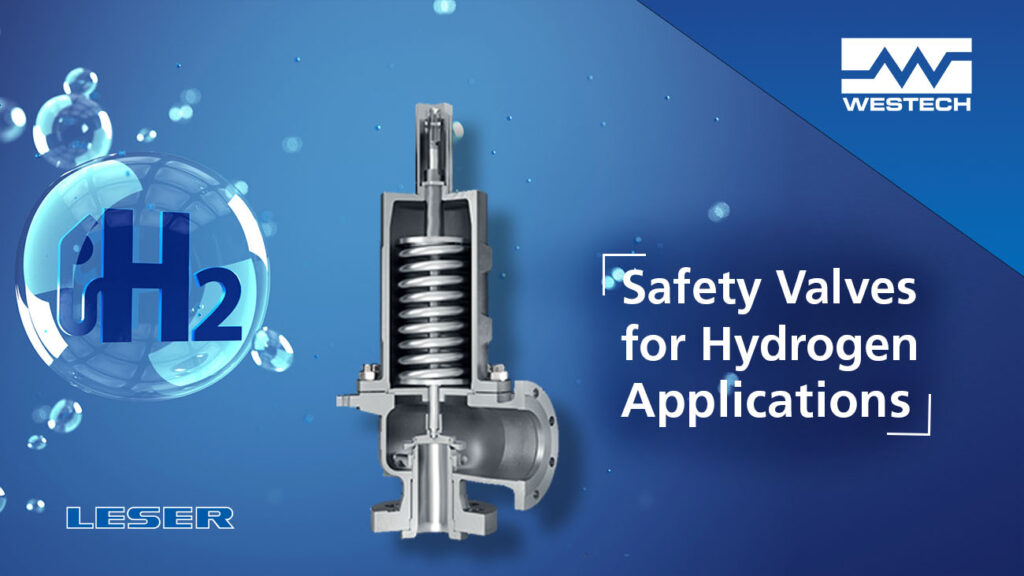
At Westech Industrial, we are committed to providing our customers with the highest quality products and services. As a partner of LESER, we can offer reliable and safe valves for hydrogen applications. Contact us today at 1-800-912-9262 or visit our website to learn more.
Share This: