


 CDN NEWS |
  US NEWS









In 2022 the Canadian oilpatch emerged from a long slump that actually began in 2008.
The result is a solid foundation for 2023 and beyond. If we don’t screw it up.
Why 2008? Because that’s the last time the Canadian oilpatch was truly firing on all cylinders.
That year WTI peaked at the record price of US$145 a barrel. AECO spot gas approached $10/GJ. Oil and gas prices have not approached those lofty levels since.
In 2008 Stephen Harper was Prime Minister, and the original Keystone pipeline was under construction. Fossil fuels were still regarded as affordable and dependable sources of energy, not the end of life on earth as we know it. Harper regularly mused about Canada becoming an “energy superpower.”
There were hydrocarbon-friendly governments in B.C., Quebec, and even America. After winning the 2008 election on a climate-concern platform, U.S. President Barack Obama presided over a massive increase in U.S. oil and gas production to the point that America alone made fossil fuels more affordable globally.
The fundamental driver of investment decisions was free cash flow from operations.
The primary guilt associated with investing was not making as much money as everybody else.
Government debt was lower and manageable. According to OECD data, the average debt to GDP ratio for all 38 member countries in 2008 was 44.6%. Canada was at 28.6%.
By 2021 those numbers had exploded to 124% and 131% respectively.
What has changed since 2008 is incredible. It’s amazing we’re still in business.
What is less understood is the ways in which things improved significantly in 2022.
Here’s three favorable fundamentals for 2023 and beyond.
And what could derail a multi-year recovery.
Natural gas makes a big comeback
The commodity that has received the least credit for Alberta’s recovery in 2022 is natural gas. Back in 2008 the Alberta government’s AECO spot reference peaked at $9.87/GJ in June. What followed was the collapse of Alberta gas prices and significantly reduced jobs, investment and production volumes. The cause was the North American shale gas revolution which began in 2005.
By June of 2019 gas averaged only $0.55/GJ, a 94% reduction. Production declined significantly as export markets in Ontario and the US Northeast were lost to U.S. gas much closer to consumers from the Marcellus Shale. Alberta gas output peaked at 13.8 billion cubic feet per day in 2000. By 2013 it was down 30%.
The core conventional gas drilling areas of central and southeast Alberta would eventually be abandoned. Here’s some drilling data from 2005 compared to 2021.
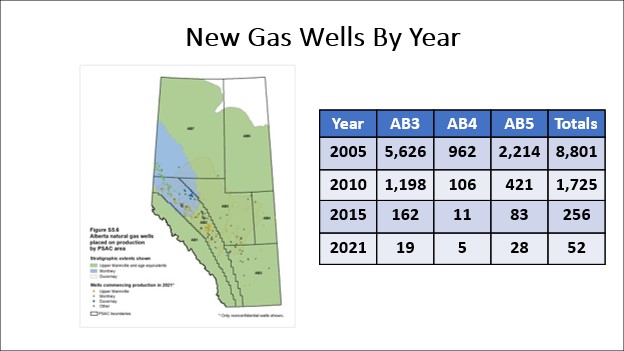
For decades much of the gas activity took place in PSAC (now Enserva) areas AB3, AB4 and AB5. They comprise almost half the province by area.
Back in 2005 when gas prices were higher, there was record drilling activity in these areas.
Low prices and rising operating costs clobbered drilling activity. The long-vibrant oil service industry in Brooks, Medicine Hat, Taber and Drumheller has been severely impacted.
Billions of dollars of oil service assets have been rendered obsolete as investment in conventional gas plunged and capital migrated to the oil sands and the lights tight oil plays of western and northwest Alberta.
Billions more were required to build a new generation of drilling rigs, hydraulic fracturing spreads and coiled tubing units to create and service extended reach horizontal wellbores.
Gas production has been sustained, but not as a target. Gas has primarily been a by-product of the pursuit of more valuable oil and natural gas liquids.
Alberta gas came back big time in 2022, averaging $4.66/GJ for the first ten months with monthly highs not seen in 14 years. The average would have been higher had it not been for continued issues with the NGTL system.
In the fall of 2022 gas production was back above 11 bcf/day, 41% higher than some months in 2013.
From 1970 to the estimates for the 2022/23 fiscal year, 35% of total provincial royalties will be from natural gas. In the go-go gas years from 1996 to 2006 it averaged 64%.
Due to years of underinvestment in new gas supplies globally and Russia’s invasion of Ukraine, an international gas market has emerged through LNG. Growing U.S. LNG exports have put a new floor under North American gas prices.
With LNG Canada ready to start shipping 1.8 bcf/d in 2025 – 10% of Canadian output – gas prices are going up, not down.
Not well understood is that Alberta has become Canada’s largest gas consumer thanks to oil sands, petrochemicals and electricity generation.
According to the Canadian Energy Regulator, in 2020 Alberta used over half the natural gas in Canada, 6.4 bcf/day or 56% of Canadian demand. Alberta’s “industrial sector” required 5.4 bcf/day, 84% of the total. Low gas prices have provided the province with a significant competitive edge in many areas.
More gas production will be essential. It is time for the province and explorers to be looking at all sources of future supplies. It should come from everywhere.
One obvious solution is to look at the cost structure and regulations that have helped cause drilling for conventional gas in central and southeast Alberta to collapse. It is not just price.
Western Canadian natural gas once again has a tremendous future. But it requires attention.
Oil sands persecution ends at last
Although it went unnoticed at the time, 2008 was the year U.S. environmental activist group Corporate Ethics invented The Tar Sands Campaign, a multi-prong, multi-faceted initiative intended to ensure the explosive growth planned for oil sands production was capped by every means possible.
Over the next ten years oil sands – and by default Alberta – became the poster child for everything wrong with fossil fuels. Campaigns were launched, books were written, protests were organized, NEB hearings disrupted, pipelines were cancelled or abandoned, and elections were fought and won.
Famous people flew to Fort McMurray on chartered jets to pose for photos, hold press conferences, trash the place, and fly home. There was no combination of words too strong nor offensive to vilify this single resource and the people and places that produced it.
The anti-bitumen frenzy made its way to the EU where at one point there was a plan to ban imports of this deadly hydrocarbon. The Keystone XL pipeline become such a flash point for U.S. environmentalists that it was cancelled in late 2015 by President Obama.
That year new climate-concerned governments in Edmonton an Ottawa added more weight to the oil sands assault. NDP Premier Notley’s Climate Leadership Plan capped oil sands emissions. Her party was already on the record as opposing the KXL and the Northern Gateway pipelines.
Federally, Prime Minister Justin Trudeau pledged to cancel Northern Gateway and replace the National Energy Board, the out-of-touch federal regulator that kept approving new oil export pipelines after concluding they were in the national interest.
Notley and Trudeau went arm-in-arm to the Paris climate change conference in November 2015 and agreed to everything regarding emission reductions. The signal to the oil industry and investors on the future of Alberta’s oil sands was clear, powerful and universally negative.
By 2017 billions of dollars of investment capital was fleeing the country as formerly enthusiastic oil sands developers sold out to Canadian operators. With no secure pipeline takeaway capacity and a de-facto cap on output, it made no sense to expand production in Canada.
The oil sands hit bottom in 2019 when the Liberals passed bill C-48, the Northern BC tanker ban. This ensured no oil sands crude would ever find its way from Alberta to the nearest tidewater access.
Other countries have prohibited oil exports. But the reason has been domestic security of supply, not international environmental protection.
“Civil society” would not permit this resource to be fully exploited. Woke climate politics made Canadians feel embarrassed about exploiting the world’s second largest oil deposit.

Most haven’t noticed, but in 2022 the awfulness of oil sands all but disappeared from public discourse. Last March Energy Minister Jonathan Wilkinson told the International Energy Agency that Canada may be able to increase oil exports by 300,000 b/d by year end to assist Europe in getting off Russian crude.
Dreaded oil sands of course, the stuff the EU once considered banning.
Having cancelled KXL a second time in early 2021, U.S. president Joe Biden is now encouraging increased production from the other country with massive heavy oil resources, Venezuela. Appalling human rights and environmental records are now less important than keeping oil prices down.
Because price and availability is what matter most. Again.
Oil sands producers deserve significant credit for fighting back with major emissions reduction commitments and programs. The current high levels of profitability while reducing emissions was long claimed to be impossible.
But what’s more important is the realization that 3.2 million b/d of oil production securely situated in the North American land mass is a fantastically valuable strategic supply asset.
How ridiculous did the anti-oil sands crusade get?
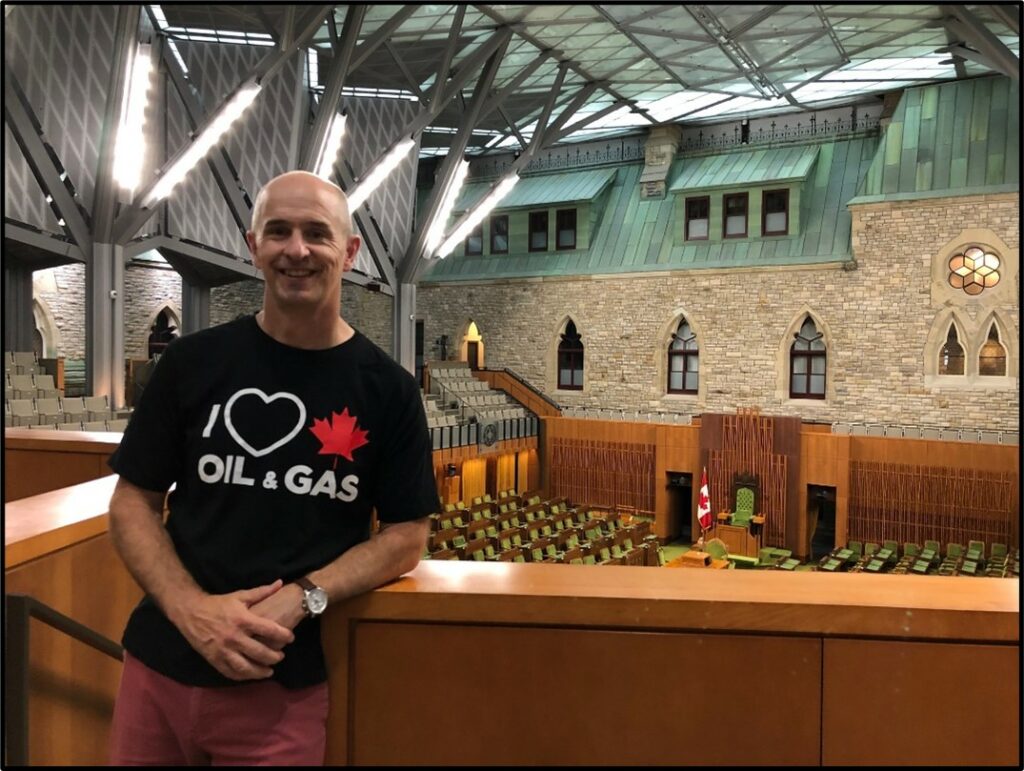
When Calgary oil finance executive William Lacey wore this t-shirt to the senate in Ottawa while on vacation in 2019, he was asked by security to turn it inside out lest some other poor Canadian be “triggered” by the mere sight of oil, gas, a heart and a Canadian maple leaf within inches of each other.
In the end a mistake was admitted, and an apology issued.
But such was the intensity of the irrational, woke-driven, anti-oil psychosis that affected ordinary Canadians.
For which Alberta paid dearly. It was quite fashionable for too many Canadians to trash oil sands, Alberta and Albertans.
It’s over. Thankfully. And is unlikely to return.
Tough times change the channel for consumers
The most significant improvement for the oil industry and western Canada is the political and economic engagement of a generation of Canadians confronting problems it has never seen – wars, shortages, inflation, and rising interest and mortgage rates.
A large portion of the population has no experience with such difficult economic conditions. The 2021 federal census revealed that of the country’s 38 million inhabitants, 15 million – nearly 40% – were born in 1977 or later and fell into the age group of 15 to 44. This includes the so-called “millennials,” those born from the early 1980s to the late 1990s.
None of these folks would recall the high energy prices and gasoline shortages of the 1970s, the double-digit interest rates and inflation rates of the 1980s, unemployment rates of 10% or more from 1982 to 1985, or rapidly falling housing prices. If they were alive, they were still children.
Another factor affecting 21st century policy is urbanization. Today over 80% of Canadians live in towns and cities. It was only 60% in 1951 and 13% in 1851. This means that more people than ever don’t know where anything comes from.
This trend has not been kind to resource or food producers.
These are the voters who were easily persuaded that fossil fuels were bad, wind and solar electricity were good, and politicians who campaigned for climate change policies and against fossil fuels had their best interests at heart.
For urban voters, fuel came from a gas pump, electricity from a wall socket, and food from the grocery store. What else did they need to know?
That has all changed because of a troubling new world where the essentials of life aren’t always cheap and readily available.
And developed countries previously thought to be past military conflicts and territorial expansion are killing each other with weapons from all over the world. The economic impact on European people and industries is devastating.
In November national house prices were down 12% on average from the previous year. This hurts most where most of the houses are, the major urban centers.
Mortgage rates are rising. Lenders are already allowing borrowers to skip the principal portion and pay interest only. Or skip a payment entirely once a year and add it to the outstanding balance.
But in Alberta, house prices are only down 1% year-over-year. Why? Because rising commodity values have a positive economic impact.
The rest of the country is still paying attention to Alberta, but for entirely different reasons.
The CBC reported December 21 that, “Alberta sees largest population increase ever: StatsCan data.” The subtitle read, “Good economy, cheaper cost of living are contributing to exodus to Alberta, economist says.”
The article opened, “Alberta’s population grew by nearly 60,000 people between July and September of this year — more than in any other year since Statistics Canada began estimating populations in 1951.”
Around the world the conversation about what really matters is changing fast. This includes Canada.
Whatever has been awful about Alberta for years is now less important than major economic drivers. This will change the channel for western Canada and the oilpatch for many years to come.
How to wreck it all
Canadian climate wedge politics and lack of voter interest in the economy in the past seven years has ruined Canada’s reputation as a safe, predictable and reliable place to invest.
Alberta and its oil industry bore the brunt of a myriad of poor political decisions designed to attract votes, not investment, jobs and wealth creation.
In 2022, the forces of global energy and economics have reminded the world what really matters.
The collateral benefits to Alberta have been tremendous.
There will be at least one political fork in the road in 2023. Possibly two.
In Alberta, the NDP wants another shot at governing. Leader Rachel Notley is apologizing for her mistakes in 2015 and claiming that if given another chance, she will do things differently. Notley now preaches “stability,” fully aware of how little of that the NDP provided last time.
The polls among decided voters indicate that were an election held today, the NDP could be returned to office.
How quickly we forget.
Federally, there are persistent musings about the Liberals going to polls again in 2023. With Justin Trudeau as leader.
It seems incomprehensible after the events of the past seven years that he could win another federal election.
But so was the idea that the world no longer needed oil, coal and natural gas.
Happy New Year.
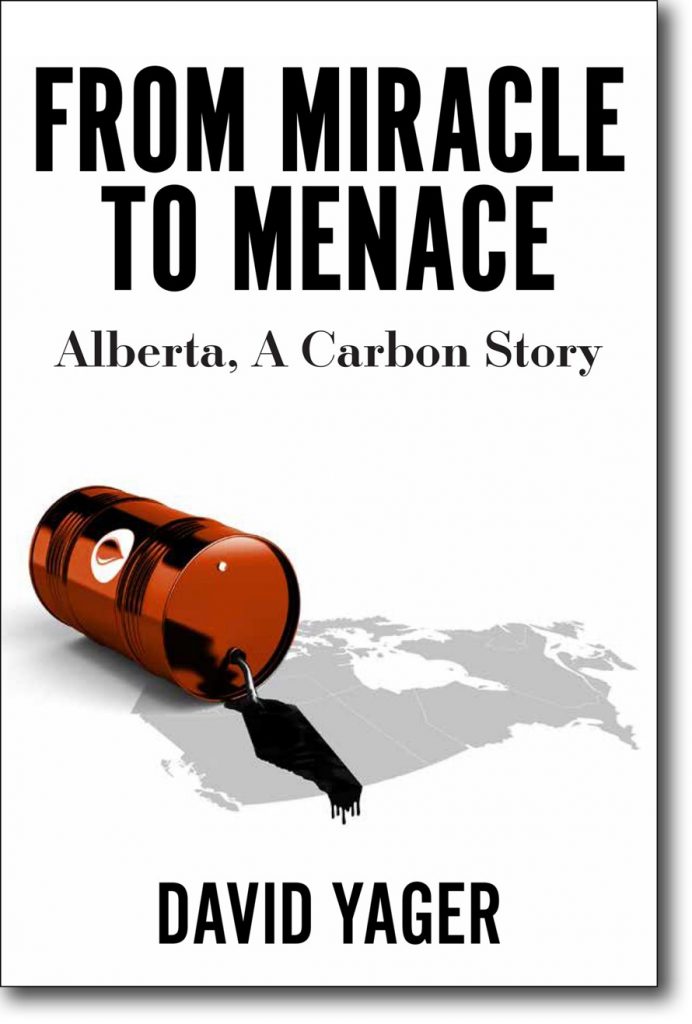
David Yager is an oil service executive, oil and gas writer, energy policy analyst and author. His book From Miracle to Menace – Alberta, A Carbon Story can be found at www.miracletomenace.ca
Share This:




















COMMENTARY: Hot Air and Fires in Ontario Mean its Climate Panic Time in Central Canada: That’s Never Good News for Supporters of Conventional Energy Production – Jim Warren