


 CDN NEWS |
  US NEWS







By Geoffrey Cann
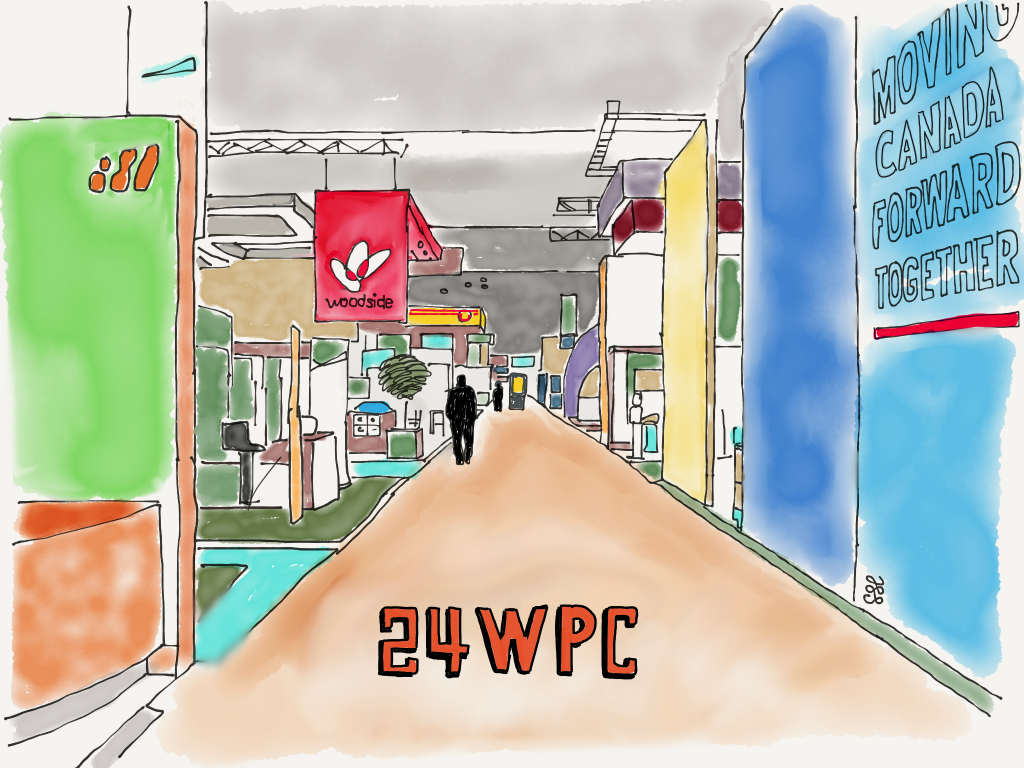
The World Petroleum Congress is just around the corner, and it’s coming to Calgary. Now is the time to get this on your business calendar for 2023.
The WPC
In the global landscape of oil and gas events, a few stand out because they are truly global in that they change venues rather like the Olympics, they’re infrequent (perhaps every three or four years, allowing the passage of time to provide for fresh insight on the latest topics), and they’re large. My most recent personal experience at such an event was LNG18, held in Perth, Australia in 2016, with a focus (obviously) on the global liquefied natural gas trade. Australia had arisen, from the ashes of the 2008-09 global financial crisis, to become one of the world’s largest producers of LNG, and Australia’s experiences were the topic of considerable global interest.
Well, Calgary is about to experience something quite rare, which is a return visit of the World Petroleum Congress (WPC), in September of 2023. This is a big deal, and not just because of the inflow of tourism dollars into the local economy. Only four cities have ever hosted the WPC more than once.
I remember the last WPC that was held in Calgary, in 2000 (yes, I’m that old). The event attracted every serious oil company on the planet, including the big international players, OPEC, the national oil companies, the leading think tanks, the biggest traders, the most important shippers, the largest equipment companies, bankers, consultants, engineering firms … The city, which is already fairly cosmopolitan, turned into a United Nations of flags, customs and events.
This congress is important for Canadians and Canadian oil companies because the domestic industry is only tangentially linked to the global market — almost all of Canada’s oil is either consumed domestically, or is sent to the US. As a result, the national conversation about oil tends to be on domestic or continental issues, such as market access, provincial spats, pipeline politics, the Inflation Reduction Act, and regulations.
Even Russia’s invasion of Ukraine feels distant in that the impacts are mostly indirect—relatively few Canadian oil or gas companies had operations in Russia, and supply chain exposure for equipment companies was limited. Canada’s political leadership is pretty mixed on its commitment to energy—on the one hand, the federal government purchased a pipeline project to serve the Asian market, but can’t quite see a business case to get energy to the EU.
But for the rest of the world, energy security is of national strategic concern, and the Congress affords energy nerds like me a week to marinate in the most interesting discussions on the most important topics facing energy today. Here’s just a taste.
The Outlook for Demand
The WPC will speak loudly about demand.
The forward curve for oil demand is as unpredictable as ever. Consumption data points to flat or declining demand in the OECD economies (a club of rich nations), but rising demand in the big demographic nations (China, India). There is huge untapped demand still in Africa which remains dramatically under-energized relative to the West. The pace of decarbonization efforts to curb demand has been pitifully slow to date, but is expected to increasingly temper the demand curve as companies, industries and nations follow through with their commitments under the COP process.
And of course plenty of unknowns pepper the demand equation with additional uncertainty. How quickly can the auto industry migrate away from internal combustion drive trains to new drive train designs (electric, hydrogen, other)? What will be the uptake of new transportation energy options by the various material market segments (personal vehicles, light duty trucks, heavy haulers, aircraft, shipping)? Will the plastics industry adopt a closed-loop model for their products, increasing plastics reuse, and potentially trimming demand for virgin plastics? What other factors impact demand forecasts, such as carbon capture, the shifts to service weighted economies, on-shoring, and efficiency and productivity gains from business transformation?
There will be many early and important presentations on the demand outlook, from the IEA, the EIA, OPEC, and many others. I would expect a country by country analysis from the great importing economies (Korea, Japan, China, India, the EU). Consuming nations may be tempted to paint a rosy demand picture so as to motivate supply so there should still be some pointed questions on the outlook.
What About Supply?
Oil is a long game – you can see the competition coming for years. It can take a decade or more to discover a new field, negotiate access, finalize contracts, obtain permits, plan and deliver infrastructure like pipelines, and get product to market. The players are well established (OPEC, Russia, the US, Canada, Brazil, Mexico, China). Big discoveries are few and far between, so supply growth tends to be incremental.
It’s not clear where incremental supply will come from any longer. At one time, Canada aspired to be an energy superpower, but that’s no longer a national aspiration (although clearly a provincial one). Venezuela is all but shut in. Russia may supply but to whom? OPEC struggles (or resists calls) to raise supply. The US looks like the new global swing player, but even that market now requires oil producers to be fully economic and not addicted to a diet of cheap capital.
Annual decline curves of 6% on average dictate constant investment to keep supply steady, but with demand so hard to predict, rosy talk about big new basins being opened up is unlikely.
Each exporting nation and producing jurisdiction will be invited to the podium to present their national story of supply promise. The majors will also sketch out their supply positions, mostly to support their capital market assessments.
Economists will be busy with their slides and charts working with incomplete aggregate data trying to show how new supply will satisfy new demand. There will be discussions about whose oil is most likely to be shut in as demand first flattens and then contracts (some nations are already talking about being the last supplier standing).
Energy Transition
The big topic will be the pathway to net zero, or energy transition. Not every company and not every nation have committed fully to net zero, but enough have that net zero will consume a meaningful chunk of the agenda. I suspect that companies without a net zero story won’t be invited to address the gathering, and that says much about the company, frankly.
At the most macro level, energy transition is about balancing the unpredictable and slowly sloping downward demand curve with the choppy and step function supply curve. The winter storm in Houston last year underscored just how interrelated our energy supply chains are—shortages of power can shut down gas infrastructure, and gas shortfalls for power generation mean power shutdowns. See the vicious cycle? Energy transition is also a hard money issue at the local level, and proving very challenging at the macro level (see the COP meetings).



A company strategic discussion will be on how the players in the industry may be adjusting their product portfolios to diversify. With the world becoming more electric and less combustive, the oil company of today may well become the energy company of tomorrow. The pace of that diversification will vary, with the example of DONG Energy at one end (very fast, ahead of the market), and just about everyone else at the other (resolute, focused).
Carbon will no longer be a four-letter word, but will feature prominently in working sessions around measurement, carbon markets, carbon credits, financing models, and other related topics.
Finally, the oil industry is doubly impacted by energy transition because the companies in the industry consume oil products themselves and will make their own net zero commitment, in addition to being purveyors of fossil fuels that everyone else is trying to offset. There is plenty of opportunity for the oil industry to materially impact its own carbon footprint because of mechanical weaknesses throughout the industry — over-pressured tanks that vent, flare pilots that flame out, wells that use pressurized off gas to actuate valves, assets that rely on diesel generators for power, rogue leaks from faulty valves, and excessive energy use because of overburdened filters and compressors.
Expect lots of conversation about practical net zero moves that companies can make, a just energy transition for the masses, state interest in energy security, and quite possibly, an interest in mineral and mined commodities for future energy.
Oil and Geopolitics
The big lesson of 2022 is that leading energy suppliers, at least those under the direction of autocrats, may be tempted to turn their energy products into geopolitical weapons. That’s been the take away for all big energy importers thanks to Russia’s hot war with Ukraine. Few countries in the future will permit themselves to fall into such a trap, and will seek energy diversity of supply to manage for energy security risk. Supply portfolio rebalancing is well underway.
At the congress, I would not expect much discussion about Russia and Ukraine, but I would expect to see real data on how trade flows have materially changed, where new infrastructure could be profitably deployed, how shipping has transformed to deal with moving crude oil to market, and the impacts of price sanctions on the overall market. I would anticipate seeing supplier relationship realignments as China and India purchase Russian crude at deep discounts, while Middle Eastern crude supplies swing to the EU. Data about crude volumes passing through the major canals (Suez, Panama) will be instructive.
Other voices, from the insurance industry, the legitimate shipping sector, banking sector, and trade finance (the three levers that can throttle oil trade), will provide data about the markets from their vantage points — pricing, volumes, availability, utilization rates.
The forum will not get into topics like NATO expansion, economic sanctions, and infrastructure nationalization. Save that for some other event.
Business Transformation
Finally there are a huge range of lesser topics that will get some measure of airtime, including:
DIGITAL TRANSFORMATION
The industry has historically lagged in embracing digital for its business, but the pandemic has finally unlocked enthusiasm to do business differently, particularly among those players in the west.
CAPITAL EXECUTION
The oil industry, particularly in the upstream, starts with capital execution. The industry needs a few hundred billion dollars of fresh capital per year, but construction management has not yet been dramatically improved through digital. Pressure is building on the major engineering houses to up their game.
TALENT
Young people don’t want to work in an industry that the world wants to transition from. This is firstly self-interested career risk management. For others it’s about their personal brand—some young people do work in the industry but avoid any public acknowledgement of that in case their friends find out.
The industry is still not reflective of the population at large. Women and indigenous people continue to be under-represented in the front lines of the industry. The industry will be again asking hard questions about talent.
Conclusions
WPC only comes every four years, and rarely twice to the same city. Canadians should be proud that WPC is paying a return visit. Add the WPC to your plans for September 2023.
Check out my latest book, ‘Carbon, Capital, and the Cloud: A Playbook for Digital Oil and Gas’, available on Amazon and other on-line bookshops.
You might also like my first book, Bits, Bytes, and Barrels: The Digital Transformation of Oil and Gas’, also available on Amazon.
Take Digital Oil and Gas, the one-day on-line digital oil and gas awareness course on Udemy.
Take the one-hour Digital for the Front Line Worker in Oil and Gas, on Udemy.
Mobile: +1(587)830-6900
email: [email protected]
website: geoffreycann.com
LinkedIn: www.linkedin.com/in/training-digital-oil-gas
Share This:






















REMAKING THE LANDSCAPE FOR INVESTORS – The First-Ever Canada Investment Summit – Maureen McCall