


 CDN NEWS |
  US NEWS









David Yager
When Premier Danielle Smith enters the Alberta legislature today, it will mark the most remarkable political comeback in provincial history.
Smith started thinking seriously about seeking this job 14 years ago when she was approached to become the leader of the Wildrose Party. She won that title in 2009, became an MLA and leader of the opposition in 2012, then lost her nomination race before the 2015 election.
After seven years outside of politics, Smith won the UCP leadership race October 6, became an MLA in a by-election November 8, and today will take charge in the provincial legislature.
Since entering politics in 2009, much has been written about Premier Smith’s media positions and every mistake she has ever made. There’s lots to choose from.
What is never mentioned is that Danielle Smith is the most knowledgeable premier in history when it comes to the oil and gas industry and energy policy. She grew up in the oil business because both her parents worked in it. Smith has been an active student of and participant in energy policy for 13 years.
Many positions and policies negatively affect Alberta’s oil industry. These include Premier Stelmach’s New Royalty Framework, the American Tar Sands Campaign, pipeline protests and cancellations, emission caps, carbon taxes, the replacement of the National Energy Board, west coast tanker bans, and depriving the fossil fuel industry of investment capital.
While most are external, several have been invented in Alberta.
In the quest for expanded market access, in the past 10 years Alberta has been at loggerheads with BC, Ontario, Quebec, Ottawa and the US.
Premier Smith has a keen interest in all aspects of public policy. This includes how the oil and gas business works, and how resource wealth goes from subterranean Alberta into the pockets of Albertans and into fuel tanks and furnaces across North America.
Alberta is one of the top ten gas producing jurisdictions in the world. Considering the outsized influence of this industry in this province, you would think that having a premier with deep understanding of the sector would matter at the ballot box.
But it doesn’t. Looking back at all the premiers since Leduc, industry knowledge or experience has never been a factor at election time.
Too bad.
Because in these times of a continued political assault on fossil fuels, global energy shortages, inflation, skyrocketing federal debt, the worst federal/provincial relations in decades, and a strained relationship with other parts of Canada, it should.
**********
The officially incorporated Wildrose Party was created just before the 2008 election. It gained immediate financial support from the oil industry during the campaign in response to the New Royalty Framework introduced by Progressive Conservative premier Ed Stelmach in 2007. Wildrose MLA Paul Hinman was the only member of the legislature opposed to the policy.
Although Stelmach openly campaigned against Alberta’s most important industry, he won 72 of 83 seats.
This very un-conservative policy was created to ensure the oilpatch would finally pay its “fair share” of the government’s expenses through sharply increased production royalties.
What makes the attractiveness of Stelmach’s royalty hikes difficult to comprehend is that in the previous eight years, non-renewable resource revenue from land sales and production royalties totalled a record $79 billion. This averaged nearly $10 billion per year.
This massive windfall paid off the provincial debt from the 1980s and 1990s, stuffed $17 billion into the Sustainability Fund, and allowed premier Klein to give 400 “Ralph bucks” to every living Albertan in early 2006.
By comparison, in the previous thirty years back to 1970, the total was $83 billion, an annual average of only $2.8 billion.
But politics and mathematics are not the same thing. Even though oil and gas is the primary reason 4.4 million people live in this landlocked, remote and otherwise underpopulated region of North America, the oilpatch is increasingly taken for granted.
As Stelmach proved in 2008, what the voters want to know is, “What have you done for us lately?”
Now that the ‘patch is back in the chips after eight tough years, demands for more producer cash for more people and projects has resumed.
With an election set for the spring of 2023, politicians who are paying more attention to spending oil revenue instead of keeping it coming should be a serious concern for the industry.
In the budget update released on November 24, estimated non-renewable resource revenue for the fiscal year ended March 31, 2023 could be $28 billion.
Put another way, in 12 months the provincial treasury will collect over 11% of all the non-renewable resource revenue it received in the previous fifty years. Of the total, 69% will come from the dreaded oil sands which has become so controversial this century.
With all this new loot in the treasury, the battlefield for the next election won’t be about how to keep the golden goose laying these colossal eggs, but how much of the windfall will end up in your pocket if you vote appropriately.
While the recovery is welcome and long overdue, the oilpatch faces serious challenges on many fronts. Years of multi-pronged assaults from inside and outside the province won’t end soon, if ever.
Having a premier with a deep understanding of the intricacies of the 21st century global energy industry is more important than ever before.
But for Albertans, this has never been a prerequisite.
**********
The premier when Imperial Oil struck oil at Leduc in 1947 was Ernest Manning, a Social Credit cabinet minister who replaced Premier William Aberhart as leader after he passed away in 1943. Manning joined the Socred party as an organizer and became an MLA when it won its first election in 1935. He was 29.
The Wikipedia version of Manning’s training for public office reads, “Manning was among the first students of William Aberhart’s Calgary Prophetic Bible Institute, which opened in 1927, and became its first graduate in April 1930.”
Back then people expected little from government and usually got less. But Manning was a capable administrator and his government played a major role in turning Leduc #1 into a permanent economic bonanza. His government expedited and/or funded continuous infrastructure expansions including export pipelines, a natural gas gathering system, and roads, schools and hospitals for the growing population.
The Social Credit party won nine consecutive majority governments.
In 1971 the post-war baby boom generation was of voting age and wanted something more modern politically. After 25 years of peace and prosperity after the Second World War, “progressive” politics were gaining popularity. That year the Progressive Conservative party under Peter Lougheed won the first of 12 majority governments, a political dynasty that would govern Alberta for 44 years.
Thanks to his father Senator James Lougheed, Peter Lougheed had a head start in Alberta politics and its business establishment. But no direct experience in oil and gas. He was a lawyer and businessman before he won the PC party leadership in 1965. In the 1971 election Lougheed’s PCs won 49 of 75 seats.
One of his first acts as premier was to raise oil and gas production rents to get more funds to “modernize” the provincial government. When OPEC jacked up oil prices in 1973, the cash really started pouring in. An epic federal/provincial revenue and control battle ensued culminating in the National Energy Program of 1980.
Under Lougheed, wellhead royalties rose from about 12.5% to as high as 50% depending on price ten years later. He was very popular when the economy was booming. Protecting Alberta from Ottawa’s interference rallied Albertans around their leader and government.
The PCs had so much money they had to invent new ways to spend or save it. The size and cost of government grew dramatically, as did the expectations of what voters should expect from their elected politicians.
Whatever his legacy, Peter Lougheed was no great friend of the oil industry, particularly when he cut back oil production by 15% to protest the NEP. As one quip from an oil executive at the time illustrated, “He may be a son-of-a-bitch, but he’s our son-of-a-bitch.” Lougheed’s popularity fell with the oil price collapse, recession, and skyrocketing interest and inflation rates of the early 1980s.
Don Getty became the new party leader in 1985. While seldom recognized for this, Getty had more direct oil industry experience than any PC premier. He earned a business degree, worked for Imperial Oil, and started his own oil company.

While Getty’s legacy remains tarnished, his achievements were significant. They included gas deregulation, new gas export pipelines, and a major royalty review in 1991 that significantly reduced them from the Lougheed era.
These initiatives laid the foundation for the industry’s gas-driven recovery in the 1990s.
In 1992 Ralph Klein became PC leader. A TV news reporter and mayor of Calgary, Klein was well known, well liked and personable. Thirty years ago the majority of voters understood that Alberta’s success would require less government, not more. The cuts began. Tough love from Edmonton in the 1990s was popular, perhaps because the 1980s had been so awful.
Klein’s timing was perfect as oil and gas prices and production volumes rose. His popularity grew with the economy. But by 2006, he was a spent force as evidenced by only 55% support at a leadership review. He resigned as leader.
Klein was replaced by Ed Stelmach, a farmer from Vegreville with no love for the oil and gas business. Stelmach won the 2006 PC leadership race in part by promising a royalty review. In politics, that rarely means they will be reduced.
In 2007 he announced the New Royalty Framework, a major transfer of wealth from producers to the province. But as Stelmach won the 2008 election, world capital markets had already begun to tremble. By year end oil prices collapsed and a global economic crisis was underway.
In response to the PC’s increased royalty rates, capital and equipment fled Alberta. At first Stelmach claimed it was geology. Alberta had no shale gas like BC, or shale oil like Saskatchewan. But by late 2009 it was clear that Stelmach’s royalty review was a policy disaster for an allegedly conservative government.
Alberta was no longer competitive for investment capital with other jurisdictions. So by mid-2010 it was all reversed, as was Stelmach’s future as premier.
After winning the 2011 leadership race, Allison Redford became premier. A lawyer by training, much of Redford’s career was in international human rights law, which had nothing to do with the oil business. She became a PC MLA in 2008 and was Minister of Justice and Attorney General under Stelmach.
After winning the 2012 election, Redford’s career as PC leader was short-lived following a series of spending scandals and poor decisions. By 2014 she too had stepped down, undoubtedly with a lot of help from her party.
PC MLA David Hancock served as acting premier for a few months while yet another PC leadership race was conducted. Jim Prentice won. Another lawyer, he became a federal CPC MP in 2004. Under Stephen Harper he was minister of Indian of Affairs and Northern Development, Industry and Environment. He left politics to work on Bay Street then decided to enter Alberta politics in 2014.
As pipeline construction and First Nations issues grew, Prentice appeared attractive to the oil industry because it was perceived he could overcome growing opposition to new export pipelines. Prentice was regarded as so unbeatable at the ballot box that eleven Wildrose MLAs crossed the floor to join his caucus in late 2014.
Seeing the economy deteriorating because of falling oil prices, Prentice called an early election in 2015. With Wildrose and the PCs splitting the conservative vote, the NDP snuck up the middle delivering Rachel Notley a majority government.
In power at last, the NDP immediately began shaping Alberta in its own image. This included a Climate Leadership Plan, a cap on oil sands emissions, corporate and high-income tax increases, and a restructuring of electricity markets.
The same year the Liberals under Justin Trudeau won a majority government. Trudeau and Notley went arm-in-arm to the 2015 COP 21 climate conference in Paris in November and agreed to everything. Through emissions ceilings, Notley’s prize was delivering a de facto cap on oil sands production that environmentalists in North America and Europe had been demanding for years.
Thanks to blocked market access, emission caps, and two key governments clearly unfriendly to the oil industry, what followed was the greatest outflow of capital, equipment and investment from Alberta since the NEP of 1980.
It wasn’t just the price of oil that caused the exodus. When Donald Trump became US president in 2016, he introduced tax changes that made American oil and gas investment very attractive. US oil production soared despite low oil prices. In response, Alberta capital and equipment headed south.
Edmonton and Ottawa made no effort to adjust their policies to keep Alberta competitive. For Notley and Trudeau, it was all climate all the time.
Jason Kenney’s career has had little to do with oil and gas. After working at the Canadian Taxpayers Federation, in 1997 he became an MP for the Reform Party which eventually morphed into the CPC. In 2016 he resigned and entered Alberta politics by winning the PC leadership on a platform to “unite the right” by merging the Wildrose and PC parties.
To ensure the NDP would not win the next election, the PCs and Wildrose merged in 2017. Jason Kenney won the subsequent leadership race. In the 2019 election the UCP won a majority government.
While Jason Kenney was always a booster of the oil industry, he had little exposure to the details until he became premier. But after garnering only 51.4% of support in a UCP leadership review three years later, he stepped aside and the UCP leadership race was underway.
Danielle Smith’s political career with Wildrose began in 2009 with knowing what not to do. Significant industry financial support followed Smith’s commitment to undo the PC’s New Royalty Framework. For the next six years she made a point of learning as much as she could about how the industry worked, and how to make it better.
After leaving politics, Smith became a radio talk show host. In almost six years at Calgary’s QR 77 she did hundreds of interviews with energy industry and policy experts. Because of the challenging times for the oilpatch, they rarely discussed friendly policies, high profits, production growth, or windfall provincial royalties.
As premier, her support for the oil industry is undiminished even though she now has many more issues and files to manage.
At the annual forecast meeting of the Canadian Association of Energy Contractors on November 23, Smith declared “We know that Alberta is the engine that drives Canada’s prosperity and the energy sector is quite literally the fuel in the engine…From the government of Alberta’s standpoint, let me be clear, we will always be allies to you in the industry as you embark upon ambitious growth.”
As the UCP leadership drama continued, the NDP began running attack ads. The promise was more of everything governments can provide for everybody. Their reference to oil and gas is still confined to “supporting a strong energy industry.”
When the election campaign starts, energy is not an area where the NDP will want to run on its record. Looking back at all the premiers since Leduc, Rachel Notley stands alone as the only one that formed government with sitting MLAs publicly opposed to oil sands and oil export pipelines.
But the NDP can hardly wait to get control the control of the huge bitumen royalties flowing in today.
While oil and gas still dominates Alberta’s economy, the popular public debate has been how it shouldn’t.
As a result, public awareness of the huge role oil and gas still plays in supporting Alberta’s economy remains low, particularly in the larger urban centres.
**********
In his 1961 inauguration speech US President John F. Kennedy famously stated, “Ask not what your country can do for you, but what you can do for your country.”
But in this era of massive public spending, public programs and public debt, that declaration is certainly stale dated.
The question for Albertans is clear.
Is 21st century Alberta an oil-funded welfare state with an uncertain future, or an important economic and energy engine for the province, Canada and the modern world?
Rachel Notley offers the former, Danielle Smith the latter.
That matters to me.
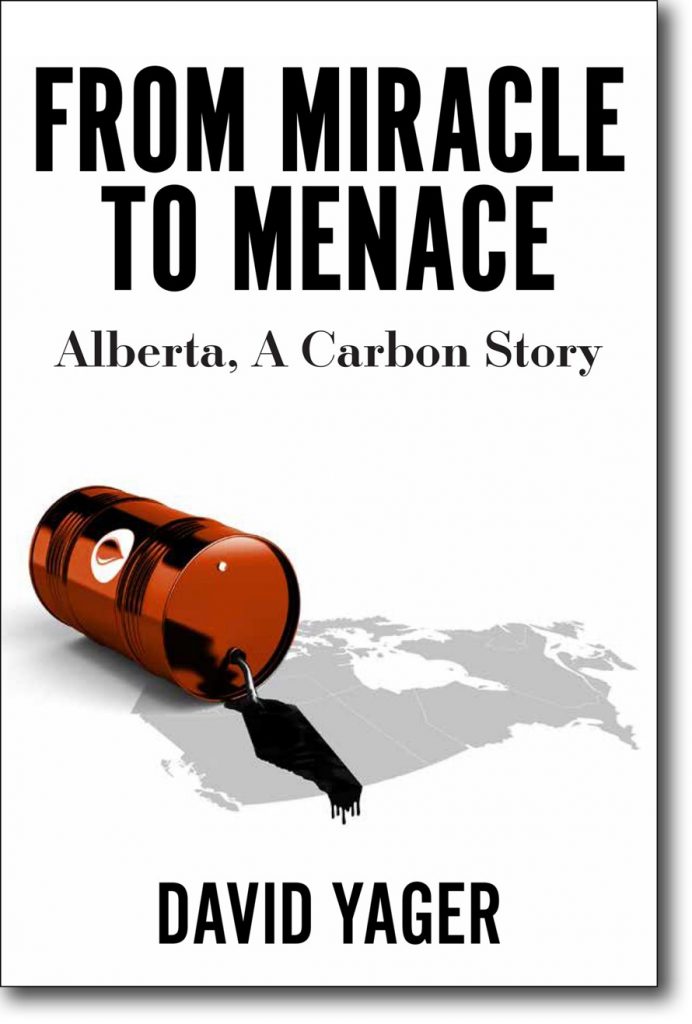
David Yager is an oil service executive, oil and gas writer, energy policy analyst, and author of From Miracle to Menace – Alberta, A Carbon Story. Find the book at www.miracletomenace.ca. He is President and CEO of Winterhawk Casing Expansion which is commercializing a new technology for improving wellbore integrity.
Share This:




















COMMENTARY: Hot Air and Fires in Ontario Mean its Climate Panic Time in Central Canada: That’s Never Good News for Supporters of Conventional Energy Production – Jim Warren