


 CDN NEWS |
  US NEWS







With its significant undeveloped oil and natural gas reserves, Canada can do much more to contribute to Europe’s energy security by filling the supply gap that sanctions on Russian energy are creating.
Unfortunately, the federal government is continuing in its determined efforts to strangle the oil and natural gas industry in pursuit of a rapid energy transition that is unlikely. Natural Resources Minister Jonathan Wilkinson did suggest that Canadian oil production could be ramped up to 300,000 barrels per day to help Europe. However, he sounded so half-hearted that it appeared unlikely he would take steps to make it happen.
More investment in Canadian energy development will produce jobs, energy security and tax revenue. Conversely, the federal government’s energy transition goal creates the following negative consequences for Canada:
- Failure to help European countries accentuates the impact of their energy insecurity. Aren’t these countries Canada’s friends and allies?
- Lower economic growth due to reduced investment in energy development. Can we defend the avoidable unemployment?
- Lower government income from energy industry taxes. Don’t we need this tax income to finance our ambitious social programs?
- Higher energy insecurity for Quebec and the Maritime provinces that rely on imported crude oil for almost half of their energy needs. Do we want to inflict avoidable disruption on Canadians that live in these provinces?
- Foregoing the opportunity to invest energy industry profits in cleantech projects. Don’t many Canadians want to pursue the energy transition at an achievable pace?
Immediate actions Canada can take
Ministers Wilkinson and Guilbeault’s comments about Canada’s constraints in responding to the European energy supply crunch were an embarrassment at best and a misrepresentation at worst. These European countries are supposedly our allies. We’re leaving them in the lurch when we can help.
Here are the obvious immediate actions Canada can take to help because the crude oil infrastructure is in place:
- Ship crude oil through the St. Lawrence Seaway to Europe.
- Ship crude oil from the Irving Oil refinery in New Brunswick to Europe.
- Ship Canadian crude oil from the US Gulf Coast to Europe.
Intermediate-term actions Canada can take
Canada can approve multiple LNG export terminals on the east coast. Investment in Canadian LNG infrastructure has the advantage of being closer to Europe than other LNG suppliers. The obvious projects that have been discussed or been in development for years are:
- Buckeye Partners’ Bear Head LNG project in the Strait of Canso – It’s fully permitted for construction and exports but has remained dormant for years due to low commodity prices.
- GNL Quebec Inc. Énergie Saguenay LNG Project – The Quebec government has rejected the proposal.
- Pieridae Energy LNG project in Goldboro, Nova Scotia – It’s currently stalled.
- Repsol LNG import terminal in Saint John, New Brunswick – The proposal is to add export capability.
To support additional crude oil exports and new LNG export terminals, Canada will have to:
- Revive the Energy East oil pipeline proposal to displace imported crude oil, including Russian volumes, and provide capacity to ship crude oil to Europe.
- Add capacity to the TC Energy mainline pipeline for natural gas.
Longer-term actions Canada can take
Canada can encourage investment in Canadian energy development by:



- Signaling receptivity for additional offshore oil and natural gas development proposals. Fortunately, the federal government recently approved the Bay du Nord Oil Project.
- Signaling receptivity for crude oil and refined petroleum products export terminals.
- Reversing Quebec’s ban on oil and gas development.
How much Russian energy are European countries buying?
The significant and continuing European energy demand ensures the economic viability of new Canadian energy development and related export projects.
During the first 100 days of the war in Ukraine, from February 24 to June 3, the largest energy importers from Russia were China (EUR12.6bln), Germany (EUR12.1bln), Italy (EUR7.8bln), Netherlands (EUR7.8bln), Turkey (EUR6.7bln), Poland (EUR4.4bln), France (EUR4.3bln) and India (EUR3.4bln).
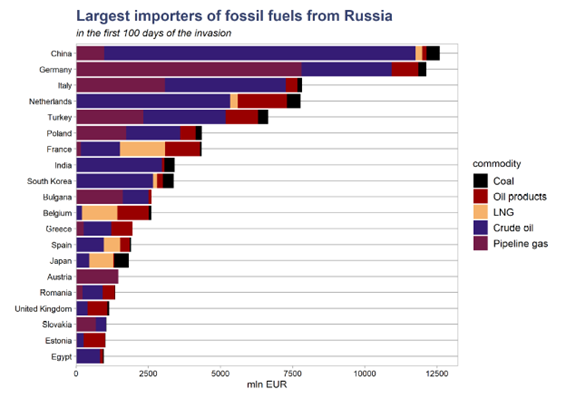
Source: Financing Putinʼs war: Fossil fuel imports from Russia in the first 100 days of the invasion
Given these large energy purchases, it will be difficult for these countries to change suppliers. We can expect that the European countries of Germany, Italy, Netherlands, Poland, and France will reduce Russian energy purchases as quickly as possible. That likely means starting to reduce seriously in 2023 and continuing reductions for at least five years.
If you want to know more about the European energy upheaval, please read: COMMENTARY: Can Europe wean itself from Russian natural gas? – Yogi Schulz
Yogi Schulz is an information technology consultant who works extensively in the petroleum industry to select and implement administrative, operations, and geotechnical systems. He writes regular articles about developments in the energy industry and technology.
You can contact Yogi Schulz through his LinkedIn profile at this link.
Share This:






















INSIGHT: Canada’s Economy Falling Behind Despite Misleading Headlines – Fraser Insitute