CDN NEWS |
  US NEWS







By Roger Chen, PhD, PEng and Jeff Nicholls, PEng, Stress Engineering Services Canada
Energy pipelines may need to be excavated to make repairs (e.g., of insulation, valves, welds) or assess the need for repairs (integrity digs). Excavations, especially longer ones, are usually carried out during a shutdown or reduced operational state to limit the thermal loading and stress in the pipeline. However, if possible, it is more economical to avoid associated shutdown costs by excavating during full operation. Although design assumptions would likely be exceeded under such a scenario, this does not necessarily entail a compromise of pipeline integrity as modern line steels have significant capacity to tolerate some plasticity. However, the following potential failure modes must be considered and assessed: line instability (global buckling); tensile overstraining of girth welds; and compressive overstraining leading to wrinkling. In doing so, it is necessary to consider and model locked-in stresses/strains resulting from construction (e.g., installation temperature, roping).
At Stress Engineering Service Canada, we have the experience and capability to assess the feasibility of hot excavation operations and are ready to help you plan yours.
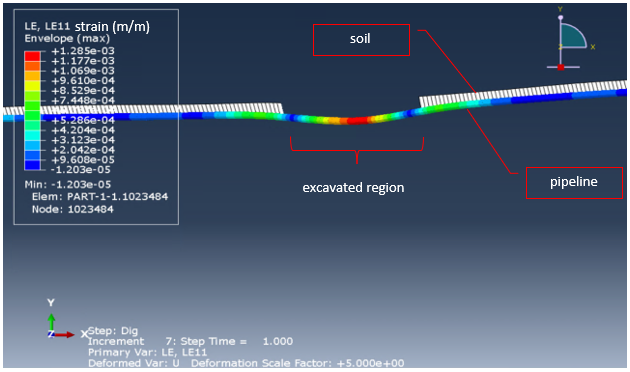
Strain Results Using a Finite Element Model of a Hot Pipeline Excavation
Contact: [email protected] or [email protected]
Share This: