


 CDN NEWS |
  US NEWS







By David Yager
March 8, 2022
For over one hundred years the growth and prosperity the world has been directly affected by international events that impact the supply and price of oil.
Despite what we’ve been repeatedly told about oil this century, nothing has changed.
Life on earth requires energy. And petroleum is the most common, compact, powerful, versatile and lowest cost multi-purpose energy source available. That is why oil has become, and continues to be, the most important and valuable natural resource in the world.
The invasion of Ukraine by Russia is a blunt reminder to thought leaders, pundits, analysts, politicians and policy makers of something they should have never forgotten. That petroleum security of supply is essential to keep the world functioning. It will remain that way until it can be replaced with something of equivalent utility.
Or until 7.9 billion people accept living without it, either voluntarily or by force.
*********
Most think the geopolitical influences of oil began with the 1973 embargo by OPEC of oil shipments to the US and the European countries that supported Israel in the 1973/74 Arab Israeli war.
But oil and international politics have always been intertwined.
It began in 1908 following massive discoveries in what was then called Persia, now Iran. The First World War from 1914 to 1918 made it obvious that petroleum powered war machines like airplanes and tanks were far superior to horse-drawn artillery and hand-to-hand combat. Oil quickly became the only fuel for an effective army or navy. Airplanes wouldn’t exist without it.
After World War I, the Ottoman Empire was carved up when Britain, France and Italy demarcated the borders of Turkey, Iraq, Syria, Jordan, Saudi Arabi and Lebanon. It was all about oil. This was the start of a century of petroleum politics whereby politicians and governments interfered and intervened in the ownership, price, availability and future of petroleum.
The Second War World was also about oil, but in a different way. Even though it invaded Romania early to secure oil supplies, Germany still relied on its Fischer-Tropsch process to make liquid fuel from coal to power its war machine. Japan’s attack on Pearl Harbor followed the US cutting off oil supplies. Japan lost the Pacific war in part because of insufficient oil supplies.
Thanks to North America, the allies had lots of oil. Alberta’s Turner Valley oilfield was a significant source for high octane aviation fuel. The giant American oilfields of Texas, Oklahoma and California enabled the US to mount massive military campaigns in two hemispheres and never worry about fuel supplies.
As world oil demand grew, more attention was focused on the Middle East by the US and Europe. From 1950 to 1973 Saudi oil production increased from 500,000 to 8.5 million b/d. Even after western private sector interests were nationalized by increasingly militant host countries, the oil kept flowing. Governments needed the cash.
By the time the 1973 OPEC embargo took place, oil had long been a weapon of war. But only for military purposes. OPEC made oil a geopolitical weapon to attack countries, not just opposing armies.
As supply was restricted but demand continued, prices skyrocketed. From 1973 to 1980 oil rose ten fold from $3 a barrel to $30. The economic repercussions were devastating. In 1974 the prime lending rate exceeded 10%. It wouldn’t go below that again until 1991. The peak was 20% in 1981. Inflation was equally severe.
In the early 1980s, high oil prices worked their magic in two ways. There was demand destruction from natural gas, nuclear power and fuel-efficient Japanese cars. And significant new production from Alaska’s North Slope, Europe’s North Sea and Alberta’s oil sands increased supply. Oil prices finally collapsed in 1986 and didn’t recover for 17 years.
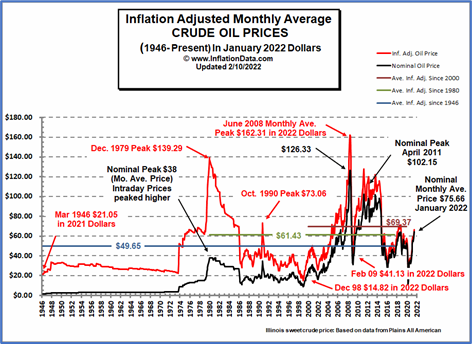
This chart shows the historical price of oil since 1946 in current and inflation-corrected January 2022 US dollars. The Iranian revolution of 1979 caused oil to peak in real terms at US$139.28, a price not seen again until 2008. There was a brief spike in 1990 caused by the First Gulf War when Iraq invaded Kuwait.
The all-time high price was June 2008 at US$162.31. The average price from 2010 to 2014 was not reached again until Russia invaded Ukraine.
After the 1970s, the next big rise in oil prices began this century. It was driven by the industrialization of the economies of Asia, particular China. From 2000 to 2008 oil consumption rose from 77 million b/d to 87 million b/d, nearly 13%. Pressure on price was assisted by declining production from North America and Europe, and only modest growth from Central and South America.
But non-OPEC oil producers again saved the day. What caused the world oil price to decline after the global economic recession of 2008/09 was the addition of 10 million b/d of oil production from the US and Canada over the next 11 years.
This was unprecedented. World prices finally collapsed in late 2014 after OPEC withdrew supply management. But thanks to North America, crude prices stayed near or below the 66-year average inflation-corrected price from 2015 to 2021. Cheap oil provided a tremendous economic boost to the global economy.
After oil collapsed again in 2020 due to the pandemic lockdown, multiple voices emerged questioning whether the world even needed petroleum any longer. Security of supply was taken for granted. The future was decarbonization and renewables.
Oil was dead. Sunset industry. Stranded assets.
**********
Canadian oil politics has taken two opposite directions in the past 50 years. This is possible because federal elections can be won regionally. There are more votes in oil consuming regions than oil producing regions.
In the 1970s the issue was that oil cost too much and there wasn’t enough of it. In 2015 the problem was oil was too cheap and the world must use less. Both were the handiwork of Liberal governments led by Prime Ministers named Trudeau. And both caused serious divisions within the country.
After prices jumped in 1973, angry consumers demanded the federal government do something. For the Liberals under Pierre Elliot Trudeau from Montreal, winning elections over oil policy and pricing was easy. Attract votes in the heavily populated oil consuming regions of central Canada at the expense of the oil producing regions of western Canada.
This culminated in the National Energy Program of 1980, the most divisive and intrusive federal policy in history. But the ink was barely dry when global oil markets reversed, prices started declining, and it became clear that the NEP was addressing a problem that no longer existed.
The NEP was dismantled by the mid-1980s and the Liberals were tossed from office. The oil industry was generally left alone for the next 30 years. It grew significantly first because of natural gas, and later from oil sands, which combined to make Canada the fourth-largest producing country in the world.
But by 2015 oil was a problem for different reasons. Now it was climate change, and oil was a major cause. Under leader Justin Trudeau, also from Montreal, the Liberals campaigned on cancelling the Northern Gateway pipeline, increasing the cost of fossil fuels through carbon taxes, and replacing the NEB. By 2019 three new oil pipelines were dead, there was a legislated west coast oil tanker ban, and a new and highly politicized major project approval process became law.
This was popular in the major urban centres of Ontario, Quebec and the lower mainland of BC, and extremely unpopular in the oil producing regions of western Canada. Capital fled and projects were shelved. All but one major LNG export project was cancelled, blocked or delayed. The most recent cancellation by Quebec occurred last summer.
Since winning the 2019 election the Liberals have added even more obstacles to increased oil and gas production growth through emission caps, escalating carbon taxes, legislated minimum EV sales, a national net-zero emission electricity grid, and the pending Clean Fuel Standard.
But like the NEP of 42 years ago, these policies are being overwhelmed by international events. The world the Liberals claimed to be protecting by capping Canadian oil and gas output has changed dramatically. Because of skyrocketing fossil fuel prices and the Ukraine/Russia conflict, the Trudeau government’s insistence that the best solution is more renewable energy is completely out of touch with global realities.
**********
Following the global economic collapse of 2008/09, two major political events occurred that are connected. One involved the economy, and the other involved oil.
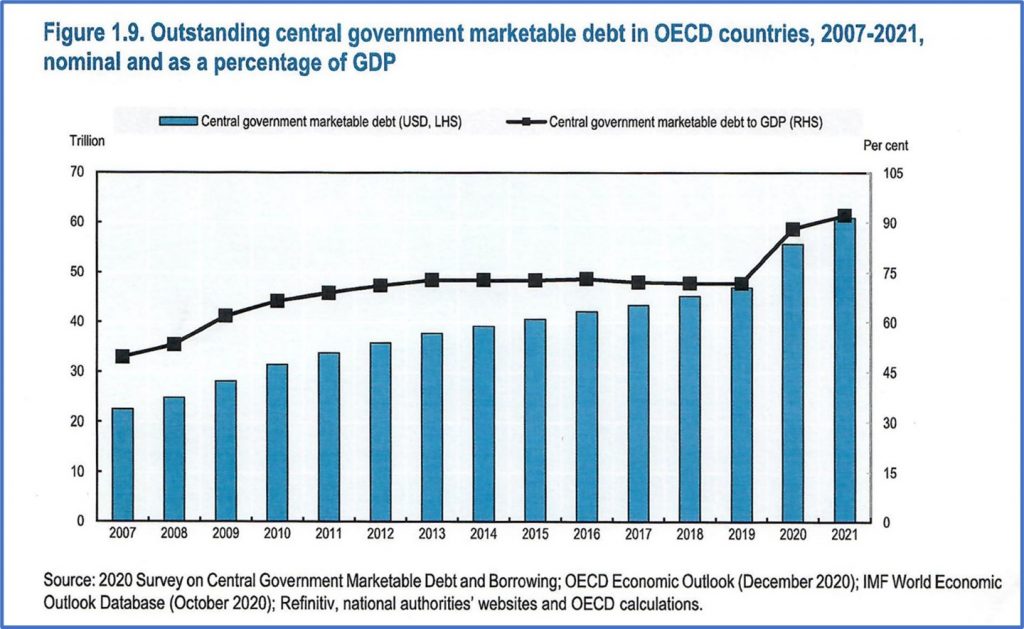
After the collapse of Lehman Brothers and intense pressure on the global financial system in the fall of 2008, central banks flooded capital markets with liquidity. The central bank “bazooka” was regarded as an appropriate measure at the time. It also gave policy makers the belief they had new tools with which to macro-manage the economy. The response by central banks to the pandemic lockdown was swift because they had been practicing since 2008/09.
In 2007 the OECD average debt/GDP ratio was only 50%. It rose sharply in 2008 and 2009 because of the financial crisis (black line above).
But politicians and central bankers clearly liked what they saw. By 2010 “quantitative easing” became a component of fiscal policy, particularly in the US. Governments kept borrowing even though the economy had recovered. Perhaps that’s why it recovered. By 2013 the debt/GDP ratio was approaching 75%, 50% higher than six years earlier. This additional liquidity helped offset the inflationary impact of stubbornly high oil prices.
The cause of the financial collapse was said to be overleveraged borrowers, overextended lenders, and subprime mortgages. Somehow, the price of oil got a hall pass even though it had increased by almost 500% from US$30 in 2000 to a peak of US$147 by mid-2008. Food prices also spiked in this period because of higher energy costs.
Mortgage defaults increased because so many borrowers on fixed income were paying so much more for everything that they couldn’t make their payments.
But the borrowing continued, even after oil prices collapsed in 2015 which provided considerable economic relief to consumers. Food and energy prices declined. By 2019, the last normal year before the pandemic, OECD debt/GDP was 75%. But after 12 years of borrowing, “central government marketable debt” had doubled from $22 trillion to $46 trillion.



The oil price collapse, low natural gas prices the resulting low global energy prices kept a lid on inflation and interest rates. This allowed the economy and public debt to grow simultaneously. Stock markets rose, real estate values increased, and unemployment was low. A new term for perpetual government stimulus was coined Modern Monetary Theory. Ideas like a guaranteed minimum income became increasingly popular.
As so-called “progressive” governments won more elections in North America and Europe, there was no end to all the great things enlightened politicians could do. They could save the world from climate change through an engineered energy transition and nobody would suffer economically.
But the pandemic changed everything. By the end of 2021, the OECD debt/GDP ratio was up to 90% and total debt reached $63 trillion. Compared to 2007, debt/GDP had almost doubled and total debt liabilities had almost tripled.
This is the financial position from which OECD governments are dealing with the highest inflation levels in decades, skyrocketing energy prices and rising interest rates.
**********
By 2008 climate change had become a major political issue in North America and Europe. A pivotal event that shaped opinion was Al Gore’s 2006 movie An Inconvenient Truth, which won a Nobel Peace Prize and an Oscar. For years the rhetoric has cranked up steadily as more governments at all levels declared climate emergencies.
You know the rest. The war on fossil fuels began. Pipelines were cancelled. The fossil fuel divestment movement began and grew. Renewables were encouraged and supported through favorable government policies, preferential grid access, and power purchasing agreements.
Attacking fossil fuels in the name of climate change became a badge of honor. Angry teenager Greta Thunberg became a worldwide sensation. Elections were fought and won by climate-crusading politicians in Canada, the US and Europe. Coal and gas-fired power plants were mothballed or obstructed and replaced with interruptible wind and solar electricity sources.
Investment in new supplies of oil and gas globally declined from 2015 to 2020 due to low commodity prices, increasingly prohibitive regulations, market access obstruction, and the loud and proud restriction of investment capital by banks and institutional capital pools. By 2020 major producers like Shell and BP told the world they were getting out of the oil business.
There were consistent warnings that this would end poorly. But noise about security of supply, the unreliability of renewable energy, the affordability of Net Zero By 2050, and even the cost and shortage of the minerals necessary to decarbonize the global energy complex, were dismissed as climate change denialism.
Meanwhile, the inherent deficiencies with renewable energy began to emerge. It started with the hot summer in California in 2020 which led to electricity shortages and rationing. An extraordinary cold snap in Texas in early 2021 left millions without power for days. Last summer the wind quit blowing in Europe causing a spike in natural gas and electricity prices. Oil prices were creeping up anyway, then along came the Russia/Ukraine crisis.
The invisible hand of Adam Smith has slapped the tall foreheads of world central planning in the head as market forces have overwhelmed the forced retooling of the world’s energy future. The “Resilient Recovery,” “Great Reset,” “Just Transition” and “Build Back Better” initiatives never considered or anticipated geopolitical risk or energy security of supply.
The master plan required that a world that has never been peaceful would behave as required, and the available low carbon energy substitutes would do things they cannot.
So here we are. What a mess.
**********
What the world is learning the hard way is that reliable, affordable and essential energy on demand is privilege, not a right.
The 21st century world cannot function without continuous electricity. It powers everything. You can argue about where it comes from, but modern society will not accept life with it.
Food. You gotta eat. Right now feeding 7.9 billion people is only possible because of fossil fuels for fertilizer, farming equipment, refrigeration, transportation and processing.
Ukraine and Russia supply almost one-third of the world’s wheat exports. Because export ports are blocked by the conflict, the price of wheat has recently soared to levels not seen since the last food price crisis of 2007/08. Ukrainians that should be planting crops are fighting for their lives. Food price increases this year were inevitable because of higher fertilizer costs. Now it could get much worse.
There is no substitute for petroleum for transportation. Not whether or not your car is electric, but fuel for trucks, ships, rail lines and aircraft. Nor will be there any substitutes in scale for the immediate future.
Then there’s heat, clothing, plastic, petrochemicals. The list is endless.
Vested interests opine that Europe and the world’s energy problems can be solved with more renewables. But the refusal to accept the science and physics of energy is what helped get us into this situation. Wind and solar electricity cannot grow more food or power heavy transportation.
What makes the Ukraine situation bizarre is that fossil fuels are in such short supply that Russia’s opponents have to keep buying them. From the Russians! So despite economic sanctions on everything else, Vladmir Putin’s armed forces will never run out of cash to fund their military objectives.
The biggest single obstacle to a quick and effective international response is that the countries that have successfully reduced high oil prices in the past are run by governments that helped create this mess.
The political leaders of North America and Europe must concede that the fastest path to repairing the world economy and returning security to Europe is to increase global oil and gas supplies as quickly as possible.
Many countries have already made significant policy reversals. Canada, with more undeveloped oil and gas than any of them, is conspicuous by its silence.
Lower oil and gas prices will help contain inflation and temper future interest rate increases. This will help heavily indebted governments manage public finances.
Capital markets must reverse their positions on fossil fuels. What the world needs is higher oil and gas production, not higher dividends. Banks should resume lending based on cash flow and assets, not ill-defined and no longer virtuous ESG objectives.
The only solution is for cash-rich producers to resume finding and producing more oil and gas. Putting money back into the ground and the economy to increase production will help everyone. This is the largest single contribution the western world can make to attacking the energy supply and financial challenges in 2022 and beyond.
Remember that the massive oil price increases of the 1970s and the first fourteen years of the 20th century were ended by more oil from OECD producers, not OPEC. Or Russia.
Time to do it again.
For years, the western world has been wealthy enough to try to shape fossil fuels into what they think they should be while ignoring what they are.
It’s over. Let’s fix the immediate problem fast and first, plus continue to reduce emissions at a pace that the world can afford and absorb.
Don’t listen to me. Don’t listen to political opponents. Don’t listen to the oil and gas industry.
Listen to Elon Musk, the world leader in electric vehicles and large-scale storage batteries and a big player in solar power.
On Twitter Musk has written recently:
“Hate to say it, but we need to increase oil and gas output immediately. Extraordinary times demand extraordinary measures. Increased oil and gas production in the short term is critical or people around the world will be placed under great duress. This is not a question of money, it is a question of having enough energy to power civilization…sustainable energy solutions simply cannot react instantaneously to make up for Russian oil and gas exports”
Drill baby, drill.
And be proud of it.
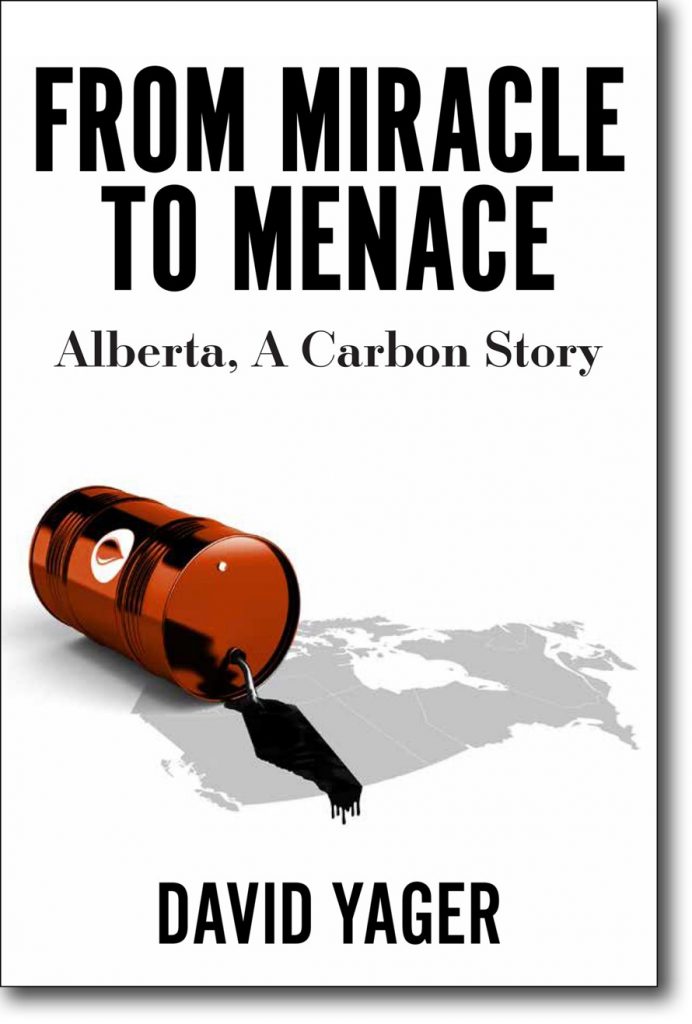
David Yager is a Calgary-based oil service executive, oil and gas writer, energy policy analyst, and author of From Miracle to Menace – Alberta A Carbon Story. More at www.miracletomenace.ca
Share This:




















REALITY: Carney’s EU Deal Threatens Alberta, Energy, & Sovereignty – 170,000 Reasons to Reject Canada’s EU “Associate Membership”