


 CDN NEWS |
  US NEWS







Is it still socially acceptable to be optimistic?
You wouldn’t know it from the daily news coverage or the chambers of government.
Everything is a mess. The world must be repaired. Not only is the future in doubt, but even the past requires changes.
Statues, monuments and symbols are being removed or banned. School curriculums teach the wrong things. Systemic racism is rampant. Even certain words must be avoided because of possible trigger effects.
Defund the police? Seriously? Where did that nugget come from?
Prime Minister’s Trudeau mandate letters to his cabinet are woke to the core. The National Post headline stated, “Trudeau tells ministers to focus on goal of creating more diverse, inclusive Canada.”
The future is, well, there is no future. The climate emergency/apocalypse/Armageddon is on a trajectory to render the Earth uninhabitable.
Fortunately, the tall foreheads in central planning advise us that there is a chance to avoid climate disaster if we all behave as instructed. Life won’t be as enjoyable, but that’s a small price to pay to save the world.
A growing number of young people are so worried about the future they are not having children.
In The Population Bomb in 1968 author Paul Ehrlich proposed sterility drugs in America’s drinking water to slow population growth.
The prophets of doom have managed to put them in our brains instead.
Fortunately, on a global statistical basis there is no evidence that the world is a worse place than it was a year ago. Or ten years ago. Or ever.
And flashes of common sense are emerging as the improved new world unfolds much differently than advertised.
I remain optimistic about 2022 and the future of life on earth.
Keep reading and decide for yourself.
**********
According to www.worldometers.info, the world’s population exceeded 7.9 billion this year. On December 18, the site reported nearly 135 million people had been born in 2021. A total of 56.6 million had died, leaving a net gain of just over 79 million. That’s twice the population of Canada. The average population increase every year this century is about 80 million.
In 1950 there were 2.5 billion people living on Earth. There are 3.2 times that many today. Of interest is how the additional 5.4 billion people are making out in a world with such a bleak outlook. Here’s some selected demographic data.
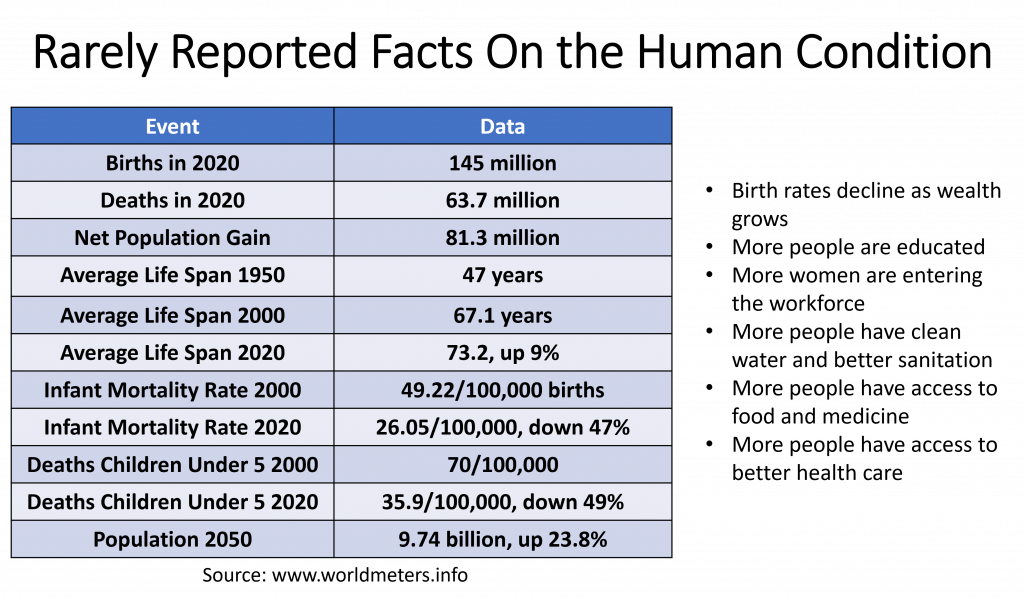
The population when the steam engine was invented in England in 1698 was 610 million. Since then fossil fuels providing cheap and reliable energy have advanced everything, not just population growth.
That increasing the population would face challenges was first predicted by Malthus in the late 1700s. He concluded that the number of people was growing more quickly than the world’s ability to feed itself.
As I have written on this page before, human ingenuity, technology and necessity have combined to not only feed almost ten times as many as were on earth 320 years ago, but provide better nourishment.
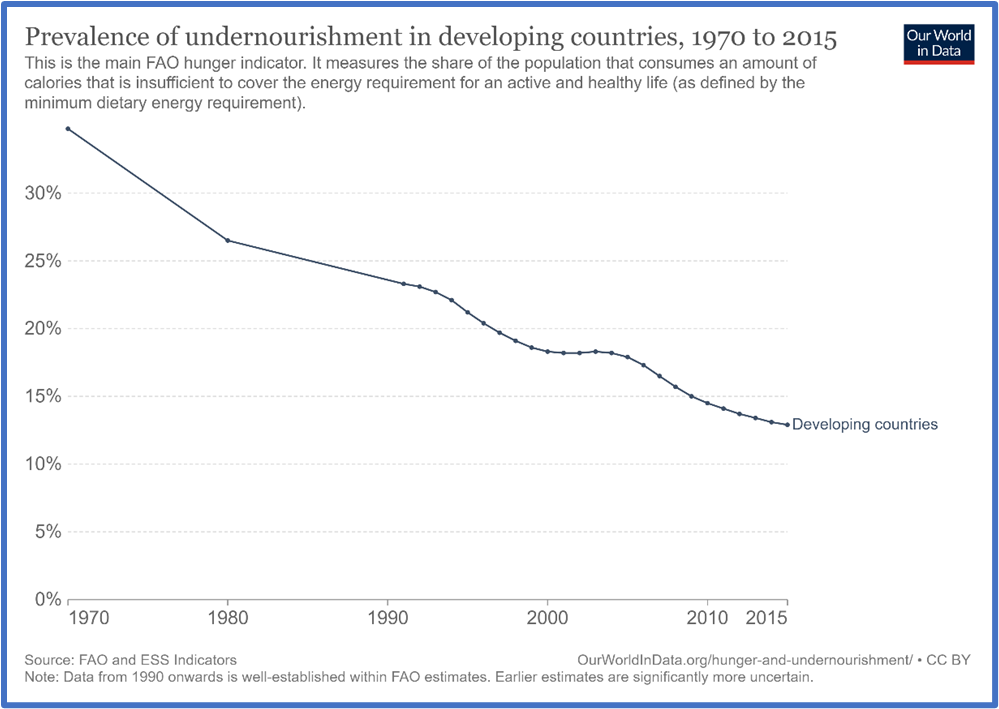
This chart uses data from the UN’s Food and Agricultural Organization to track the percentage of the population in developing countries that “consumes an amount of calories that is insufficient to cover the energy requirement for an active and healthy life.”
The world is increasingly better educated, another collateral benefit of rising incomes, prosperity and health. This chart from www.ourworldindata.org shows the remarkable progress civilization has made in advancing literacy and science in the past 50 years. It also predicts this will continue to improve.
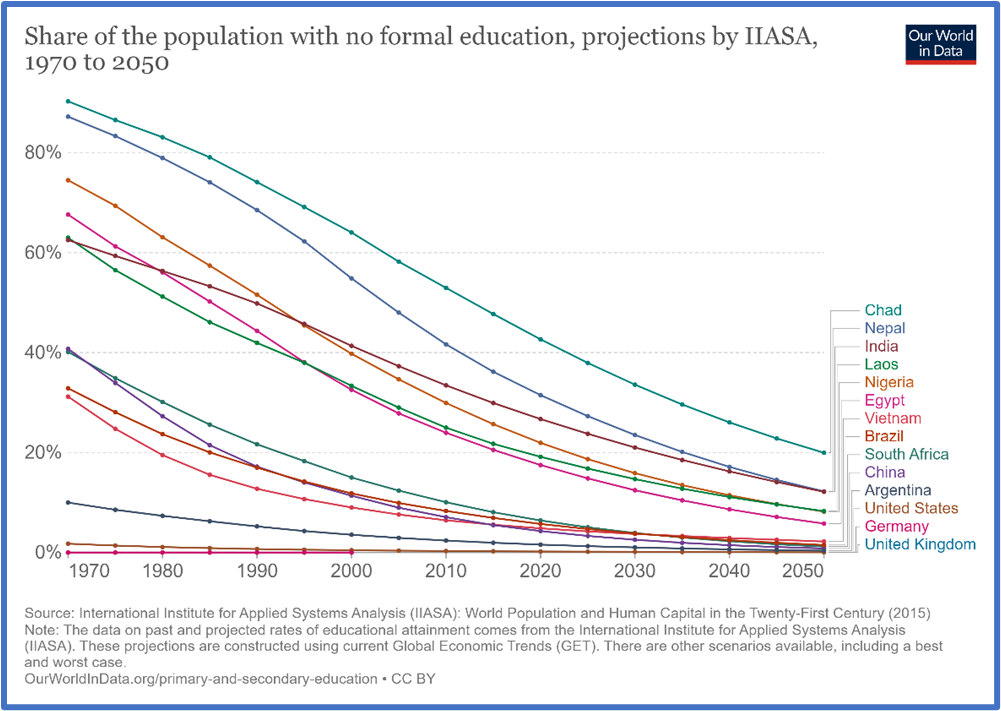
More people with more education drive the growing demand for electricity for internet access, smartphones and computers. These are providing more people with the opportunity to learn about the rest of the world.
The late Hans Rosling was a serial optimist about mankind’s future. In his 2019 book FactFulNess – Ten Reasons Why We’re Wrong About the World – and Why Things Are Better Than You Think, he explained why.
The inside back cover reads, “Hans Rosling was a medical doctor, professor of international health, and renowned public educator. He was an advisor to the World Health Organization and UNICEF…he was listed as one of Time magazine’s one hundred most influential people in the world.”
When it comes to understanding the state of the world, Rosling was obviously no Justin Trudeau, Steven Guilbeault, Elizabeth May, or Greta Thunberg.
But as a practicing physician and medical director on the ground Africa for 20 years, Rosling had more real-world exposure to developing countries than these four luminaries combined.
Rosling’s optimism about humanity’s progress should be required reading. It’s contagious!
He analyses the main reasons why so many believe things are so awful, then counters with research data explaining why they are wrong. Rosling explains how first impressions are frequently wrong because they are based on fear, misinformation, education, lack of awareness and other human shortcomings, not facts.
Had the “defund the police” movement existed when Rosling wrote his book, he would have proven statistically that this was based on a handful of dreadful video images broadcast all over the world, not the hundreds of thousands of essential and useful daily interactions between law enforcement and citizens.
Facts matter.
Rosling concludes, “…a fact-based worldview is more comfortable. It creates less stress and hopelessness than the dramatic worldview, simply because the dramatic one is so negative and terrifying. When we have a fact-based worldview, we can see that the world is not as bad as it seems – and we can see what we have to do to keep making it better.”
As American President Thomas Jefferson said, “A well informed citizenry is the best defense against tyranny.”
Which explains Canada’s last three federal elections.
**********
With the proliferation of the internet and the contraction of the mainstream media that historically provided a broad cross-section of news of the world, there are only two ways to reach people in the 21st century.
Their smartphone and their wallet.
There are some 6 billion connected smartphones in the world. This is the most powerful and far-reaching communication device in the history of humanity. It is so ubiquitous its negative impact on our lives, thinking and behavior is greatly underestimated.
At our peril.
Unless you’re looking for something specific, what appears on your mobile device is increasingly controlled by sophisticated software algorithms that analyse what you like and ensure you receive more of it.
For commercial information distributors, smartphones are a battle for eyeballs, so-called “click bait.” News feeds are targeted based upon on your usage history, or so shocking that you can’t ignore them. As the old media saying goes, “It if bleeds, it leads.”
That 7.9 billion people didn’t die yesterday will never appear on your screen. Or that millions are emerging from poverty and living better lives every day.
Nowadays, every bit of bad weather everywhere is captured digitally and transmitted globally. For somebody to blame on climate change.
There are previously unimaginable numbers of digital cameras globally – all connected to the internet – creating an unlimited and continuous supply of bad news. Smartphones distort Rosling’s “worldview” much more than most people appreciate.
The original saying was, “No news is good news.” What it should say is “Good news is no news.”



But some have figured it out. Because when it comes to public policy and opinions, an amazingly small number of people have learned how to use the internet and smartphones to influence and dominate the public agenda.
Assisted greatly by the vast majority not paying attention.
Often only a handful of people participate in the dramatic events that appear on your smartphone. Like pulling down a statue of Sir John A MacDonald, vandalizing pipeline construction equipment, or publicly protesting their definition of offensive behavior.
But perception is reality. Ten people and a video feed can persuade millions that there is something big going on. When there isn’t.
The other way to reach a lot of people is through their wallets. Including children, the world is home to 7.9 billion wallets. These are the ordinary folks who wake up each morning and set about figuring out how to live through another day.
One of the ways by which the world’s wallets have been kept full is through debt. Big debt. Record debt.
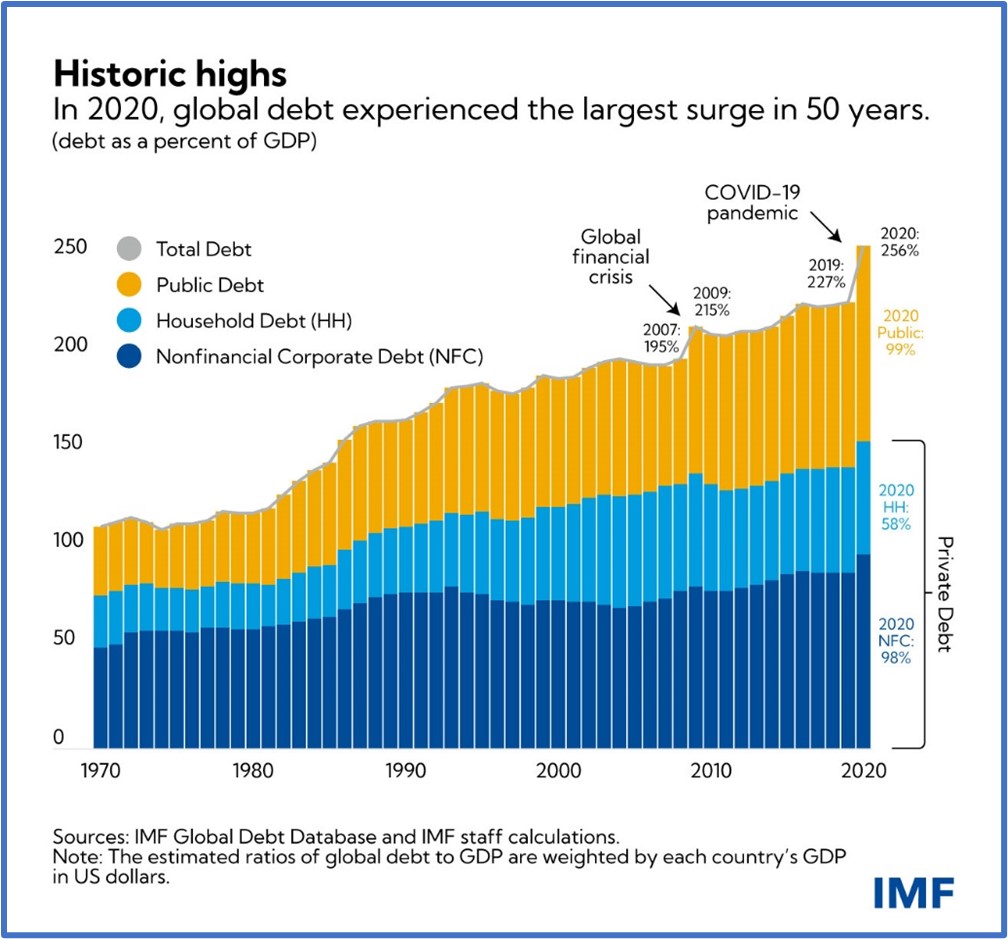
This data from the International Monetary Fund shows fifty years of near-continuous growth in global debt presented as a percentage of GDP.
According to https://www.macrotrends.net/countries/WLD/world/gdp-per-capita , in 1970 global GDP per capita was US$684. Corrected for inflation to 2019 dollars, this is US$4,507. In 2019 it was US$11,417, a gain of 153%.
While the population of the world grew by 110% over this period, the debt/GDP ratio rose by 144%.
Household debt/GDP grew from about 26% in 1970 to 58% in 2020. Non-financial debt more than doubled, from about 52% to 98%.
Public debt ballooned. Measured by debt/GDP, it was 36% in 1970 and nearly three times that much 50 years later.
A significant portion of the per capita GDP growth people have enjoyed in the past half-century has been created with borrowed money.
Debt is a marvelous instrument if interest rates aren’t too high, and if you can afford to pay it back.
On December 16, the Bank of England responded to rising inflation – caused in part by skyrocketing energy costs – by raising interest rates from 0.1% to 0.25%, a 250% increase.
Because other central banks around the world are contemplating similar actions, The Economist described this move as Britain being, “…the first big rich economy to experience interest-rate rises since the pandemic struck.”
It is not intuitive that the ultra-low interest rates we have enjoyed in recent years are sustainable given the rising rate of inflation.
Low interest rates are relatively new. The average prime lending rate in Canada from January 2001 to December 2008 was 4.97%. Once central banks embraced “quantitative easing” and got out the fiscal “bazooka” to fight the global financial crisis, a new era of low interest rates and government-supported liquidity began.
From January 2009 to November 2021 the prime lending rate averaged only 2.93%, 40% lower than pre-crisis levels. If inflation and interest rates get really bad, let’s not forget that the average prime lending rate in the 1980s was 12.57%, and 7.69% in the 1990s.
In today’s heavily leveraged world, rising inflation and interest rates will impact the world’s wallets in a big and negative way.
This is good news because more people will be forced to pay attention to the direction the world economy is headed and hopefully will demand a course correction.
**********
One of the most important but least mentioned causes of the world financial crisis of 2008/2009 was the high cost of energy. In mid-2008 WTI hit its all-time record high price of US$145.31 a barrel. Corrected for inflation that is US157 in 2021 dollars, more than double current levels.
The reason for this major economic meltdown was said to be overzealous bankers selling subprime mortgages to high-risk borrowers. In fact, it was the first major financial challenge the modern world had faced where sky-high energy prices got a hall pass. What contributed significantly to rising mortgage defaults was the inability of homeowners to make their loan payments because disposable income was redirected to key expenditures like gasoline to get to work.
Fast forward to the winter of 2021, where Europe is gripped in an energy price spike of historic proportions.
Thanks to aggressive decarbonization of energy supplies and other factors that now include the recent shutdown of nuclear reactors in France due to operating issues, electricity prices have on average quadrupled this year.
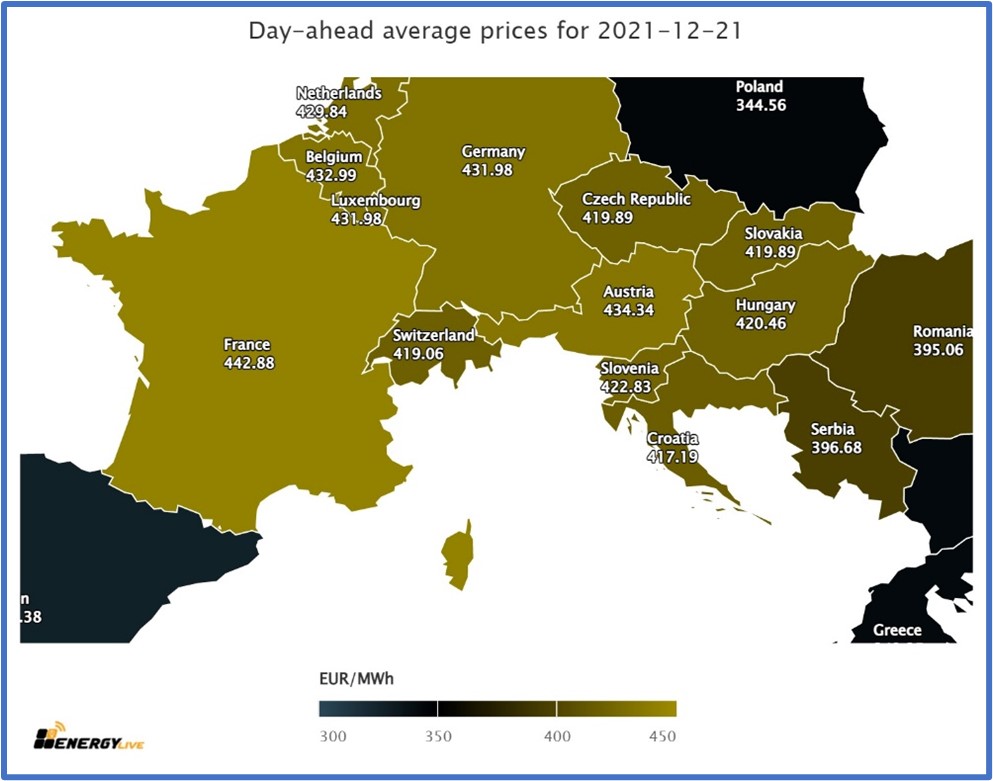
This image from https://www.energylive.cloud/ shows the spot prices for electricity in Europe for market opening on December 21. Alberta’s current electricity prices are about €76/MWh. This is less than 20% of some of the figures posted above.
A big factor is high natural gas prices. A final decision to allow more gas from Russia via Nord Stream 2 to Germany has been postponed until July. The closing price of Dutch TTF Natural gas futures for January 2022 on December 17 was US$45.29, more than ten times that of US Henry Hub and 15 times AECO spot for the same month.
In the UK, the story goes that fixed income pensioners must decide whether to “heat or eat.”
Will events like this cause the world’s wallets to demand a rethink of what really matters in 2022 and beyond?
**********
Smartphones versus wallets.
Smartphones continue to report we live in a world in serious need of repair. There’s always something awful happening somewhere.
Oblivious to what is going on in global energy and food markets, our mobile devices report that the fight against climate change must continue and accelerate. Do you think things are bad now? Just wait! As Greta reminds us regularly, “The world is on fire.”
But despair, not repair, is the focus of the wallets as real disposable incomes fall because of the rising cost of everything from food to energy to household goods.
The improved future of civilization that has been pitched and promoted so frequently by so many is finally collapsing under the weight of its own unsustainable underpinnings.
This will come as a shock to many, but the whole world isn’t just about you. In recent years, society has moved from “we” to “me” – by the millions.
Worldview data on the ever-improving human condition contradicts the dominant issues of the current political and public policy narrative.
The wallets of the world accepted a lot of peculiar ideas because life was generally improving. They didn’t pay close attention.
But the evidence is mounting that this brave new world only works in digital format. Because its execution is materially and negatively affecting the people it is purporting to save.
The wallets are grumbling. As they should. It’s painful, but necessary.
As a worldview person myself, that is good news.
Happy New Year.
David Yager is an oilfield service executive, oil and gas writer, energy analyst and author of From Miracle to Menace – Alberta, A Carbon Story. More at www.miracletomenace.ca
Share This:






















COMMENTARY: Varcoe: ‘Do No Harm’: Should Alberta Step in to Fix Gas System Constraints, Given Past Energy Interventions?