


 CDN NEWS |
  US NEWS







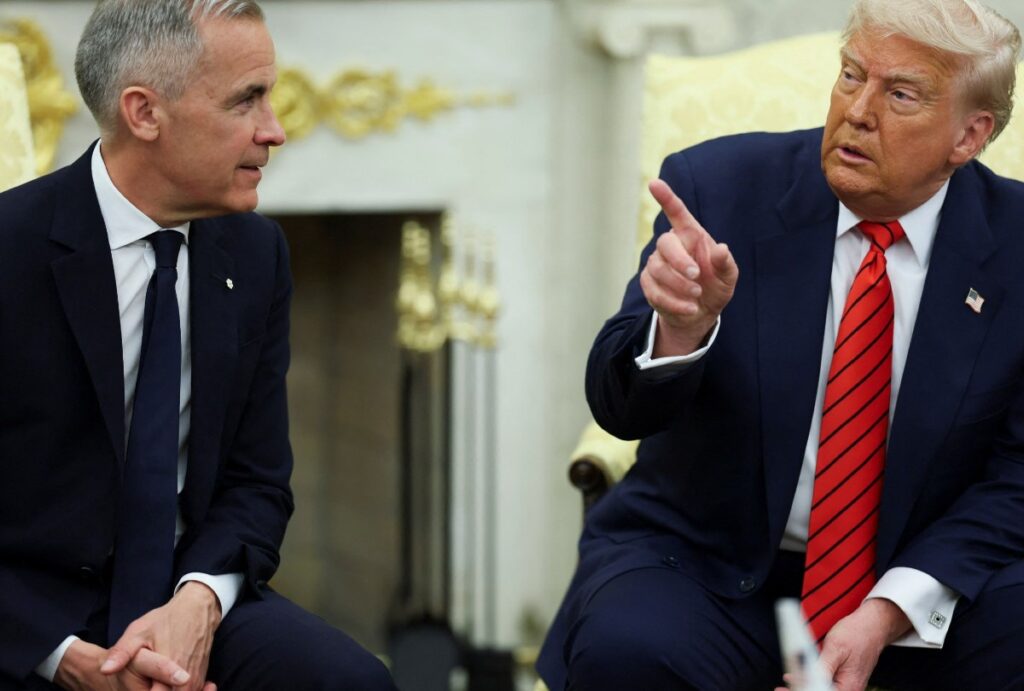
The finger-pointing over the collapse of Canada-U.S. trade negotiations intensified Monday morning, with U.S. Trade Representative Jamieson Greer and former senior White House adviser Kelly Ann Shaw both placing responsibility squarely on Canada, before President Donald Trump dramatically raised the temperature with a new threat of 50 per cent tariffs on Canadian vehicles, auto parts and steel beginning January 1, 2027.
The comments present a strikingly different version of events from Prime Minister Mark Carney’s account of why Canada walked away from negotiations late Friday.
Carney has said the United States introduced last-minute conditions that were “uneconomic, unfair” and raised questions about whether Washington could be relied upon to honour an agreement. His government has also said some U.S. demands crossed Canadian red lines involving sovereignty, culture and the French language.
Washington’s message Monday was essentially the opposite: Canada had a favourable deal in front of it and chose to walk away.
Greer: Canada “Wanted More”
Speaking on CNBC Monday morning, Greer said negotiators appeared to have identified a pathway toward an agreement earlier in the week before Canada’s position changed during the final stages.
“Then we set about to finalize it, and then in the last hours … they wanted more,” Greer said.
According to Greer, Washington had demonstrated considerable flexibility, including potential reductions in U.S. tariffs affecting Canadian steel, aluminum, automobiles and softwood lumber.
Greer’s position is consistent with comments he made immediately after negotiations collapsed, when he said Canada had declined to finalize a deal under terms Washington believed had already been agreed upon.
The U.S. offer, according to Greer, would also have included greater North American supply-chain coordination in aerospace, cooperation on critical minerals, measures addressing forced-labour imports and the beginning of more formal negotiations involving the Canada-U.S.-Mexico trade agreement.
On Monday, Greer also attempted to minimize the overall economic impact of the current tariffs.
“I think this is a little bit of a tempest in a teapot,” he told reporters at the White House, noting that the latest tariffs cover roughly five per cent of Canadian trade and, according to his calculation, only 0.06 per cent of total U.S. consumption.
Greer said his office is preparing possible responses for Trump if Canada follows through with its promised dollar-for-dollar retaliation.
Shaw: Washington is Confused About Why Canada Walked
That same message was delivered during a Monday morning CTV News interview with Kelly Ann Shaw, a former senior White House adviser, who said there is considerable “confusion” and “frustration” in Washington over Canada’s decision.
Shaw said the U.S. believed it had offered tariff concessions considerably better than those extended to other major trading partners.
She said Washington was prepared to reduce Section 232 tariffs covering steel, aluminum, automobiles and lumber, while expecting Canada to reduce retaliatory measures and address American concerns surrounding its USMCA dairy commitments.
From the American perspective, she argued, Canada walking away has left officials wondering what additional concessions Washington could realistically make.
Shaw also rejected reports suggesting significant divisions between Greer and U.S. Commerce Secretary Howard Lutnick during the negotiations, saying both officials needed to be at the table because the discussions involved traditional trade issues as well as Section 232 tariffs.
The difference between the two countries’ accounts, she suggested, has become part of the problem itself.
“There are two completely different narratives on both sides of the border that are playing out,” Shaw told CTV.
Trump Fires Back
Any suggestion that Trump might remain relatively quiet about the collapse disappeared during the CTV interview itself.
As Shaw was speaking, Trump issued a new Truth Social post sharply attacking Canada and threatening another major escalation beginning next year.
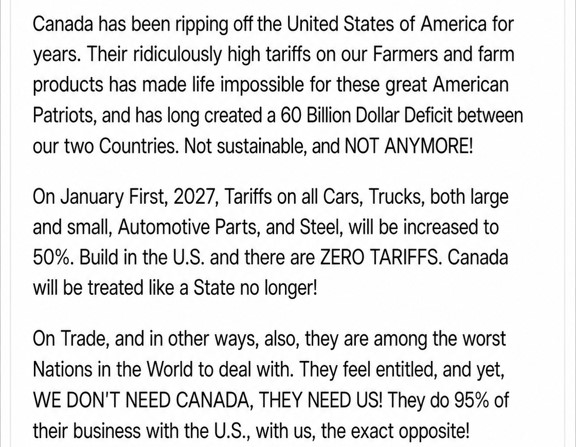
Trump’s announcement means the dispute now potentially has a second major deadline: January 1, 2027.
Financial Times and other outlets subsequently confirmed Trump’s announcement that tariffs on Canadian cars, trucks, automotive parts and steel would rise to 50 per cent on that date.
One of Trump’s assertions should be put in context. While Canada is heavily dependent on the U.S. market, the claim that Canada does “95%” of its business with the United States substantially overstates that dependence. Roughly 72 per cent of Canadian goods exports went to the United States last year, according to reporting cited by the Associated Press.



Trump’s reference to a roughly US$60-billion trade deficit is much closer to official U.S. merchandise-trade figures: Greer has previously cited the U.S. goods deficit with Canada rising to approximately US$61 billion in 2024. That figure, however, is a merchandise-trade calculation and does not represent the entire bilateral economic relationship.
“Everyone Needs to Buckle Up”
Reacting in real time to Trump’s new post, Shaw acknowledged that the temperature had suddenly increased considerably.
She characterized Trump’s statement partly as a response to the tough language used by Carney over the weekend, but maintained that the fundamental prescription remains the same: allow some time to pass and eventually find a way back to negotiations.
“I think everyone needs to buckle up in the short term,” Shaw said.
Importantly, she also pointed to the January 1 date.
While a 50 per cent tariff would be extremely significant, Shaw said the actual effect cannot be known until Washington releases the proclamation or executive order explaining exactly how broadly the tariff would apply.
And January is still several months away.
“That still gives the parties a couple of months to try to work something out if they want to,” she said.
What Happens Next?
For now, neither country appears ready to make the first move.
Canada intends to introduce dollar-for-dollar retaliatory tariffs beginning September 8, targeting sectors including steel, dairy, appliances, agricultural equipment, pulp and paper and electronics.
Greer has said Washington currently has no new negotiations scheduled with Canada and is instead preparing responses to Canadian retaliation.
Shaw similarly said she does not expect the Trump administration to approach Canada with an immediate “off-ramp.”
“If Canada is going to retaliate further and double down, I think that it’s going to take a little bit more in terms of Canada approaching the United States for the U.S. to come back to the table,” she said.
There are nevertheless several potential paths back.
The most obvious would be returning to the apparent landing zone that existed before Friday: meaningful U.S. tariff relief on steel, aluminum, autos and lumber in exchange for reductions in Canadian retaliation and movement on specific U.S. market-access concerns.
Canada has already indicated it was prepared to remove remaining retaliatory tariffs in several strategic sectors if Washington substantially reduced its own tariffs, encourage provinces to resume selling American alcohol and take administrative steps concerning supply management — while refusing to dismantle the system itself.
The January 1 deadline may also ultimately become negotiating leverage rather than an inevitable outcome. Before Trump’s proposed 50 per cent tariffs on vehicles, auto parts and steel can take effect, the administration will have to define exactly what products and exemptions are covered.
That leaves time for another agreement.
The larger danger is that the two countries allow retaliation to create another cycle of retaliation.
For Canada’s energy sector, most cross-border oil and natural gas trade remains outside the immediate dispute, but a prolonged deterioration in the broader relationship could still affect steel costs, infrastructure investment, critical-mineral cooperation, manufacturing supply chains and future CUSMA negotiations.
Despite Monday morning’s rhetoric, Shaw argued that geography and economics ultimately leave the two countries little choice but to find a way forward.
“The United States and Canada aren’t going anywhere,” she said. “We are trading partners. We are going to have to work this out somehow.”
The question now may not be whether Canada and the United States return to the negotiating table.
It may simply be how much economic damage occurs before they do.
Share This:






















INSIGHT: Canada’s Economy Falling Behind Despite Misleading Headlines – Fraser Insitute