CDN NEWS |
  US NEWS







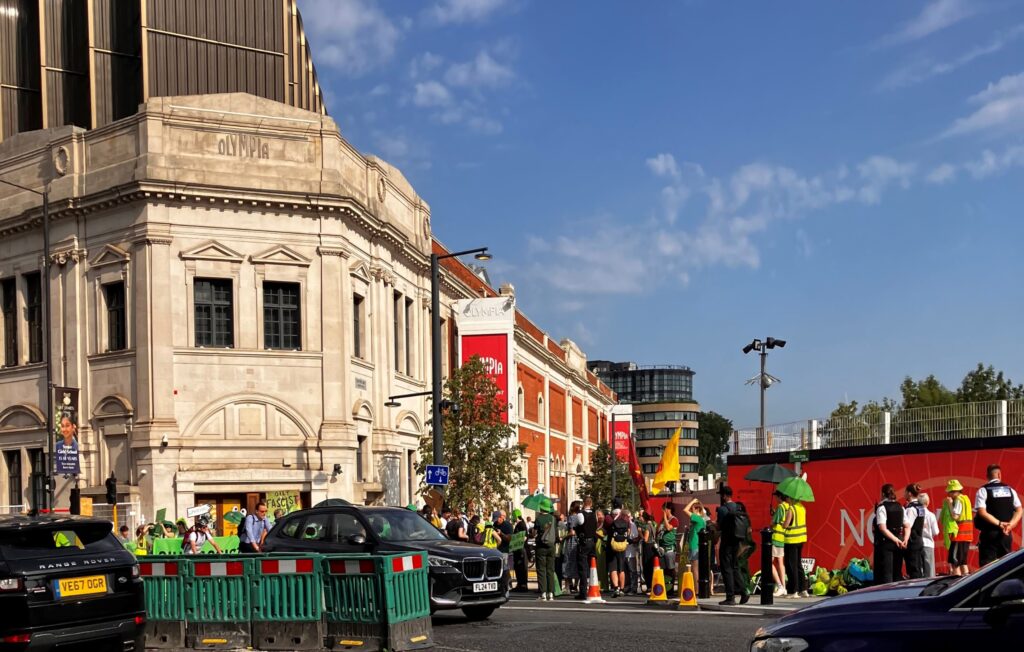
In late June 2026, London offered a striking case study in competing visions for our energy future. On one side was London Climate Action Week (LCAW), which drew a crowd of 100,000 people calling for an accelerated net-zero transition and sweeping global system change, spanning governance, mitigation, behaviour change, climate finance, a “just transition,” and a host of related causes. On the other side was the Alliance for Responsible Citizenship (ARC), which convened more than four thousand people over three days under the banner “The Age of Reconstruction.” Unlike LCAW, which was protest free, ARC attracted daily protests from climate activists who appeared less interested in dialogue than disruption, including one who bypassed security and stormed the stage.
The starkest contrast was not the scale or tone, but of first principles. LCAW’s core message was familiar: the only solution to our growing climate woes is to double down on decarbonization, keep hydrocarbons in the ground, change how people live, and scale up intermittent wind and solar; no matter the cost, no matter the strain on the system. The heatwave in London that week supplied a convenient and ready-made marketing device for climate campaigners: the heat was held up as real-time evidence for accelerated decarbonisation and more urgent action. Yet, as temperatures soared on June 23rd, the UK grid buckled under the pressure: the National Energy System Operator issued emergency instructions, sought assistance over the interconnectors, and had to beg the EU for emergency imports. Solar output slumped, wind was nowhere to be found, and demand spiked as Londoners (and residents in other British regions) desperately sought relief in cooling systems, if they had access to them at all.
This was not a one-off event. The brittleness of the UK grid, exposed repeatedly by extreme weather, is the predictable result of policies that have prioritized net-zero targets over reliability and affordability. As documented elsewhere, grid emergencies and capital flight are now regular features of the British and European power landscape. Yet, inside the LCAW net-zero bubble, the heat itself was treated as proof that even more drastic action is needed; never mind the consequences for ordinary people, or the fact that the grid’s fragility is a direct outcome of these very policies.
At ARC, the conversation was quite different. Energy was not reduced to an emissions problem but recognized as the foundation of human prosperity and the material basis of modern life: from heat and light to mobility. Speakers challenged the wisdom of net-zero pathways that raise costs, erode industrial capacity, and leave the world’s poorest nations in the dark. The focus was on abundance, reliability, affordability, and technological progress rather than the managed decline of net-zero. For the first time, “stewardship” emerged as a theme. Yet, despite the promise of stewardship as a guiding framework for responsible energy development, it was left undefined and felt more like an undeveloped idea than an operational guide. There was little discussion of how to reclaim the older duty-of-care tradition in energy stewardship: accountable, technically competent management that maximizes long-term resource recovery, reasonable environmental protection, and public value while minimizing waste for the benefit of future generations. Thus, the concept of “stewardship” was not distinguished from the activist usage that often equates stewardship with degrowth and non-development “protection” under the guise of conservation, as exemplified by the 30 x 30 agreement to set aside or protect and conserve 30 percent of Earth’s land and water by 2030.
The most profound split, though, is philosophical. For LCAW, energy is a problem to be managed, its use to be constrained, and its benefits rationed. For ARC, energy is the enabler of flourishing, and to restrict it is to invite and choose decline. The answer to the question “who pays?” for the net-zero transition is revealing. LCAW’s answer is the “just transition” that spreads the costs across companies, taxpayers, and consumers, while private capital is corralled and directed by ESG metrics (now rebranded as “Resilience” and “Sustainable Growth”) into ever-narrower channels. ARC speakers, by contrast, pointed out that high energy prices are already a regressive tax, and that shuttering reliable capacity not only exports emissions and jobs to less scrupulous jurisdictions, but it also undermines energy security and destabilises domestic grids.
As the International Energy Agency and others have noted, billions still lack reliable electricity. The net-zero agenda, for all its talk of justice, has yet to resolve the tension between climate ambition and energy poverty. ARC’s answer was clear: to deny people affordable, abundant power is both a moral and practical failure.



During my days in London, decline felt tangible. At ARC, evening dinners were held away from the main venue; at LACW venues were scattered across downtown London with attendees encouraged to use public transport. Riding the Tube (the subway) in stifling oppressive cars without air conditioning, which were hotter than the platforms, reinforced a growing realization: civilizational decline is a choice. Large and small decisions in the UK and Europe and other jurisdictions have produced a system in which air conditioning is frowned upon or constrained by net-zero logic, while the grid itself cannot reliably support the cooling people already need. The same net-zero logic that constrains cooling now promises to electrify all heating and transport but lacks any credible plan to supply the massive increase in reliable power this demands. Without powerful, dispatchable sources like natural gas, residual coal capacity where still available, and nuclear it is difficult to see how the dangerously exposed UK grid can absorb the load net-zero inevitably creates.
Neither gathering was monolithic; people of goodwill exist on both sides. Yet the overarching visions remain fundamentally if not diametrically opposed. The net-zero vision advanced at LCAW is one of a global managerial technocracy driven by emissions targets, climate finance, and litigation to force a rapid reordering of the global energy system in the name of stopping climate change. To be clear, net-zero not only requires technocracy, but it also prioritises the weather, the planet, and the climate over people. In contrast, the ARC vision places people first. It seeks human flourishing while respecting the environment and nature, embraces energy realities rather than demonising hydrocarbons, and supports forms of energy capable of delivering abundant, reliable, and affordable power for all.
For Canada, the UK, the EU, and other western industrial nations, the consequences of net-zero destabilisation are no longer theoretical: capital flight, grid strain, deindustrialization, and rising energy insecurity are already visible. The real choice is not between caring for the environment and ignoring it. It is between accepting scarcity as policy and recovering stewardship as a discipline: the competent, accountable management of energy resources for long-term human benefit, environmental improvement, and national resilience. History is clear: prioritising people and reliable energy lead to prosperity and environmental progress. Civilizations and societies advance when they build; when they choose abundance over rationing, reliability over wishful thinking, and human flourishing over managed decline. These two visions offer us a choice between scarcity managed from the technocracy above and stewardship rooted in responsibility and abundance; we must choose wisely.
Tammy Nemeth is a UK-based energy analyst, consultant, and author of The Nemeth Report on Substack.
Share This: